
Assoziiertes Mitglied

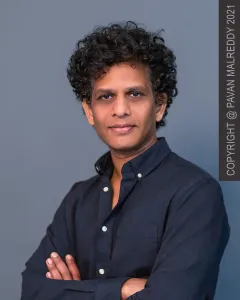
PD Dr. Pavan Kumar Malreddy

  • Biografische Angaben

    Dr. Pavan Malreddy teaches at the Institute of English and American Studies. He specializes in 20th and 21st century comparative Anglophone literatures & cultures with a regional focus on East Asia, Africa, and South Asia and with a thematic focus on conflicts, communal bonds, insurgencies, and populism. He has authored essays on figures and themes as wide-ranging as Aung San Suu Kyi, Salman Rushdie, Franz Kafka, George Orwell, Ngũgĩ wa Thiong’o, Indian cinema, Brexit, populism, terrorism, and the civil war in Burma, among others (see full list of publications). He has interviewed prominent novelists and theorists such as Arundhati Roy, Yann Martel, Homi K. Bhabha, Mohsin Hamid, Tom McCarthy, Amit Chaudhuri, and Tabish Khair. His current research project focuses on the armed insurgencies in India, Burma, and Nigeria. He co-edits Kairos: A Journal of Critical Symposium, and the South Asian and Middle Eastern volumes of The Literary Encyclopedia. He is affiliated with the research group Democratic Vistas (Institute for Advanced Study, Bad Homburg), Frankfurt Memory Studies Platform, and Moving Cultures Masters Programme.

  • Publikationen

    2022 ‘Im Konflikt verbunden: Der Staat, die Straße und das organisierte Misstrauen/Bound by Conflict: The State, the Street and Organized Distrust in India’s Communal Violence’. Special Issue ‘Vergemeinschaftung durch Misstrauen? (ed. Greta Wagner) WestEnd: Neue Zeitschrift für Sozialforschung 2 (22): 97-105.

    2022 ‘Postsecular Longings? Religious Dissent, Faith, and Gurus in Indian Cinema’. Third Text 35 (5), https://doi.org/10.1080/09528822.2022.2049159.

    2021 ‘The Syntax of Everyday Injustice: A Conversation with Arundhati Roy’. Special issue ‘Crisis and Recovery’. Wasafiri 107, 41-49.

    2020 (co-edited with Michael C. Frank) Narratives of the War on Terror: Global Perspectives. Oxon and New York: Routlegde.

    2020 (with Anindya S. Purakayastha and Birte Heidemann) ‘Discoursing Populism: Types, Typologies and Contexts’. Special Issue of Kairos: A Journal of Critical Symposium 5 (2): 1-8S.

Aktuelles aus dem Forschungszentrum

Veranstaltung
25./26.06.2026 | Frankfurt

DGTF Conference 2026: Shifting Regimes, Changing Orders

Konferenz

Conference as part of WDC 2026 in collaboration with Deutsche Gesellschaft für Designtheorie und -forschung (DGTF), Kunstgewerbemuseum/Design Campus SKD and Design and Democracy

weitere Infos ›
Veranstaltung
30.06.2026 | Frankfurt am Main

Recht und Angst in Demokratien

Vortrag

Vortrag von Benno Zabel (Universitätslehrer für Strafecht und Rechtsphilosophie der Goethe-Universität Frankfurt a.M., Forschungszentrum Normative Ordnungen der Goethe-Universität Frankfurt a.M.) im Rahmen der partizipativen Redenreihe "DenkArt_ Im Schmelztiegel der Angst"

weitere Infos ›
Veranstaltung
09./10.07.2026 | Frankfurt am Main

Democracy: Principles and Practice, Resilience and Innovation

Konferenz

Annual Conference of the Research Program "Zeitenwenden. Normative Ordnungen im Umbruch?" with Arthur Ripstein, Astrid Séville, John McCormick, Nadia Urbinati, Claudia Landwehr, Hubertus Buchstein and Peter Niesen.

weitere Infos ›
News
19.06.2026

Internationales Symposium würdigt Lebenswerk von Jürgen Habermas

Am Freitag, den 19. Juni 2026, würdigte das Forschungszentrum Normative Orders gemeinsam mit dem Suhrkamp-Verlag den verstorbenen Jürgen Habermas mit einem internationalen Symposium an der Goethe-Universität Frankfurt.

weitere Infos ›
Veranstaltung
01./03.07.2026 | Frankfurt am Main

Sexual Agency

Konferenz

Die dreitägige Konferenz über Sexual Agency befasst sich mit Fragen von sexueller Handlungsfähigkeit, Autonomie, Verantwortung, Macht, Zustimmung, Lust und Verkörperung. Organisiert von Manon Garcia und Milena Bartholain.

weitere Infos ›
News
26.05.2026

Neuer Sammelband zu Ehren von Ute Sacksofsky

Der Sammelband „Gerechtigkeit als Thema der Rechtswissenschaft“ bündelt die Beiträge des Ehrensymposiums zum 65. Geburtstag von Prof. Dr. Dr. hc. Ute Sacksofsky und beleuchtet aus intergenerationeller Perspektive zentrale Fragen feministischer Rechtswissenschaft zu Geschlecht, Gerechtigkeit, Gleichheit und juristischen Methoden.

weitere Infos ›