

01.06.2025
Zeitschriftenartikel

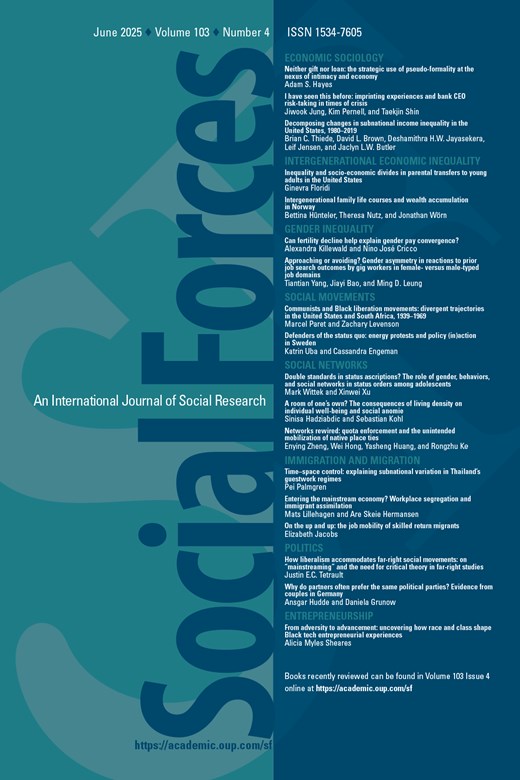
Why do partners often prefer the same political parties?

Abstract

Research has demonstrated that couples have similar partisan preferences, a finding associated with political polarization. However, it remains debated to what extent different mechanisms contribute to this homogamy. Analyzing dyadic panel data from the German Socio-Economic Panel 1984–2020, we distinguish analytically between (1) direct political matching (i.e., partner selection on matching party preferences); (2) indirect political matching (i.e., social structural homogamy with political homogamy as a by-product); and (3) couples’ political alignment over time, to explain party preference similarity. First, we study matching among recently formed couples using an innovative method that compares real-world couples with three types of counterfactuals: couples that are matched (1) randomly, (2) by multidimensional social structural characteristics, and (3) by maximizing similarity in party preference. Second, we study couples’ political alignment over the course of relationships, tracking real-world couples over time and controlling for macro-level changes in the party-political landscape. Results indicate substantial political homogamy among recently formed couples, which is best explained by political matching (i.e., direct selection based on partisan preferences). Effects of social structural homogamy appear weak in comparison and rather stable across cohorts. Couples further align in their partisan preferences over time, but this effect is countered by an increasing heterogeneity of the German political landscape.

Aktuelles aus dem Forschungszentrum

News
18.05.2026

Videopodcast-Reihe „Our Planet, Our Health“ gestartet

Mit „Our Planet, Our Health“ startet eine neue Videopodcast-Reihe zu Fragen globaler Gesundheitsgerechtigkeit. Die Reihe, gehostet von Dr. Romina Rekers, ist eine Initiative des Global Health Justice Postdoctoral Programme (GHJ), gefördert von der Höppschen Stiftung.

weitere Infos ›
Publikation
12.05.2026 | Onlineartikel

Disinhibited Informalization: Talk Radio, Bro Podcasts and the Aesthetics of Populism

This essay by Johannes Völz is a revised and updated translation of “Enthemmte Informalisierung: Talk Radio, Bro-Podcasts und die Ästhetik des Populismus,” WestEnd: Neue Zeitschrift für Sozialforschung 22.2 (2025): 3–24. It is published here as part of the b2o Review’s “Stop the Right” dossier.

weitere Infos ›
Veranstaltung
20.05.2026 | Frankfurt am Main

Von der Selbstermächtigung zum sozialen Widerstand

Vortrag

Vortrag von Prof. Dr. Axel Honneth (Frankfurt am Main / New York Columbia University) mit anschließender Diskussion im Rahmen des Rechtstheoretischen Mittwochsseminars von Klaus Günther, Dan Wielsch und Benno Zabel.

weitere Infos ›
News
11.05.2026

Gertrud Koch spricht über Kulturindustrie heute

Im Rahmen der Gesprächsreihe Frankfurter Schule hat die Professorin für Filmwissenschaft gemeinsam mit dem Journalisten und Filmkritiker Bert Rebhandl über die Aktualität des Begriffs Kulturindustrie und sein Verständnis im Kontext digitaler und globaler Medien gesprochen.

weitere Infos ›
Veranstaltung
19.05.2026 | Frankfurt

Speculative Truth Regimes

Podiumsdiskussion

Event with Adam Kahlil (New Red Order) and Toby Lee (NYU) as part of the Series Visual Truth Regimes, organized by Laliv Melamed (Goethe University Frankfurt, Normative Orders), Felix Trautmann (Institut für Sozialforschung; HBK Braunschweig) and Franziska Wildt (Institut für Sozialforschung).

weitere Infos ›
Veranstaltung
25./26.06.2026 | Frankfurt

Shifting Regimes, Changing Orders

Konferenz

Conference as part of WDC2026 in collaboration with Deutsche Gesellschaft für Designtheorie und -forschung (DGTF), Kunstgewerbemuseum/Design Campus SKD and Design and Democracy

weitere Infos ›
Veranstaltung
28./29.05.2026 | Frankfurt am Main

Global Health Justice: Principles and Practice

Konferenz

Following the research focus of the Global Health Justice Postdoctoral Programme, funded by Höppsche Stiftung, the "Global Health Justice: Principles and Practice" conference places a particular emphasis on themes such as the human right to health, political activism and health justice issues, and problems of structural injustice and vulnerable populations in health care. Keynote lectures by Jonathan Wolff and Kanchana Mahadevan. The Global Health Justice Programme and this conference are supported by the Höppsche Stiftung in Villmar.

weitere Infos ›
Veranstaltung
14.07.2026 | Frankfurt am Main

Democracy Over Time and the Climate Crisis

Ringvorlesungen

Vortrag von Anja Karnein (Binghamton). Die Vortragsreihe untersucht Fragen der Klimakrise als Herausforderungen für demokratische Gesellschaften und konzentriert sich auf Themen wie politische Legitimität, Widerstand gegen fossile Brennstoffe und die Interessen künftiger Generationen. Sie wird organisiert von Prof. Dr. Darrel Moellendorf und Dr. Lukas Sparenborg.

weitere Infos ›
Veranstaltung
10.06.2026 | Frankfurt am Main

Capital Investment, Inequality, and State Power in a Time of Climate Emergency

Ringvorlesungen, Vortrag

Vortrag von MartinO'Neill (University of York). Die Vortragsreihe untersucht Fragen der Klimakrise als Herausforderungen für demokratische Gesellschaften und konzentriert sich auf Themen wie politische Legitimität, Widerstand gegen fossile Brennstoffe und die Interessen künftiger Generationen. Sie wird organisiert von Prof. Dr. Darrel Moellendorf und Dr. Lukas Sparenborg.

weitere Infos ›