

01.06.2025
Journal article

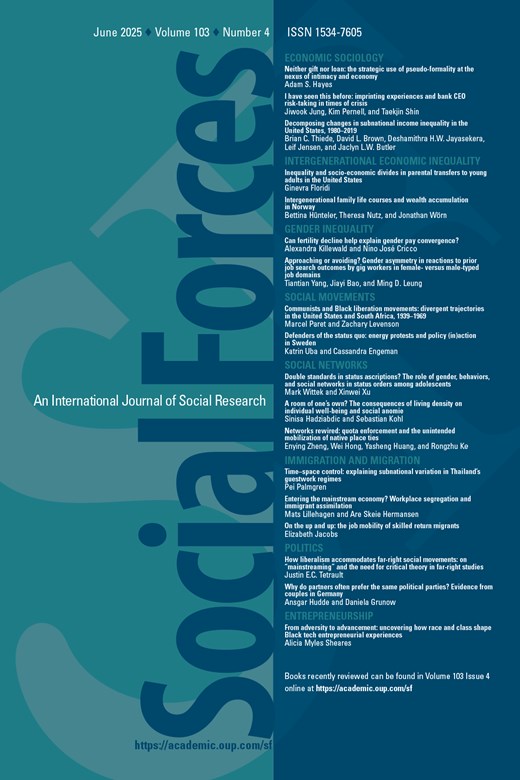
Why do partners often prefer the same political parties?

Abstract

Research has demonstrated that couples have similar partisan preferences, a finding associated with political polarization. However, it remains debated to what extent different mechanisms contribute to this homogamy. Analyzing dyadic panel data from the German Socio-Economic Panel 1984–2020, we distinguish analytically between (1) direct political matching (i.e., partner selection on matching party preferences); (2) indirect political matching (i.e., social structural homogamy with political homogamy as a by-product); and (3) couples’ political alignment over time, to explain party preference similarity. First, we study matching among recently formed couples using an innovative method that compares real-world couples with three types of counterfactuals: couples that are matched (1) randomly, (2) by multidimensional social structural characteristics, and (3) by maximizing similarity in party preference. Second, we study couples’ political alignment over the course of relationships, tracking real-world couples over time and controlling for macro-level changes in the party-political landscape. Results indicate substantial political homogamy among recently formed couples, which is best explained by political matching (i.e., direct selection based on partisan preferences). Effects of social structural homogamy appear weak in comparison and rather stable across cohorts. Couples further align in their partisan preferences over time, but this effect is countered by an increasing heterogeneity of the German political landscape.

News from the research center

Event
10.02.2027 | Frankfurt am Main

Shifting Visions of Peace and Security

Panel Discussion, Lecture Series

Podiumsdiskussion im Rahmen der Ringvorlesung “Peace and Security in Post-Liberal Times” mit Lisbeth Zimmermann (Goethe University/Normative Orders), Antonia Witt (PRIF), Siddarth Tripathi (University of Erfurt). Moderation: Jonas Wolff (Goethe University/PRIF/Normative Orders).

more information ›
Event
03.02.2027 | Frankfurt am Main

AI, War, and Big Tech

Lecture Series, Lecture

Vortrag von Ingvild Bode (University of Southern Denmark)im Rahmen der Ringvorlesung “Peace and Security in Post-Liberal Times”.

more information ›
Event
16.12.2026 | Frankfurt am Main

International arms control in a world of uncertainties

Lecture Series, Lecture

Vortrag von Malte Göttsche (TU Darmstadt/PRIF) im Rahmen der Ringvorlesung “Peace and Security in Post-Liberal Times”.

more information ›
Event
02.12.2026 | Frankfurt am Main

Enabling Authoritarianism: UN Peacekeeping and the Politics of Authoritarianism

Lecture Series, Lecture

Vortrag von Sarah von Billerbeck (University of Reading) im Rahmen der Ringvorlesung “Peace and Security in Post-Liberal Times”.

more information ›
Event
25.11.2026 | Frankfurt

Deterrence in “Post-Liberal Times“

Lecture Series, Lecture

Vortrag von Maria Mälksoo (Copenhagen University) (Goethe-Universität/PRIF/Normative Orders) im Rahmen der Ringvorlesung “Peace and Security in Post-Liberal Times”.

more information ›
Event
18.11.2026 | Frankfurt am Main

The Case for (Neo)colonialism: Neotrusteeship in International Relations as the ‘Imperial Mind’ of the ‘Colonial Present’

Lecture Series, Lecture

Vortrag von Nick Lemay-Hébert (Manchester University) im Rahmen der Ringvorlesung “Peace and Security in Post-Liberal Times”.

more information ›
Event
28.10.2026 | Frankfurt am Main

Postliberal vs. liberal Perspectives on Peace and Security and Crises

Lecture Series, Lecture

Vortrag von Prof. Dr. Christopher Daase (Goethe-Universität/PRIF/Normative Orders) im Rahmen der Ringvorlesung “Peace and Security in Post-Liberal Times”.

more information ›
Event
02.02.2027 | Frankfurt

Klassenjustiz, race und abolitionistische Demokratie

Lecture Series, Lecture

Vortrag von Prof. Dr. Daniel Loick (Amsterdam) im Rahmen der Ringvorlesung "Ist das Recht am Ende?" im Wintersemester 2026/2027. Organisiert von Klaus Günther und Benno Zabel.

more information ›
Event
19.01.2027 | Frankfurt

Nach der Normativität. Zum Verhältnis von Politik und Recht unter komputationalen Bedingungen

Lecture Series, Lecture

Vortrag von Prof. Dr. Sabine Müller-Mall (Frankfurt am Main) im Rahmen der Ringvorlesung "Ist das Recht am Ende?" im Wintersemester 2026/2027. Organisiert von Klaus Günther und Benno Zabel.

more information ›