

14.05.2025
Zeitschriftenartikel

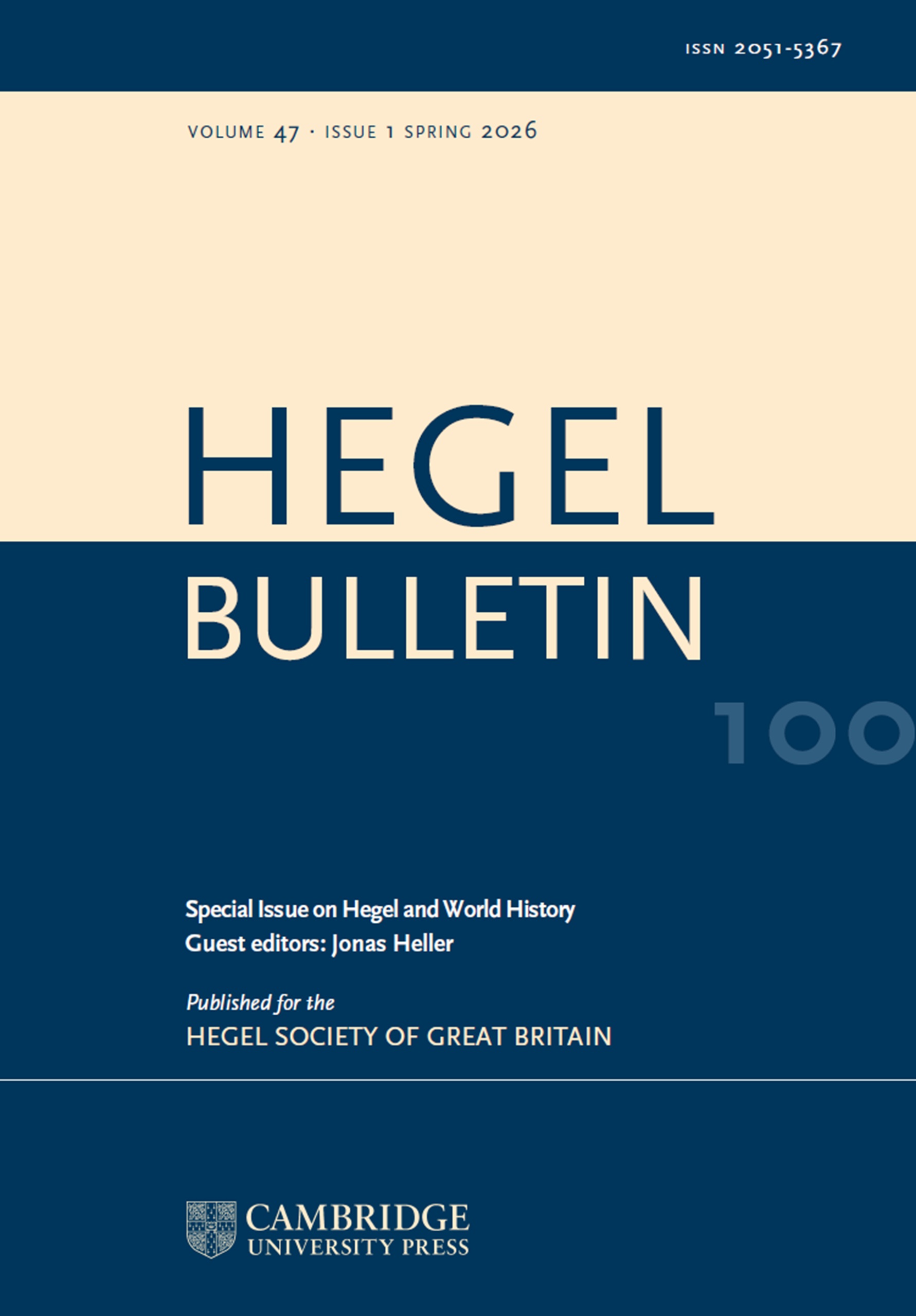
The Dialectic of Utility: Reconsidering Enlightenment in Hegel and Horkheimer/Adorno

In the Phenomenology of Spirit, Hegel places the concept of utility at the centre of his analysis of the Enlightenment period. Utility does not appear merely as a criterion of individual action, but describes a social context of mutual support, realized in a collective referred to by Hegel as a ‘troop’ (Trupp). In Adorno and Horkheimer’s critique of a reason fixated on utility, the Hegelian image of the ‘troop’ came to symbolize a repressive equality which removes the freedom of the individual and seals the failure of enlightenment. In contrast, this article demonstrates that Hegel’s concept of utility cannot be reduced to an attitude which instrumentalizes everything and everyone. In fact, utility refers to a mode of interaction which also takes account of the heterogeneity of each individual. Drawing on Hegel and going beyond his analysis, the article develops a post-Hegelian concept of utility as a formation of social practices that neither instrumentalizes people, nor simply represents an instantiation of social freedom, but rather establishes a constitutive relation between caring for oneself and being useful to others. From this perspective, the concept of utility is not only part of the problem of enlightenment, but also contributes to the endeavour to which Adorno and Horkheimer committed themselves: to work towards an affirmative understanding of enlightenment.
Aktuelles aus dem Forschungszentrum

Publikation
08.09.2026 | Monographie

Bedingungen unserer Existenz. Zur Aktualität Michel Foucaults

Saar, Martin; Vogelmann, Frieder (2026): Bedingungen unserer Existenz. Zur Aktualität Michel Foucaults. Berlin: Suhrkamp. 

weitere Infos ›
Veranstaltung
10.10.2026 | Frankfurt

Von der East West Street zum Anthropozän: Das Recht gegen Gewalt und Zerstörung

Podiumsdiskussion

Auf der Frankfurter Buchmesse spricht der diesjährige Preisträger des Friedenspreises des Deutschen Buchhandels Philippe Sands mit dem Friedensforscher und Historiker Hendrik Simon über die Geschichte, Gegenwart und Zukunft des Völkerrechts, über Ökozid und über die Frage, welche Rolle das Recht in einer von massiver Gewalt und globaler Zerstörung geprägten Welt spielen kann: von der East West Street bis zum Anthropozän.

weitere Infos ›
Veranstaltung
10.10.2026 | Frankfurt am Main

Das Recht der Gewalt. Warum Waffen allein keinen Frieden schaffen

Buchvorstellung

»Der Krieg ist zurück in Europa!«, heißt es – und mit ihm die Angst. Müssen wir wieder die Sprache der Machtpolitik lernen, um den Frieden zu sichern? Stehen wir wirklich vor dem Ende der regelbasierten Ordnung? Dr. Hendrik Simon bezieht im Gespräch mit Dr. Stefan Kroll in dieser hitzigen Debatte Stellung.

weitere Infos ›
Publikation
07.09.2026 | Monographie

The Examined Illness. A Philosopher's Confrontation with Deadly Disease

Moellendorf, Darrel (2026): The Examined Illness: A Philosopher Confronts Deadly Disease, Bristol: intellect.

weitere Infos ›
Publikation
20.08.2026 | Buchkapitel

Abschied vom Neoliberalismus im Zeichen des Postliberalismus?

Biebricher, Thomas (2026): Abschied vom Neoliberalismus im Zeichen des Postliberalismus? In: Selk, Veith; Hofmann, Julian Nicolai (Hrsg.): Postliberalismus? Eine transatlantische Debatte. Berlin: Suhrkamp, S. 222-246.

weitere Infos ›
Publikation
20.08.2026 | Buchkapitel

Krise oder Verfall der Weltordnung? Liberale und postliberale Erklärungen internationalen Wandels

Daase, Christopher (2026): Krise oder Verfall der Weltordnung? Liberale und postliberale Erklärungen internationalen Wandels. In: Selk, Veith; Hofmann, Julian Nicolai (Hrsg.): Postliberalismus? Eine transatlantische Debatte. Berlin: Suhrkamp, S. 205-221.

weitere Infos ›