

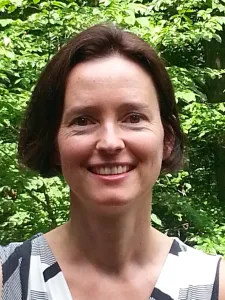
Fellow (ehemalig)

Prof. Dr. Julia Roos

Professorin für Geschichte, Indiana Universität

Forschungsprojekt:
German Racial Regimes in a Transnational Context: An Afro-German Microhistory

Forschungsvorhaben (engl.):
The project focuses on a biographical microhistory to examine broader aspects of different German “racial regimes”—or, historically specific constellations of predominant beliefs about, and legal and political practices towards, Blacks as perceived racial “Others”—during crucial moments of the twentieth century. “Erika Diekmann” was born in Worms in the occupied Rhineland in 1920. Her mother was German. Her father was a Senegalese French soldier. Until she was eleven, Erika stayed in a Protestant children’s home in Worms. In 1931, her guardians sent her to a Lutheran school for Christian Arab girls in Jerusalem. In 1949, Erika returned to West Germany, along with her (white) German husband and their son. In 1957, she and her family immigrated to the United States. Erika died in Kentucky in 1963.
Erika’s story offers unique opportunities for situating German attitudes towards Blacks within broader international and transnational contexts. As a child of the first Rhineland occupation, Erika was the target of 1920s propaganda against the “black horror on the Rhine” (schwarze Schmach), which aimed to discredit the Versailles Treaty by falsely accusing colonial French soldiers of mass rapes of Rhenish women. “Black horror” propaganda borrowed selectively from Allied war propaganda about the “rape of Belgium” by atavistic “Huns.” The Nazis revived black horror propaganda in their murderous campaign against African French soldiers during WW II. Memories of the Weimar-era and Nazi campaigns against colonial French soldiers continued to reverberate in postwar West Germany and helped shape Germans’ encounters with African-American GIs. Erika’s biography also points to certain hitherto neglected complexities and realignments in twentieth-century German racial discourse.  For instance, while Erika’s conservative Protestant mentors impressed on her the centrality of marriage and motherhood, the Nazis subjected hundreds of other Afro-German children of the Rhineland occupation to compulsory sterilization, irrevocably depriving them of the right to become parents.

Veranstaltungen:
29. Oktober 2016, 14 Uhr
Kamingespräch des Frauennetzwerkes des Exzellenzcluster „Die Herausbildung normativer Ordnungen“

11. November 2016, 11.30 Uhr
Paper Presentation
Forschungskolleg Humanwissenschaften
Am Wingertsberg 4
61348 Bad Homburg v.d. Höhe

  • Biografische Angaben

    Julia Roos hat 2001 an der Carnegie Mellon Universität in Geschichte promoviert. 2002 erhielt sie den Fritz Stern Preis für die beste eingereichte Dissertation im Feld deutsche Geschichte an einer nordamerikanischen Universität. Von 2002-2003 war sie Visiting Research Fellow am Institut für Geschichte an der Princeton Universität. Seit 2006 hat Roos eine Stelle als Professorin für Geschichte an der Indiana Universität in Bloomington inne. Im Jahr 2012 wurde sie dort vom Assistant Professor Without Tenure zum Associate Professor With Tenure befördert.

  • Publikationen

    Weimar through the Lens of Gender: Prostitution Reform, Woman’s Emancipation, and German Democracy, 1919-1933. Ann Arbor: University of Michigan Press, 2010.
    “An Afro-German Microhistory: Gender, Religion, and the Challenges of Diasporic Dwelling,” Central European History vol. 49, no. 2 (June 2016): 240-60.
    “Racist Hysteria to Pragmatic Rapprochement? The German Debate about Rhenish ‘Occupation Children,’ 1920-1930.” Contemporary European History 22, no.2 (May 2013): 155-180.
    “Nationalism, Racism, and Propaganda in Early Weimar Germany: Contradictions in the Campaign against the ‘Black Horror on the Rhine.’” German History 30, no. 1 (March 2012): 45-74.

Aktuelles aus dem Forschungszentrum

Publikation
12.05.2026 | Onlineartikel

Disinhibited Informalization: Talk Radio, Bro Podcasts and the Aesthetics of Populism

This essay by Johannes Völz is a revised and updated translation of “Enthemmte Informalisierung: Talk Radio, Bro-Podcasts und die Ästhetik des Populismus,” WestEnd: Neue Zeitschrift für Sozialforschung 22.2 (2025): 3–24. It is published here as part of the b2o Review’s “Stop the Right” dossier.

weitere Infos ›
Veranstaltung
20.05.2026 | Frankfurt am Main

Von der Selbstermächtigung zum sozialen Widerstand

Vortrag

Vortrag von Prof. Dr. Axel Honneth (Frankfurt am Main / New York Columbia University) mit anschließender Diskussion im Rahmen des Rechtstheoretischen Mittwochsseminars von Klaus Günther, Dan Wielsch und Benno Zabel.

weitere Infos ›
News
11.05.2026

Gertrud Koch spricht über Kulturindustrie heute

Im Rahmen der Gesprächsreihe Frankfurter Schule hat die Professorin für Filmwissenschaft gemeinsam mit dem Journalisten und Filmkritiker Bert Rebhandl über die Aktualität des Begriffs Kulturindustrie und sein Verständnis im Kontext digitaler und globaler Medien gesprochen.

weitere Infos ›
Veranstaltung
19.05.2026 | Frankfurt

Speculative Truth Regimes

Podiumsdiskussion

Event with Adam Kahlil (New Red Order) and Toby Lee (NYU) as part of the Series Visual Truth Regimes, organized by Laliv Melamed (Goethe University Frankfurt, Normative Orders), Felix Trautmann (Institut für Sozialforschung; HBK Braunschweig) and Franziska Wildt (Institut für Sozialforschung).

weitere Infos ›
Veranstaltung
25./26.06.2026 | Frankfurt

Shifting Regimes, Changing Orders

Konferenz

Conference as part of WDC2026 in collaboration with Deutsche Gesellschaft für Designtheorie und -forschung (DGTF), Kunstgewerbemuseum/Design Campus SKD and Design and Democracy

weitere Infos ›
Veranstaltung
28./29.05.2026 | Frankfurt am Main

Global Health Justice: Principles and Practice

Konferenz

Following the research focus of the Global Health Justice Postdoctoral Programme, funded by Höppsche Stiftung, the "Global Health Justice: Principles and Practice" conference places a particular emphasis on themes such as the human right to health, political activism and health justice issues, and problems of structural injustice and vulnerable populations in health care. Keynote lectures by Jonathan Wolff and Kanchana Mahadevan. The Global Health Justice Programme and this conference are supported by the Höppsche Stiftung in Villmar.

weitere Infos ›
Veranstaltung
14.07.2026 | Frankfurt am Main

Democracy Over Time and the Climate Crisis

Ringvorlesungen

Vortrag von Anja Karnein (Binghamton). Die Vortragsreihe untersucht Fragen der Klimakrise als Herausforderungen für demokratische Gesellschaften und konzentriert sich auf Themen wie politische Legitimität, Widerstand gegen fossile Brennstoffe und die Interessen künftiger Generationen. Sie wird organisiert von Prof. Dr. Darrel Moellendorf und Dr. Lukas Sparenborg.

weitere Infos ›
Veranstaltung
10.06.2026 | Frankfurt am Main

Capital Investment, Inequality, and State Power in a Time of Climate Emergency

Ringvorlesungen, Vortrag

Vortrag von MartinO'Neill (University of York). Die Vortragsreihe untersucht Fragen der Klimakrise als Herausforderungen für demokratische Gesellschaften und konzentriert sich auf Themen wie politische Legitimität, Widerstand gegen fossile Brennstoffe und die Interessen künftiger Generationen. Sie wird organisiert von Prof. Dr. Darrel Moellendorf und Dr. Lukas Sparenborg.

weitere Infos ›
News
17.03.2026

Kommunikative Vernunft. Zum Tod von Jürgen Habermas

Von Rainer Forst und Klaus Günther. Mit Jürgen Habermas verlieren wir einen unvergleichlichen, weltweit die Geistes- und Sozialwissenschaften über viele Jahrzehnte prägenden Gelehrten und engagierten Intellektuellen, der, wie er selbst anlässlich seiner Rede zu seinem 90. Geburtstag an der Goethe-Universität sagte, an dieser Universität drei glückliche Phasen seines akademischen Lebens erfahren hat. Er hat auch nach seiner Emeritierung an vielen unserer Diskussionen am Zentrum Normative Ordnungen aktiv teilgenommen, und seine Theorie war für uns stets ein zentraler Bezugspunkt der Forschung. Wir selbst verlieren unseren wichtigsten akademischen Lehrer, der uns über die Jahrzehnte hinweg freundschaftlich verbunden war.

weitere Infos ›