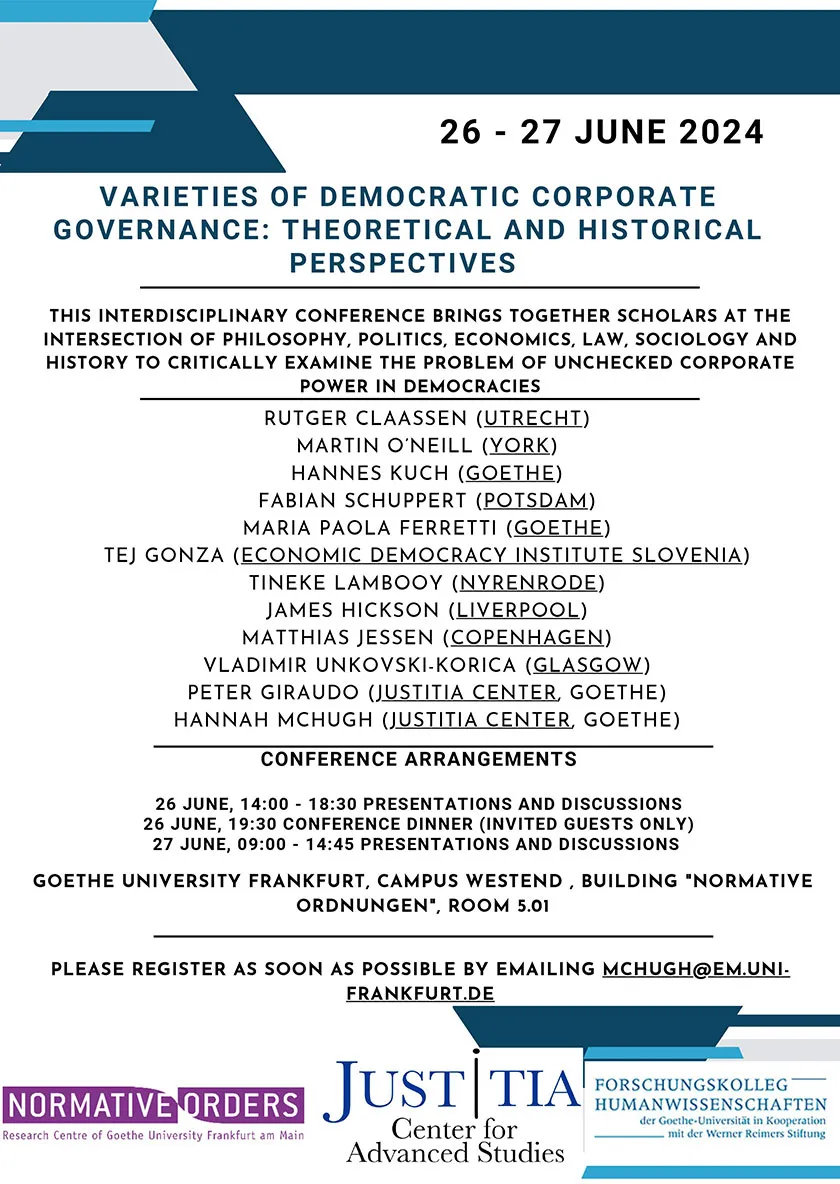
Varieties of Democratic Corporate Governance: Theoretical and Historical Perspectives
Interdisciplinary Conference
This interdisciplinary conference brings together scholars at the intersection of philosophy, politics, economics, law, sociology and History to critically examine the problem of unchecked corporate.
Goethe University Frankfurt, Campus Westend
Building „Normative Ordnungen“, Room 5.01
Please register as soon as possible by emailing Mchugh@em.uni-frankfurt.de
Participants:
Rutger Claassen (Utrecht)
Martin O’Neill (York)
Hannes Kuch (Goethe University)
Fabian Schuppert (Potsdam)
Maria Paola Ferretti (Goethe University)
Tej Gonza (Economic Democracy Institute Slovenia)
Tineke Lambooy (Nyrenrode)
James Hickson (Liverpool)
Matthias Jessen (Copenhagen)
Vladimir Unkovski-Korica (Glasgow)
Peter Giraudo (Justitia Center, Goethe University)
Hannah Mchugh (Justitia Center, Goethe University)
Corporations command vast resources, govern entire swaths of the economy, and wield immense political power. They make decisions that have a substantial impact on central aspects of social life: working conditions, prices, taxes, the provision of socially necessary goods and resources and reproductive practices, to name only but a few domains. As the unchecked power of corporations such as walmart, google, and amazon has become increasingly apparent, academics and practitioners have begun to rethink practices of corporate governance for the twenty-first century.
This conference investigates potential solutions to the problem of unchecked corporate power in democratic societies. We seek to explore the following questions: what would it mean for corporate governance to become moredemocratic and in turn responsive to stakeholders rather than simply shareholders? What role ought the state play in facilitating the emergence of more democratic forms of economic management? How do different institutionalarrangements — such as collective bargaining between unions and management, co-determination in the board room, or even state socialization—empower stakeholder voice? How should the stakeholders of corporate bodies be identified and recognized in corporate governance structures? While we now possess a nuanced understanding of different possible approaches to the democratic, stakeholding model of corporate governance, the question of how different institutional arrangements might complement each other in realizing it remains understudied. We also lack studies that consider the social preconditions of this model: what kinds of worker and, more broadly, citizen education might be required for stakeholders to effectively exercise voice within a democratic firm structure? This conference addresses these questions by examining varieties of democratic corporate governance from normative and historical perspectives. We encourage submissions that investigate what constitutes a democratic or an undemocratic corporate governance structure. We also invite contributions that analyze historical examples of and discourses about democratic corporate governance — such as the discourse of self-management in postwar france and yugoslavia as well as the practice of co-determination in postwar germany.