
Loading Events
  • Diese Veranstaltung hat bereits stattgefunden.
18.11.2010
Konferenz

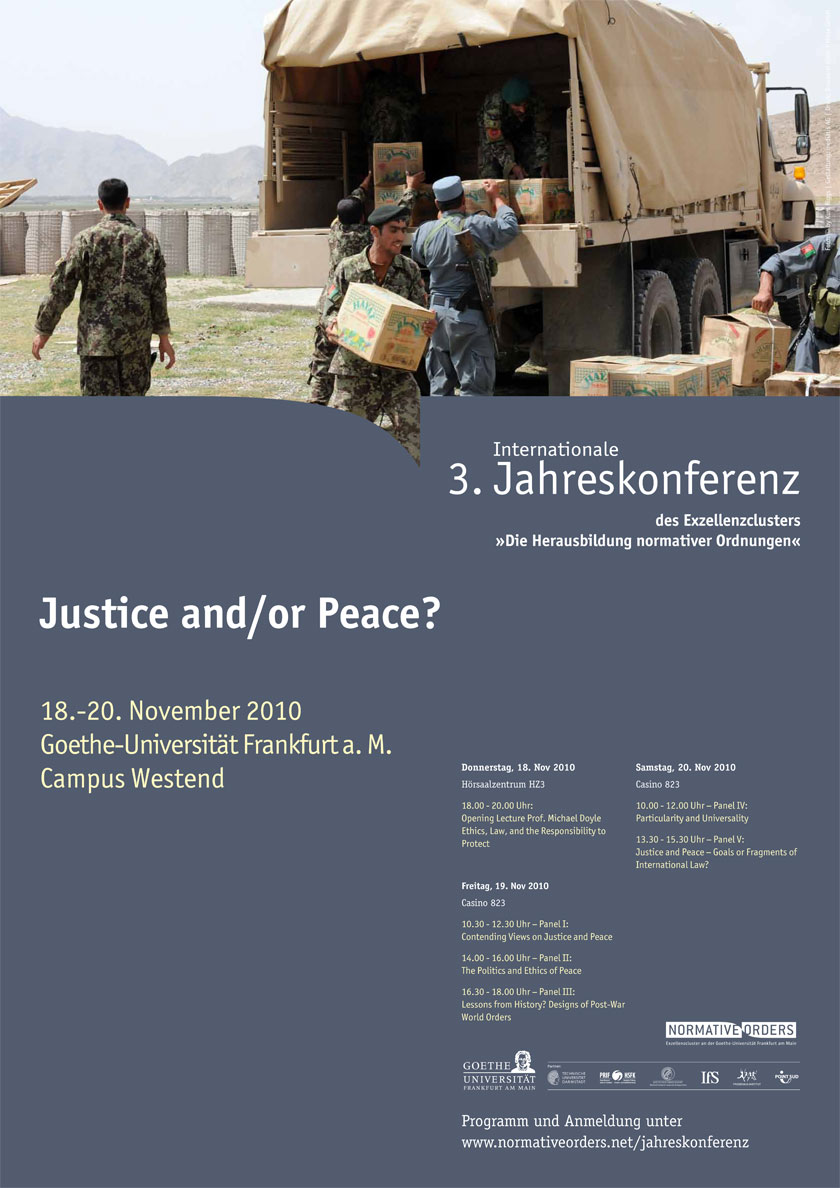
Justice and/or Peace

3. Internationale Jahreskonferenz des Exzellenzclusters

In ordinary language peace usually stands for ‘freedom from disturbance‘ or ‘a state or period in which there is no war‘. Justice, in turn, is generally associated with ‘the quality of being fair and reasonable‘. In ethical and moral discourse the two are often discussed together, suggesting an internal, if delicate relationship. Consider three different voices: When, in addressing the United Nations, Pope Benedict quotes the prophet Isaiah that ‘justice will bring about peace; right will produce calm and security‘ the mere invocation of peace and justice as mutually interdependent already portends that the realities of global life probably do not (yet) live up to Catholic normative standards. John Rawls is more explicit when he argues that a ‘liberal people tries to assure reasonable justice for all its citizens and for all peoples‘ and ‘can live with other people of like character in upholding justice and preserving peace‘. Yet the qualifiers ‘liberal‘ and ‘reasonable‘ immediately suggest that demanding normative standards have to be met if both justice and peace are to obtain. Finally, political realists like to quote Thucydides’ assertion that ‘the standard of justice depends on the equality of power to compel’. In their view, peace is mainly a function of power – ‘the strong do what they have the power to do and the weak accept what they have to accept’.

Quoting these very different perspectives on justice and peace not only provides an initial taste of the difference in disciplinary language games. It also hints at how definitions predetermine the relationship between peace and justice, i.e. whether it is conceived in terms of equivalence or hierarchy, mutual dependence or exclusivity. The title of this conference, ‘Justice and/or Peace?‘, is meant to capture these different dimensions. As in previous years we have aimed at a broad array of disciplines and perspectives, mixing contributions from members of the Cluster with scholars from outside Frankfurt. Of course, perspectives will differ and may even clash. This is to be expected – not only due to the subject matter but also to different responses to the standards of the normative order of scholarly exchange. However, as conference organisers we have taken all precautionary measures to ensure that this exchange will be conducted in a fair and peaceful manner! What remains is for all participants – speakers, chairs and audience – also to help to render it a successful and productive exchange.

Programm

Donnerstag, 18. November 2010
Hörsaalzentrum HZ3

18.00 Uhr: Begrüßung

18.15 Uhr: Eröffnungsvortrag
Prof. Michael W. Doyle (Columbia University): „Ethics, Law, and the Responsibility to Protect“

Freitag, 19. November 2010
Casino – Cas 823 Festsaal

10.00 Uhr: Offizielle Eröffnung

10.30 – 12.30 Uhr:
Panel I: Contending Views on Justice and Peace
Vortrag Prof. Harald Müller: „Justice and Peace: Good Things Do not Always go Together“
Vortrag Prof. Rainer Forst: „The Normative Order(s) of Justice and Peace“

12.30 Uhr: Mittagspause

14.00 – 16.00 Uhr:
Panel II: The Politics and Ethics of Peace
Vortrag Prof. Matthias Lutz-Bachmann: „War and Peace: Norms and Facts in a Globalized World“
Vortrag Prof. Pauline Kleingeld: „Kant on Justice and Morality and Peace“

16.00 Uhr: Kaffeepause

16.30 – 18.00 Uhr:
Panel III: Lessons from History? Designs of Post-War World Orders
Vortrag Prof. Luise Schorn-Schütte: „Religious Peace As a Political Problem in Early Modern Europe (16th to 17th Centuries)“
Vortrag Prof. Brendan Simms: „New Order of Confluence of Crises?“

Samstag, 20. November 2010
Casino – Cas 823 Festsaal

10.00 – 12.00 Uhr:
Panel IV: Particularity and Universality
Vortrag Prof. Cecelia Lynch: „Popular Casuistry and the Problem of Peace and/or Justice in Christian Ethics“
Votrag Prof. Mamadou Diawara: „Justice, in Whose Name: The Domestication of Copyright in Sub-Saharan Africa“

12.00 Uhr: Mittagspause

13.30 – 15.30 Uhr:
Panel V: Justice and Peace – Goals or Fragments of International Law?
Vortrag Prof. Andreas Paulus: „International Law between Fragmentation and Constitutionalization“
Votrag Prof. Stefan Kadelbach: „International order as an Idea – On strict rules and flexible principles“
Aktuelles aus dem Forschungszentrum

Veranstaltung
18.04.2026 | Frankfurt am Main

Das Prinzip Donald Trump und die Verrohung der Welt

Podiumsdiskussion, Vortrag

Ein neuer Politikstil macht international Karriere. Er ist gekennzeichnet von Vulgarität, Verrohung und erklärter Rechtsfeindschaft. Machtinteressen werden nicht mehr juristisch bemäntelt. Stattdessen wird das angebliche Recht des Stärkeren zur Staatsdoktrin gemacht – innenpolitisch wie außenpolitisch. Treibende Kraft hinter dieser Verrohung der politischen Sitten ist ein US-Präsident, der nicht nur die amerikanische Gesellschaft und Kultur, sondern auch die globale Ordnung nach seinen Vorstellungen und Interessen umgestaltet. Die Römerberggespräche wollen diesen Politikstil verstehen.

weitere Infos ›
Veranstaltung
29.04.2026 | Frankfurt am Main

Kulturindustrie heute?

Podiumsdiskussion

Das Gespräch „Kulturindustrie heute?“ widmet sich der Aktualität und Tragfähigkeit eines zentralen Begriffs der Kritischen Theorie. Die Filmwissenschaftlerin Gertrud Koch diskutiert im Rahmen der Gesprächsreihe "Frankfurter Schule" mit dem Filmkritiker Bert Rebhandl die gegenwärtigen Formen kultureller Produktion und Verbreitung vor dem Hintergrund von Digitalisierung, Plattformen und globalen Medienmärkten.

weitere Infos ›
News
19.02.2026

Call for Applications – Postdoctoral Fellowships

Am Forschungszentrum Normative Ordnungen sind für das akademische Jahr 2026/2027 mehrere Postdoctoral Fellowships mit einer Laufzeit von 10 Monaten (Beginn: 1. Oktober 2026) ausgeschrieben. Bewerbungsschluss für alle Programme ist der 15. März 2026.

weitere Infos ›
Veranstaltung
20.03.2026 | Frankfurt am Main

40 Jahre Schengen-Raum

Kolloqium

Der 1984 geschlossene Schengen-Vertrag schuf einen heute 29 Staaten umfassenden Raum ohne Binnengrenzen, doch Migration über die Außengrenzen führte zuletzt zur Wiedereinführung von Kontrollen, auch durch die Bundesregierung ab 8. Mai 2025. Das Walter Hallstein-Kolloquium diskutiert die rechtliche Zulässigkeit, wirtschaftliche Folgen insbesondere für Arbeitsmigration und Arbeitsmarkt sowie die Zukunft des Schengen-Raums.

weitere Infos ›
News
12.02.2026

Satanistische Politik und der Niedergang der Vernunft in liberalen Demokratien

Ein letztes Mal im Wintersemester 2025/26 lud das Forschungszentrum zur Ringvorlesung „Am Scheidepunkt. Zur Krise der Demokratie“. Zum Abschluss hat der Philosoph Michael Rosen von der Harvard University sein Konzept der „satanic politics“ als eine Variante der politischen Deutung der Welt vorgestellt.

weitere Infos ›
News
09.02.2026

Zur Aktualität des Gewaltbegriffs anhand von Camus und Derrida

Prof. Dr. Christine Abbt von der Universität St. Gallen hat im Rahmen der Ringvorlesung „Am Scheidepunkt? Zur Krise der Demokratie“ einen Vortrag über Demokratien und den Gewaltbegriff gehalten. Unter dem Titel „Demokratien verteidigen. Zur Aktualität des Gewaltbegriffs bei Camus und Derrida“ besprach die Philosophin Formen von Gewalt und Revolte und ordnete diese im Hinblick auf ein demokratisches Setting ein.

weitere Infos ›
Publikation
04.02.2026 | Zeitschriftenartikel

New Perspectives on Trust in International Conflicts

Wille, Tobias; Simon, Hendrik; Daase, Christopher; Deitelhoff, Nicole; Wheeler, Nicholas J.; Holmes, Marcus; Rathbun, Brian C.; Acharya, Amitav; Mitzen, Jennifer (2026): „New Perspectives on Trust in International Conflicts“. In: International Studies Review 28 (1), viaf027. 

weitere Infos ›
News
02.02.2026

Staatlicher Wettbewerb um Menschen – David Owen über civil geopolitics

Im Rahmen der Ringvorlesung „Am Scheidepunkt – Zur Zukunft der Demokratie“ präsentierte David Owen von der Universität Southampton sein Konzept der civil geopolitics.

weitere Infos ›
News
20.01.2026

Christine Hentschel über Neuorientierungen in katastrophischen Zeiten

Im Rahmen der Ringvorlesung „Am Scheidepunkt? Zur Krise der Demokratie“ sprach die Soziologin über das Leben in und den Umgang mit katastrophischen Zeiten. Vor dem Hintergrund der Zerstörung der Lebensbedingungen, Kriegen, dauerhafter Krisenhaftigkeit sowie der Bedrohungen der Demokratie widmete sich Hentschel dem Einsickern des Katastrophischen in den gesellschaftlichen Alltag und einem sich verändernden aktivistischen und literarischen Umgang mit der Zukunft.

weitere Infos ›