
23.05.2011
Working Paper

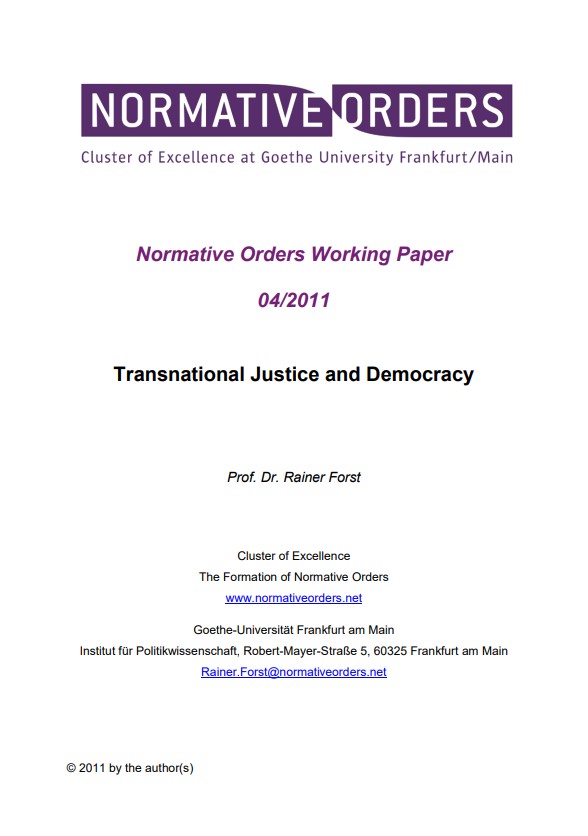
Transnational Justice and Democracy

The title I have chosen seems to signal a tension, even a contradiction, in a number of respects. Democracy appears to be a form of political organisation and government in which, through general and public participatory procedures, a sufficiently legitimate political will is formed which acquires the force of law. Justice, by contrast, appears to be a value external to this context which is not so much linked to procedures of “input” or “throughput” legitimation but is understood instead as an output- or outcome-oriented concept. At times, justice is even understood as an otherworldly idea which, when transported into the Platonic cave, merely causes trouble and ends up as an undemocratic elite project. In methodological terms, too, this difference is sometimes signalled in terms of a contrast between a form of “worldly” political thought and “abstract” and otherworldly philosophical reflection on justice. In my view, we are bound to talk past the issues to be discussed under the heading “transnational justice and democracy” unless we first root out false dichotomies such as the ones mentioned. My thesis will be that justice must be “secularised” or “grounded” both with regard to how we understand it and to its application to relations beyond the state.
Aktuelles aus dem Forschungszentrum

Veranstaltung
20.10.2026 | Frankfurt

Dr. h.c. Gerhard Wiese – Wirken als Ankläger im Auschwitz Prozess

Film, Podiumsdiskussion

Der Frankfurter Auschwitz-Prozess von 1963 bis 1965 gilt als ein zentraler Wendepunkt in der juristischen und öffentlichen Auseinandersetzung mit den nationalsozialistischen Verbrechen in der Bundesrepublik Deutschland. Dr. h.c. Gerhard Wiese, der als junger Staatsanwalt zum Anklägerteam des Prozesses gehörte, berichtet aus seiner Perspektive auf die damaligen Ermittlungen und die Hauptverhandlung. Im Gespräch mit der Historikerin Dr. Katharina Rauschenberger (Fritz Bauer Institut) wird die Bedeutung des Prozesses für die strafrechtliche Aufarbeitung der NS-Verbrechen in den Blick genommen.

weitere Infos ›
Publikation
21.09.2026 | Working Paper

Dimensionen wehrhafter Demokratie in unsicheren Zeiten

Abich, Leon; Adams, Cosima; Biebricher, Thomas; Britz, Gabriele; Daase, Christopher; Deitelhoff, Nicole; Dönges, Jan; Krause, Leon; Nitzschner, Patrick; Siebert, Hannes; Siefert, Julian; Stephanblome, Isabelle (2026): "Dimensionen wehrhafter Demokratie in unsicheren Zeiten". DemoReg Working Paper 3.1.

weitere Infos ›
Veranstaltung
10.02.2027 | Frankfurt am Main

Shifting Visions of Peace and Security

Podiumsdiskussion, Ringvorlesungen

Podiumsdiskussion im Rahmen der Ringvorlesung “Peace and Security in Post-Liberal Times” mit Lisbeth Zimmermann (Goethe University/Normative Orders), Antonia Witt (PRIF), Siddarth Tripathi (University of Erfurt). Moderation: Jonas Wolff (Goethe University/PRIF/Normative Orders).

weitere Infos ›
Veranstaltung
03.02.2027 | Frankfurt am Main

AI, War, and Big Tech

Ringvorlesungen, Vortrag

Vortrag von Ingvild Bode (University of Southern Denmark)im Rahmen der Ringvorlesung “Peace and Security in Post-Liberal Times”.

weitere Infos ›
Veranstaltung
16.12.2026 | Frankfurt am Main

International arms control in a world of uncertainties

Ringvorlesungen, Vortrag

Vortrag von Malte Göttsche (TU Darmstadt/PRIF) im Rahmen der Ringvorlesung “Peace and Security in Post-Liberal Times”.

weitere Infos ›
Veranstaltung
02.12.2026 | Frankfurt am Main

Enabling Authoritarianism: UN Peacekeeping and the Politics of Authoritarianism

Ringvorlesungen, Vortrag

Vortrag von Sarah von Billerbeck (University of Reading) im Rahmen der Ringvorlesung “Peace and Security in Post-Liberal Times”.

weitere Infos ›