

10.02.2026
Zeitschriftenartikel

The politics of international diplomatic training

Representation and socialisation in programmes for diplomats from the Balkans

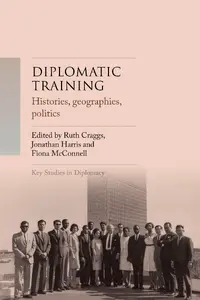
This chapter explores a central tension in international diplomatic training. Experienced diplomats who teach diplomats from other – usually less powerful – states engage in two modes of representation at once. On the one hand, they represent their state, its people, and its interests. In this sense, diplomatic training is a particular form of diplomacy and as such mediates difference without attempting to overcome or transcend it. In spaces of international diplomatic training, representatives of different polities come together, learn about each other’s views, and explore possibilities for coexisting in difference. On the other hand, diplomatic trainers also represent diplomacy as a profession and practice to their ‘young colleagues’, as they are often called irrespective of their age in these settings. While diplomatic relationships are horizontal, at least in a formal sense, these teaching and mentoring relationships are hierarchical. The relationship between master and apprentice here is distinctly undiplomatic, with the aim to assimilate the other into the world of diplomacy. Drawing on participant observation of training programs for diplomats from Kosovo and in-depth interviews, this chapter shows how this tension reproduces a particular imaginary of international politics and forms individual and collective subjects of a particular kind. Theoretically, the chapter engages with recent literatures on diplomacy as a profession and shows that diplomacy grants agency to those invited to participate in it, but always on terms that are not fully their own.
Aktuelles aus dem Forschungszentrum

Veranstaltung
02.02.2027 | Frankfurt

Klassenjustiz, race und abolitionistische Demokratie

Ringvorlesungen, Vortrag

Vortrag von Prof. Dr. Daniel Loick (Amsterdam) im Rahmen der Ringvorlesung "Ist das Recht am Ende?" im Wintersemester 2026/2027. Organisiert von Klaus Günther und Benno Zabel.

weitere Infos ›
Veranstaltung
19.01.2027 | Frankfurt

Nach der Normativität. Zum Verhältnis von Politik und Recht unter komputationalen Bedingungen

Ringvorlesungen, Vortrag

Vortrag von Prof. Dr. Sabine Müller-Mall (Frankfurt am Main) im Rahmen der Ringvorlesung "Ist das Recht am Ende?" im Wintersemester 2026/2027. Organisiert von Klaus Günther und Benno Zabel.

weitere Infos ›
Veranstaltung
08.12.2026 | Frankfurt am Main

Transformationen des Rechts im Anthropozän?

Ringvorlesungen, Vortrag

Vortrag von Prof. Dr. Doris Schweitzer (Frankfurt am Main) im Rahmen der Ringvorlesung "Ist das Recht am Ende?" im Wintersemester 2026/2027. Organisiert von Klaus Günther und Benno Zabel.

weitere Infos ›
Veranstaltung
26.11.2026 | Frankfurt am Main

Rechtskritik oder Rechtsnihilismus?

Ringvorlesungen, Vortrag

Vortrag von Prof. em. Dr. Günter Frankenberg (Frankfurt am Main) im Rahmen der Ringvorlesung "Ist das Recht am Ende?" im Wintersemester 2026/2027. Organisiert von Klaus Günther und Benno Zabel.

weitere Infos ›
Veranstaltung
24.10.2026 | Frankfurt am Main

Machtübergabe? Wie geht es weiter, wenn der demokratische Liberalismus abgewählt wird

Podiumsdiskussion, Vortrag

Gegen den Aufstieg autoritärer und populistischer Parteien hat national wie international bisher kein Mittel geholfen: Weder Brandmauern noch Anbiederung haben Wirkung gezeigt. Was geschieht, wenn sie in Regierungsverantwortung kommen und politische Macht übernehmen? Wie liefe ein solcher Prozess der Machtübergabe ab, welche Folgen hätte er für die Bundesrepublik – und wie kann die Gesellschaft darauf noch reagieren? Die Römerberggespräche als Ort demokratischer Gesprächskultur und gesellschaftlicher Kontroverse wollen sich dieses Themas annehmen und ihm statt Fatalismus Anschauung und Diskussion entgegensetzen.

weitere Infos ›
Publikation
08.09.2026 | Monographie

Bedingungen unserer Existenz. Zur Aktualität Michel Foucaults

Saar, Martin; Vogelmann, Frieder (2026): Bedingungen unserer Existenz. Zur Aktualität Michel Foucaults. Berlin: Suhrkamp. 

weitere Infos ›