
24.02.2025
Zeitschriftenartikel

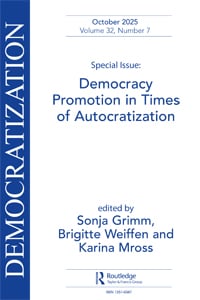
Strategic responses to autocratization in international democracy promotion

Abstract

How do states engaged in international democracy promotion react to current autocratization trends? Research on autocratization so far focuses on its patterns, causes, and consequences. However, governments pursuing democracy promotion abroad had to respond to these challenges. They adjusted projects and diplomatic practices but possibly also overall strategies. While scholars started to analyse individual cases and specific challenges, we lack systematic knowledge on strategic responses: How have governments adapted their foreign and development policies aimed at promoting democracy in a changing global context? This article contributes to filling this gap by analysing how three key states with traditionally different approaches to democracy promotion – Sweden, the United Kingdom, and the United States – have responded to autocratization at the level of overall foreign and development policy strategy. Based on a qualitative content analysis of official documents, refined by expert interviews, we assess (1) whether and how autocratization as a challenge to democracy promotion is discussed and (2) which responses and (needs for) policy adaptation are identified. In comparing the three cases, we suggest that the perception of autocratization, underlying democracy conceptions and approaches to democracy promotion as well as party-political configurations help explain commonalities and differences in the strategic responses.
Aktuelles aus dem Forschungszentrum

Veranstaltung
20.10.2026 | Frankfurt

Dr. h.c. Gerhard Wiese – Wirken als Ankläger im Auschwitz Prozess

Film, Podiumsdiskussion

Der Frankfurter Auschwitz-Prozess von 1963 bis 1965 gilt als ein zentraler Wendepunkt in der juristischen und öffentlichen Auseinandersetzung mit den nationalsozialistischen Verbrechen in der Bundesrepublik Deutschland. Dr. h.c. Gerhard Wiese, der als junger Staatsanwalt zum Anklägerteam des Prozesses gehörte, berichtet aus seiner Perspektive auf die damaligen Ermittlungen und die Hauptverhandlung. Im Gespräch mit der Historikerin Dr. Katharina Rauschenberger (Fritz Bauer Institut) wird die Bedeutung des Prozesses für die strafrechtliche Aufarbeitung der NS-Verbrechen in den Blick genommen.

weitere Infos ›
Publikation
21.09.2026 | Working Paper

Dimensionen wehrhafter Demokratie in unsicheren Zeiten

Abich, Leon; Adams, Cosima; Biebricher, Thomas; Britz, Gabriele; Daase, Christopher; Deitelhoff, Nicole; Dönges, Jan; Krause, Leon; Nitzschner, Patrick; Siebert, Hannes; Siefert, Julian; Stephanblome, Isabelle (2026): "Dimensionen wehrhafter Demokratie in unsicheren Zeiten". DemoReg Working Paper 3.1.

weitere Infos ›
Veranstaltung
10.02.2027 | Frankfurt am Main

Shifting Visions of Peace and Security

Podiumsdiskussion, Ringvorlesungen

Podiumsdiskussion im Rahmen der Ringvorlesung “Peace and Security in Post-Liberal Times” mit Lisbeth Zimmermann (Goethe University/Normative Orders), Antonia Witt (PRIF), Siddarth Tripathi (University of Erfurt). Moderation: Jonas Wolff (Goethe University/PRIF/Normative Orders).

weitere Infos ›
Veranstaltung
03.02.2027 | Frankfurt am Main

AI, War, and Big Tech

Ringvorlesungen, Vortrag

Vortrag von Ingvild Bode (University of Southern Denmark)im Rahmen der Ringvorlesung “Peace and Security in Post-Liberal Times”.

weitere Infos ›
Veranstaltung
16.12.2026 | Frankfurt am Main

International arms control in a world of uncertainties

Ringvorlesungen, Vortrag

Vortrag von Malte Göttsche (TU Darmstadt/PRIF) im Rahmen der Ringvorlesung “Peace and Security in Post-Liberal Times”.

weitere Infos ›
Veranstaltung
02.12.2026 | Frankfurt am Main

Enabling Authoritarianism: UN Peacekeeping and the Politics of Authoritarianism

Ringvorlesungen, Vortrag

Vortrag von Sarah von Billerbeck (University of Reading) im Rahmen der Ringvorlesung “Peace and Security in Post-Liberal Times”.

weitere Infos ›