

01.05.2022
Zeitschriftenartikel

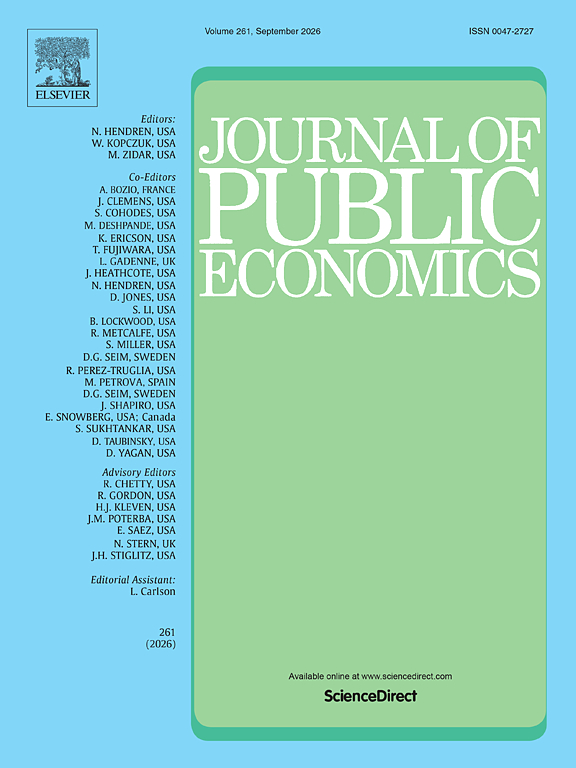
Social hierarchies and the allocation of development aid: Evidence from the 2015 earthquake in Nepal

We study the role of discrimination and in-group biases in the allocation of public funds by community-based committees. Specifically, we investigate the effect of caste hierarchies on the amount of emergency aid given to households after the 2015 earthquake in Nepal. Local committees allocated aid immediately after the earthquake, and –officially– the amount of aid was a function of the magnitude of the housing damage. To identify discrimination and in-group favoritism in this context, we utilize rich data on house characteristics and housing damage and exploit exogenous variation in earthquake intensity. We first provide evidence for caste-based discrimination by these committees: Upper caste households received more aid than lower caste households. Second, we find in-group favoritism among upper caste households: Upper caste households received more aid if individuals from their own (upper) caste were involved in the allocation of aid. In contrast, lower caste households did not benefit from the presence of their own (lower) caste representatives in aid allocation committees. The results highlight the importance of social hierarchies in the study of favoritism and contribute to a better understanding of social structure for the implementation of development policy.
Aktuelles aus dem Forschungszentrum

Publikation
08.09.2026 | Monographie

Bedingungen unserer Existenz. Zur Aktualität Michel Foucaults

Saar, Martin; Vogelmann, Frieder (2026): Bedingungen unserer Existenz. Zur Aktualität Michel Foucaults. Berlin: Suhrkamp. 

weitere Infos ›
Veranstaltung
10.10.2026 | Frankfurt

Von der East West Street zum Anthropozän: Das Recht gegen Gewalt und Zerstörung

Podiumsdiskussion

Auf der Frankfurter Buchmesse spricht der diesjährige Preisträger des Friedenspreises des Deutschen Buchhandels Philippe Sands mit dem Friedensforscher und Historiker Hendrik Simon über die Geschichte, Gegenwart und Zukunft des Völkerrechts, über Ökozid und über die Frage, welche Rolle das Recht in einer von massiver Gewalt und globaler Zerstörung geprägten Welt spielen kann: von der East West Street bis zum Anthropozän.

weitere Infos ›
Veranstaltung
10.10.2026 | Frankfurt am Main

Das Recht der Gewalt. Warum Waffen allein keinen Frieden schaffen

Buchvorstellung

»Der Krieg ist zurück in Europa!«, heißt es – und mit ihm die Angst. Müssen wir wieder die Sprache der Machtpolitik lernen, um den Frieden zu sichern? Stehen wir wirklich vor dem Ende der regelbasierten Ordnung? Dr. Hendrik Simon bezieht im Gespräch mit Dr. Stefan Kroll in dieser hitzigen Debatte Stellung.

weitere Infos ›
Publikation
07.09.2026 | Monographie

The Examined Illness. A Philosopher's Confrontation with Deadly Disease

Moellendorf, Darrel (2026): The Examined Illness: A Philosopher Confronts Deadly Disease, Bristol: intellect.

weitere Infos ›
Publikation
20.08.2026 | Buchkapitel

Abschied vom Neoliberalismus im Zeichen des Postliberalismus?

Biebricher, Thomas (2026): Abschied vom Neoliberalismus im Zeichen des Postliberalismus? In: Selk, Veith; Hofmann, Julian Nicolai (Hrsg.): Postliberalismus? Eine transatlantische Debatte. Berlin: Suhrkamp, S. 222-246.

weitere Infos ›
Publikation
20.08.2026 | Buchkapitel

Krise oder Verfall der Weltordnung? Liberale und postliberale Erklärungen internationalen Wandels

Daase, Christopher (2026): Krise oder Verfall der Weltordnung? Liberale und postliberale Erklärungen internationalen Wandels. In: Selk, Veith; Hofmann, Julian Nicolai (Hrsg.): Postliberalismus? Eine transatlantische Debatte. Berlin: Suhrkamp, S. 205-221.

weitere Infos ›