
22.02.2024
Buchkapitel

Inducing Compliance as a Transformative Process: The Bright Side of a Dismal Record

Über das Buchkapitel:

This chapter explores the apparent paradox that, despite a dismal rate of compliance with its decisions, the Inter-American Court of Human Rights (IACtHR) is constantly right in the middle of the most important controversies in Latin America. To do so, it argues that “compliance” is too narrow a prism to account for the transformative effects of the IACtHR’s expansive compliance activities. By focusing solely on compliance, we risk concealing the wider impact of the Court’s orders, which comes to light when the Court’s influence on the Latin American community of human rights practice is considered. It is in that dynamic process of interaction that the transformations triggered by the Court take root, and it is thanks to the work of that community of practice that the broader impact of the Court occurs. In the Inter-American System, compliance is transformation, and the community of practice is the key step that takes us from compliance to impact.

Über den Sammelband:

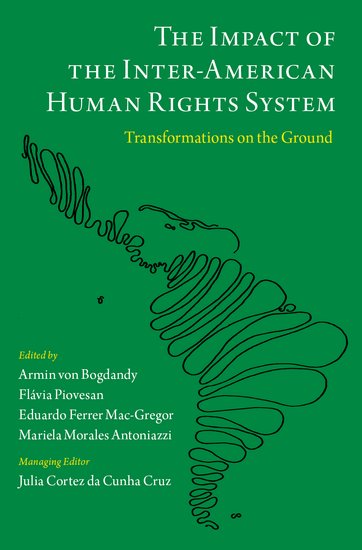
The Inter-American Human Rights System (IAHRS) fosters structural transformations throughout the Americas. This collection of analyses builds upon the studies on Ius Constitutionale Commune en América Latina and Latin American transformative constitutionalism to map out both the ground-level human rights impact of the IAHRS and the institutional characteristics that have enabled such fundamental changes in social reality. The volume starts with essays framing the concept and context of IAHRS impact. Then it navigates thematic analyses on specific rights and types of violations that are front and center to the protection of human rights in Latin America. The concluding essays explore whether and how it is possible to optimize the actions of the Inter-American System, indicating possible paths to increase positive human rights impact. The editors contend that the IAHRS victim-centric approach, community of practice, and openness to institutional reinvention have enabled it to create a virtuous cycle that catalyzes human rights in the Americas, furthering democracy and the Rule of Law throughout the continent.
Aktuelles aus dem Forschungszentrum

Veranstaltung
18.04.2026 | Frankfurt am Main

Das Prinzip Donald Trump und die Verrohung der Welt

Podiumsdiskussion, Vortrag

Ein neuer Politikstil macht international Karriere. Er ist gekennzeichnet von Vulgarität, Verrohung und erklärter Rechtsfeindschaft. Machtinteressen werden nicht mehr juristisch bemäntelt. Stattdessen wird das angebliche Recht des Stärkeren zur Staatsdoktrin gemacht – innenpolitisch wie außenpolitisch. Treibende Kraft hinter dieser Verrohung der politischen Sitten ist ein US-Präsident, der nicht nur die amerikanische Gesellschaft und Kultur, sondern auch die globale Ordnung nach seinen Vorstellungen und Interessen umgestaltet. Die Römerberggespräche wollen diesen Politikstil verstehen.

weitere Infos ›
Veranstaltung
29.04.2026 | Frankfurt am Main

Kulturindustrie heute?

Podiumsdiskussion

Das Gespräch „Kulturindustrie heute?“ widmet sich der Aktualität und Tragfähigkeit eines zentralen Begriffs der Kritischen Theorie. Die Filmwissenschaftlerin Gertrud Koch diskutiert im Rahmen der Gesprächsreihe "Frankfurter Schule" mit dem Filmkritiker Bert Rebhandl die gegenwärtigen Formen kultureller Produktion und Verbreitung vor dem Hintergrund von Digitalisierung, Plattformen und globalen Medienmärkten.

weitere Infos ›
News
19.02.2026

Call for Applications – Postdoctoral Fellowships

Am Forschungszentrum Normative Ordnungen sind für das akademische Jahr 2026/2027 mehrere Postdoctoral Fellowships mit einer Laufzeit von 10 Monaten (Beginn: 1. Oktober 2026) ausgeschrieben. Bewerbungsschluss für alle Programme ist der 15. März 2026.

weitere Infos ›
Veranstaltung
20.03.2026 | Frankfurt am Main

40 Jahre Schengen-Raum

Kolloqium

Der 1984 geschlossene Schengen-Vertrag schuf einen heute 29 Staaten umfassenden Raum ohne Binnengrenzen, doch Migration über die Außengrenzen führte zuletzt zur Wiedereinführung von Kontrollen, auch durch die Bundesregierung ab 8. Mai 2025. Das Walter Hallstein-Kolloquium diskutiert die rechtliche Zulässigkeit, wirtschaftliche Folgen insbesondere für Arbeitsmigration und Arbeitsmarkt sowie die Zukunft des Schengen-Raums.

weitere Infos ›
News
12.02.2026

Satanistische Politik und der Niedergang der Vernunft in liberalen Demokratien

Ein letztes Mal im Wintersemester 2025/26 lud das Forschungszentrum zur Ringvorlesung „Am Scheidepunkt. Zur Krise der Demokratie“. Zum Abschluss hat der Philosoph Michael Rosen von der Harvard University sein Konzept der „satanic politics“ als eine Variante der politischen Deutung der Welt vorgestellt.

weitere Infos ›
News
09.02.2026

Zur Aktualität des Gewaltbegriffs anhand von Camus und Derrida

Prof. Dr. Christine Abbt von der Universität St. Gallen hat im Rahmen der Ringvorlesung „Am Scheidepunkt? Zur Krise der Demokratie“ einen Vortrag über Demokratien und den Gewaltbegriff gehalten. Unter dem Titel „Demokratien verteidigen. Zur Aktualität des Gewaltbegriffs bei Camus und Derrida“ besprach die Philosophin Formen von Gewalt und Revolte und ordnete diese im Hinblick auf ein demokratisches Setting ein.

weitere Infos ›
Publikation
04.02.2026 | Zeitschriftenartikel

New Perspectives on Trust in International Conflicts

Wille, Tobias; Simon, Hendrik; Daase, Christopher; Deitelhoff, Nicole; Wheeler, Nicholas J.; Holmes, Marcus; Rathbun, Brian C.; Acharya, Amitav; Mitzen, Jennifer (2026): „New Perspectives on Trust in International Conflicts“. In: International Studies Review 28 (1), viaf027. 

weitere Infos ›
News
02.02.2026

Staatlicher Wettbewerb um Menschen – David Owen über civil geopolitics

Im Rahmen der Ringvorlesung „Am Scheidepunkt – Zur Zukunft der Demokratie“ präsentierte David Owen von der Universität Southampton sein Konzept der civil geopolitics.

weitere Infos ›
News
20.01.2026

Christine Hentschel über Neuorientierungen in katastrophischen Zeiten

Im Rahmen der Ringvorlesung „Am Scheidepunkt? Zur Krise der Demokratie“ sprach die Soziologin über das Leben in und den Umgang mit katastrophischen Zeiten. Vor dem Hintergrund der Zerstörung der Lebensbedingungen, Kriegen, dauerhafter Krisenhaftigkeit sowie der Bedrohungen der Demokratie widmete sich Hentschel dem Einsickern des Katastrophischen in den gesellschaftlichen Alltag und einem sich verändernden aktivistischen und literarischen Umgang mit der Zukunft.

weitere Infos ›