
22.02.2024
Chapter

Inducing Compliance as a Transformative Process: The Bright Side of a Dismal Record

About the book chapter:

This chapter explores the apparent paradox that, despite a dismal rate of compliance with its decisions, the Inter-American Court of Human Rights (IACtHR) is constantly right in the middle of the most important controversies in Latin America. To do so, it argues that “compliance” is too narrow a prism to account for the transformative effects of the IACtHR’s expansive compliance activities. By focusing solely on compliance, we risk concealing the wider impact of the Court’s orders, which comes to light when the Court’s influence on the Latin American community of human rights practice is considered. It is in that dynamic process of interaction that the transformations triggered by the Court take root, and it is thanks to the work of that community of practice that the broader impact of the Court occurs. In the Inter-American System, compliance is transformation, and the community of practice is the key step that takes us from compliance to impact.

About the anthology:

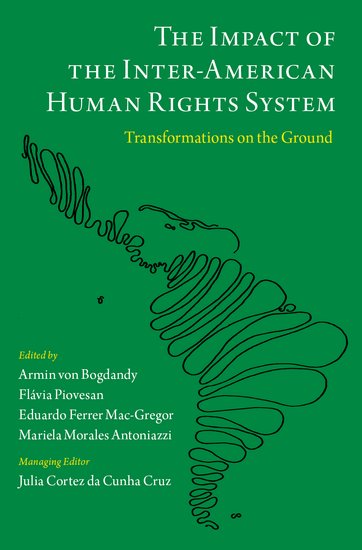
The Inter-American Human Rights System (IAHRS) fosters structural transformations throughout the Americas. This collection of analyses builds upon the studies on Ius Constitutionale Commune en América Latina and Latin American transformative constitutionalism to map out both the ground-level human rights impact of the IAHRS and the institutional characteristics that have enabled such fundamental changes in social reality. The volume starts with essays framing the concept and context of IAHRS impact. Then it navigates thematic analyses on specific rights and types of violations that are front and center to the protection of human rights in Latin America. The concluding essays explore whether and how it is possible to optimize the actions of the Inter-American System, indicating possible paths to increase positive human rights impact. The editors contend that the IAHRS victim-centric approach, community of practice, and openness to institutional reinvention have enabled it to create a virtuous cycle that catalyzes human rights in the Americas, furthering democracy and the Rule of Law throughout the continent.
News from the research center

Veranstaltung
02.02.2027 | Frankfurt

Klassenjustiz, race und abolitionistische Demokratie

Lecture Series, Lecture

Vortrag von Prof. Dr. Daniel Loick (Amsterdam) im Rahmen der Ringvorlesung "Ist das Recht am Ende?" im Wintersemester 2026/2027. Organisiert von Klaus Günther und Benno Zabel.

weitere Infos ›
Veranstaltung
19.01.2027 | Frankfurt

Nach der Normativität. Zum Verhältnis von Politik und Recht unter komputationalen Bedingungen

Lecture Series, Lecture

Vortrag von Prof. Dr. Sabine Müller-Mall (Frankfurt am Main) im Rahmen der Ringvorlesung "Ist das Recht am Ende?" im Wintersemester 2026/2027. Organisiert von Klaus Günther und Benno Zabel.

weitere Infos ›
Veranstaltung
08.12.2026 | Frankfurt am Main

Transformationen des Rechts im Anthropozän?

Lecture Series, Lecture

Vortrag von Prof. Dr. Doris Schweitzer (Frankfurt am Main) im Rahmen der Ringvorlesung "Ist das Recht am Ende?" im Wintersemester 2026/2027. Organisiert von Klaus Günther und Benno Zabel.

weitere Infos ›
Veranstaltung
26.11.2026

Rechtskritik oder Rechtsnihilismus?

Lecture Series, Lecture

Vortrag von Prof. em. Dr. Günter Frankenberg (Frankfurt am Main) im Rahmen der Ringvorlesung "Ist das Recht am Ende?" im Wintersemester 2026/2027. Organisiert von Klaus Günther und Benno Zabel.

weitere Infos ›
Veranstaltung
24.10.2026 | Frankfurt am Main

Machtübergabe? Wie geht es weiter, wenn der demokratische Liberalismus abgewählt wird

Panel Discussion, Lecture

Gegen den Aufstieg autoritärer und populistischer Parteien hat national wie international bisher kein Mittel geholfen: Weder Brandmauern noch Anbiederung haben Wirkung gezeigt. Was geschieht, wenn sie in Regierungsverantwortung kommen und politische Macht übernehmen? Wie liefe ein solcher Prozess der Machtübergabe ab, welche Folgen hätte er für die Bundesrepublik – und wie kann die Gesellschaft darauf noch reagieren? Die Römerberggespräche als Ort demokratischer Gesprächskultur und gesellschaftlicher Kontroverse wollen sich dieses Themas annehmen und ihm statt Fatalismus Anschauung und Diskussion entgegensetzen.

weitere Infos ›
Publikation
08.09.2026 | Monograph

Bedingungen unserer Existenz. Zur Aktualität Michel Foucaults

Saar, Martin; Vogelmann, Frieder (2026): Bedingungen unserer Existenz. Zur Aktualität Michel Foucaults. Berlin: Suhrkamp. 

weitere Infos ›
Veranstaltung
10.10.2026 | Frankfurt

Von der East West Street zum Anthropozän: Das Recht gegen Gewalt und Zerstörung

Panel Discussion

Auf der Frankfurter Buchmesse spricht der diesjährige Preisträger des Friedenspreises des Deutschen Buchhandels Philippe Sands mit dem Friedensforscher und Historiker Hendrik Simon über die Geschichte, Gegenwart und Zukunft des Völkerrechts, über Ökozid und über die Frage, welche Rolle das Recht in einer von massiver Gewalt und globaler Zerstörung geprägten Welt spielen kann: von der East West Street bis zum Anthropozän.

weitere Infos ›
Veranstaltung
10.10.2026 | Frankfurt am Main

Das Recht der Gewalt. Warum Waffen allein keinen Frieden schaffen

Book Presentation

»Der Krieg ist zurück in Europa!«, heißt es – und mit ihm die Angst. Müssen wir wieder die Sprache der Machtpolitik lernen, um den Frieden zu sichern? Stehen wir wirklich vor dem Ende der regelbasierten Ordnung? Dr. Hendrik Simon bezieht im Gespräch mit Dr. Stefan Kroll in dieser Debatte Stellung.

weitere Infos ›
Publikation
07.09.2026 | Monograph

The Examined Illness. A Philosopher's Confrontation with Deadly Disease

Moellendorf, Darrel (2026): The Examined Illness: A Philosopher Confronts Deadly Disease, Bristol: intellect.

weitere Infos ›