

04.05.2023
Buchkapitel

Constitutional Adjudication in the European Legal Space

Über den Sammelband:

The Max Planck Handbooks in European Public Law series describes and analyzes the public law of the European legal space, an area that encompasses not only the law of the European Union but also the European Convention on Human Rights and, importantly, the domestic public laws of European states. Recognizing that the ongoing vertical and horizontal processes of European integration render legal comparison the task of our time for both scholars and practitioners, the project aims to foster a better understanding of the specific European legal pluralism and, ultimately, to contribute to the legitimacy and efficiency of European public law. The first volume of the series began this endeavour with an appraisal of the evolution of the state and its administration, offering both cross-cutting contributions and specific country reports. The third volume (the second in chronological terms) continues this approach with an in-depth appraisal of constitutional adjudication in various and diverse European countries. Fourteen country reports and two cross-cutting contributions investigate the antecedents, foundations, organization, procedure, and specific approach to constitutional issues throughout the Continent.

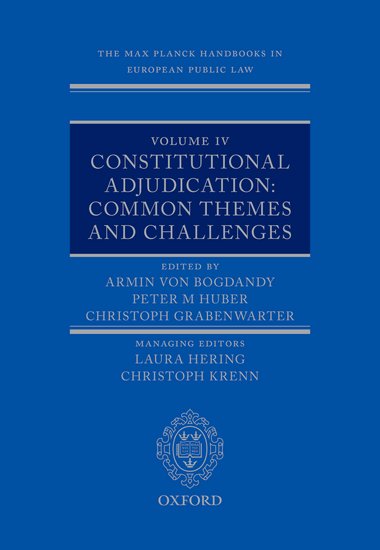
The fourth volume now compares European constitutional jurisdiction in the European legal space. It examines the structures of the organization, the appointment of judges, the procedures and the methods of argumentation and interpretation, their impact on state and society, their legitimacy as well as their role in the division of powers, and thus completes the picture following the country reports in Volume III. This comparative perspective is supplemented by an examination that illustrates the relationship with the ECJ, the ECtHR, and the Venice Commission as well as their (constitutional) function. Finally, Constitutional Adjudication: Common Themes and Challenges is devoted to the challenges constitutional jurisdiction in the European judicial area is currently facing. The historical, political, and theoretical foundations as well as the basic dogmatic features of constitutional jurisdiction are presented in such a way that the discussion about its role and further development in this legal space is sustainably stimulated.
Aktuelles aus dem Forschungszentrum

Veranstaltung
22.04.2026 | Frankfurt am Main

New Directions in Terrorism and Political Violence Research

Lecture Series

Lecture Series mit Vorträgen von Orla Lynch, Leena Malkki und Tore Bjørgo veranstaltet vom Peace Research Institute Frankfurt (PRIF) in Kooperation mit dem Forschungszentrum „Normative Orders“ und der Goethe-Universität Frankfurt

weitere Infos ›
Veranstaltung
12.05.2026 | Frankfurt am Main

Zwischen Transformation und Abolitionismus

Buchvorstellung

Buchvorstellung mit Christine Graebsch, Katrin Höffler, Jochen Bung & Ronen Steinke

weitere Infos ›
Veranstaltung
28./29.05.2026 | Frankfurt am Main

Global Health Justice: Principles and Practice

Konferenz

Following the research focus of the Global Health Justice Postdoctoral Programme, funded by Höppsche Stiftung, the "Global Health Justice: Principles and Practice" conference places a particular emphasis on themes such as the human right to health, political activism and health justice issues, and problems of structural injustice and vulnerable populations in health care. Keynote lectures by Jonathan Wolff and Kanchana Mahadevan.

weitere Infos ›
Veranstaltung
14.07.2026 | Frankfurt am Main

Democracy Over Time and the Climate Crisis

Ringvorlesungen

Vortrag von Anja Karnein (Binghamton). Die Vortragsreihe untersucht Fragen der Klimakrise als Herausforderungen für demokratische Gesellschaften und konzentriert sich auf Themen wie politische Legitimität, Widerstand gegen fossile Brennstoffe und die Interessen künftiger Generationen. Sie wird organisiert von Prof. Dr. Darrel Moellendorf und Dr. Lukas Sparenborg.

weitere Infos ›
Veranstaltung
10.06.2026 | Frankfurt am Main

Capital Investment, Inequality, and State Power in a Time of Climate Emergency

Ringvorlesungen, Vortrag

Vortrag von MartinO'Neill (University of York). Die Vortragsreihe untersucht Fragen der Klimakrise als Herausforderungen für demokratische Gesellschaften und konzentriert sich auf Themen wie politische Legitimität, Widerstand gegen fossile Brennstoffe und die Interessen künftiger Generationen. Sie wird organisiert von Prof. Dr. Darrel Moellendorf und Dr. Lukas Sparenborg.

weitere Infos ›
Veranstaltung
13.05.2026 | Frankfurt am Main

Failed States and Cloudy Skies: Tipping Points, Overshoot and Permanent Emergency, after America

Ringvorlesungen

Vortrag von Geoff Mann (Simon Fraser University, Canada). Die Vortragsreihe untersucht Fragen der Klimakrise als Herausforderungen für demokratische Gesellschaften und konzentriert sich auf Themen wie politische Legitimität, Widerstand gegen fossile Brennstoffe und die Interessen künftiger Generationen. Sie wird organisiert von Prof. Dr. Darrel Moellendorf und Dr. Lukas Sparenborg.

weitere Infos ›
Veranstaltung
22.04.2026 | Frankfurt am Main

Political Legitimacy, Authoritarianism, and Climate Change

Ringvorlesungen, Vortrag

Vortrag von Ross Mittiga (SOAS London). Die Ringvorlesung "Der Klimawandel: Von ökologischen zu demokratischen Kipppunkten?" untersucht Fragen der Klimakrise als Herausforderungen für demokratische Gesellschaften und konzentriert sich auf Themen wie politische Legitimität, Widerstand gegen fossile Brennstoffe und die Interessen künftiger Generationen. Sie wird organisiert von Prof. Dr. Darrel Moellendorf und Dr. Lukas Sparenborg.

weitere Infos ›
News
17.03.2026

Kommunikative Vernunft. Zum Tod von Jürgen Habermas

Von Rainer Forst und Klaus Günther. Mit Jürgen Habermas verlieren wir einen unvergleichlichen, weltweit die Geistes- und Sozialwissenschaften über viele Jahrzehnte prägenden Gelehrten und engagierten Intellektuellen, der, wie er selbst anlässlich seiner Rede zu seinem 90. Geburtstag an der Goethe-Universität sagte, an dieser Universität drei glückliche Phasen seines akademischen Lebens erfahren hat. Er hat auch nach seiner Emeritierung an vielen unserer Diskussionen am Zentrum Normative Ordnungen aktiv teilgenommen, und seine Theorie war für uns stets ein zentraler Bezugspunkt der Forschung. Wir selbst verlieren unseren wichtigsten akademischen Lehrer, der uns über die Jahrzehnte hinweg freundschaftlich verbunden war.

weitere Infos ›
Veranstaltung
23.06.2026 | Frankfurt am Main

Wehrhafte Demokratie: Chancen und Grenzen des Parteiverbots

Podiumsdiskussion

Im Mittelpunkt des Abends steht die Frage, ob und unter welchen verfassungsrechtlichen, politischen und gesellschaftlichen Voraussetzungen ein Verbot einer demokratisch gewählten, rechtsnational ausgerichteten Partei als legitimes Mittel in Betracht gezogen werden kann oder nicht. Ausgehend von den normativen Grundlagen des Parteienverbots im Grundgesetz, möchten wir die hohen rechtlichen Hürden und demokratietheoretischen Spannungsfelder dieser Maßnahme erörtern – zwischen Pluralismus und Selbstverteidigung, zwischen Meinungsfreiheit und Schutz der freiheitlichen demokratischen Grundordnung.

weitere Infos ›