
04.05.2023
Handbuch

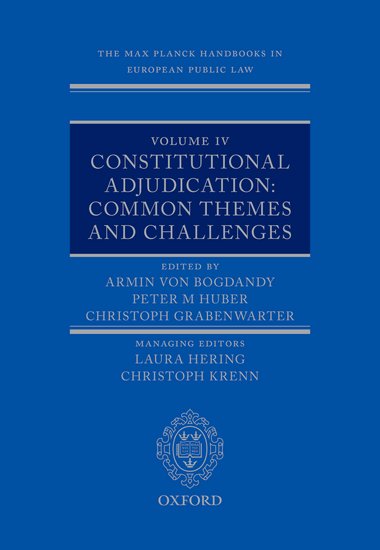
Constitutional Adjudication: Common Themes and Challenges (The Max Planck Handbooks in European Public Law Volume IV)

The Max Planck Handbooks in European Public Law series describes and analyzes the public law of the European legal space, an area that encompasses not only the law of the European Union but also the European Convention on Human Rights and, importantly, the domestic public laws of European states. Recognizing that the ongoing vertical and horizontal processes of European integration render legal comparison the task of our time for both scholars and practitioners, the project aims to foster a better understanding of the specific European legal pluralism and, ultimately, to contribute to the legitimacy and efficiency of European public law. The first volume of the series began this endeavour with an appraisal of the evolution of the state and its administration, offering both cross-cutting contributions and specific country reports. The third volume (the second in chronological terms) continues this approach with an in-depth appraisal of constitutional adjudication in various and diverse European countries. Fourteen country reports and two cross-cutting contributions investigate the antecedents, foundations, organization, procedure, and specific approach to constitutional issues throughout the Continent.

The fourth volume now compares European constitutional jurisdiction in the European legal space. It examines the structures of the organization, the appointment of judges, the procedures and the methods of argumentation and interpretation, their impact on state and society, their legitimacy as well as their role in the division of powers, and thus completes the picture following the country reports in Volume III. This comparative perspective is supplemented by an examination that illustrates the relationship with the ECJ, the ECtHR, and the Venice Commission as well as their (constitutional) function. Finally, Constitutional Adjudication: Common Themes and Challenges is devoted to the challenges constitutional jurisdiction in the European judicial area is currently facing. The historical, political, and theoretical foundations as well as the basic dogmatic features of constitutional jurisdiction are presented in such a way that the discussion about its role and further development in this legal space is sustainably stimulated.
Aktuelles aus dem Forschungszentrum

Veranstaltung
19.06.2026 | Frankfurt

„Dass niemand wirklich frei ist, bevor es nicht alle sind.“

Symposium

International Symposium in Memory of Jürgen Habermas. Featuring international panels on the rise of authoritarianism and the threats to democracy as well as on the communicative turn in philosophy and sociology, followed by a keynote from by Axel Honneth.

weitere Infos ›
Veranstaltung
23.06.2026 | Frankfurt am Main

KI Wahrheitsregime

Podiumsdiskussion

Derzeit verändert Künstliche Intelligenz, wie Wissen und Wahrheit produziert und verstanden werden. Menschen werden zunehmend von Subjekten und aktiven Gestalter*innen zu bloßen Objekten automatisierter epistemischer Prozesse. In Rahmen dieser Veranstaltung sollen die kritische Beurteilung dieser Entwicklung sowie mögliche widerständige Praxen diskutiert werden. Mit Antonio Somaini, Júlia Nueno Guitart (Forensic Architecture) und Medico International.

weitere Infos ›
Veranstaltung
23./24.06.2026 | Frankfurt am Main

The Legacy of Kant’s Political Philosophy

Workshop

A two-day workshop on Howard Williams‘ new book about Immanuel Kant‘s political philosophy.

weitere Infos ›
Veranstaltung
23.06.2026 | Frankfurt am Main

Wehrhafte Demokratie: Chancen und Grenzen des Parteiverbots

Podiumsdiskussion

Im Mittelpunkt des Abends steht die Frage, ob und unter welchen verfassungsrechtlichen, politischen und gesellschaftlichen Voraussetzungen ein Verbot einer demokratisch gewählten, rechtsnational ausgerichteten Partei als legitimes Mittel in Betracht gezogen werden kann oder nicht. Ausgehend von den normativen Grundlagen des Parteienverbots im Grundgesetz, möchten wir die hohen rechtlichen Hürden und demokratietheoretischen Spannungsfelder dieser Maßnahme erörtern – zwischen Pluralismus und Selbstverteidigung, zwischen Meinungsfreiheit und Schutz der freiheitlichen demokratischen Grundordnung.

weitere Infos ›
News
26.05.2026

Neuer Sammelband zu Ehren von Ute Sacksofsky

Der Sammelband „Gerechtigkeit als Thema der Rechtswissenschaft“ bündelt die Beiträge des Ehrensymposiums zum 65. Geburtstag von Prof. Dr. Dr. hc. Ute Sacksofsky und beleuchtet aus intergenerationeller Perspektive zentrale Fragen feministischer Rechtswissenschaft zu Geschlecht, Gerechtigkeit, Gleichheit und juristischen Methoden.

weitere Infos ›
Veranstaltung
22.06.2026 | Frankfurt am Main

Rechtsextremismus und Polizei - Erscheinungsformen, Umgangsweisen, Perspektiven

Podiumsdiskussion

Die Diskussion knüpft an den Sammelband „Rechtsextremismus als Herausforderung für Polizei und Gesellschaft“ an, der aktuelle Perspektiven aus Wissenschaft, Praxis und Zivilgesellschaft zusammenführt.

weitere Infos ›
News
18.05.2026

Videopodcast-Reihe „Our Planet, Our Health“ gestartet

Mit „Our Planet, Our Health“ startet eine neue Videopodcast-Reihe zu Fragen globaler Gesundheitsgerechtigkeit. Die Reihe, gehostet von Dr. Romina Rekers, ist eine Initiative des Global Health Justice Postdoctoral Programme (GHJ), gefördert von der Höppschen Stiftung.

weitere Infos ›
Publikation
12.05.2026 | Onlineartikel

Disinhibited Informalization: Talk Radio, Bro Podcasts and the Aesthetics of Populism

This essay by Johannes Völz is a revised and updated translation of “Enthemmte Informalisierung: Talk Radio, Bro-Podcasts und die Ästhetik des Populismus,” WestEnd: Neue Zeitschrift für Sozialforschung 22.2 (2025): 3–24. It is published here as part of the b2o Review’s “Stop the Right” dossier.

weitere Infos ›
News
11.05.2026

Gertrud Koch spricht über Kulturindustrie heute

Im Rahmen der Gesprächsreihe Frankfurter Schule hat die Professorin für Filmwissenschaft gemeinsam mit dem Journalisten und Filmkritiker Bert Rebhandl über die Aktualität des Begriffs Kulturindustrie und sein Verständnis im Kontext digitaler und globaler Medien gesprochen.

weitere Infos ›