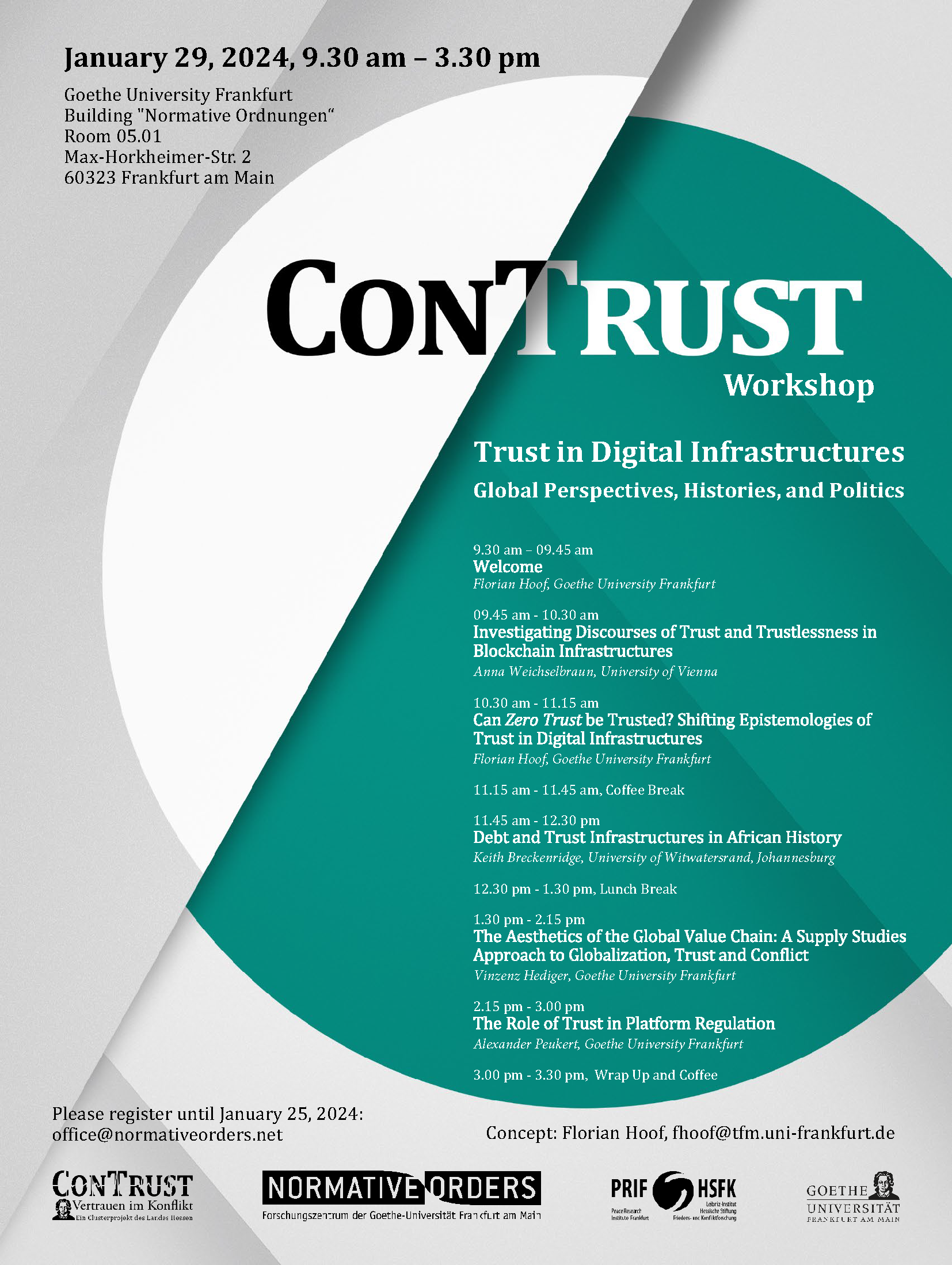

Trust in Digital Infrastructures – Global Perspectives, Histories, and Politics
Workshop
Modern societies are critically dependent on digital infrastructure (Parks & Starosielski 2015), and this is especially evident when infrastructure fails. But beyond situations of outage, infrastructures appear to us to be “as ordinary and unremarkable to us as trees, daylight, and dirt” (Edwards 2002). Because of their size and scale, they are also largely invisible and unaccountable. To act confidently in such a “middle ground between knowledge and non-knowledge” (Simmel 1922) requires infrastructural trust. The tension between the extreme dependence on infrastructures and the taken-for-granted nature of infrastructures points to forms of impersonal or generalized trust that straddle these two sides. Infrastructural trust appears as something that cannot simply be achieved or attained, but rather as part of a conflictual “set of slowly emerging rules, standards and networks of communication” (Breckenridge 2014) that over time generate potentials for the exercise of political power.
According to infrastructure studies, something becomes an infrastructure when a conflict-laden process is transformed into a working agreement that everyone can agree on. This socio-material consensus eventually “sinks into the background” and turns a problem into a “transparent” (Star & Ruhleder 1996) solution, ready to hand. Infrastructure can then function as a transparent medium “that facilitates and shapes modes of mediation“ within societies (Hoof & Boell 2019; Boell & Hoof 2020). Examples include conflicts over technological standards, the introduction and regulation of digital platforms, or the so-called digitization of public administration. Once established, in order to retain its status as a medium, infrastructure becomes a site of constant “maintenance and repair that keeps modern societies going” (Graham & Thrift 2007). From this perspective, infrastructures are less technological than “human infrastructures” (Lee, Dorish, Mark 2006) because they are always tied to membership in a particular community of practice (Bowker & Star 1999).
Focusing on the historical and socio-material dimension of infrastructures, the workshop will consider different forms of trust and misleading trust in infrastructures. What is the justification for infrastructural trust (Forst 2022), which is not only based on interpersonal relations, but is also mediated by institutional structures? Can the deployment, maintenance, and regulation of infrastructure be understood as a series of conflicts and negotiations that stabilize forms of “second-order institutional trust” (Warren 2018)? What happens to infrastructural solutions tied to Western communities of practice as they circulate on a global scale? In what ways does infrastructural (mis)trust enable or prevent cultural, social, and economic activity (Larkin 2008)? How does the “logistical imagination” (Hockenberry et al., 2021) of digital media infrastructure relate to the signaling of trust?
Bibliography:
Boell, Sebastian K., and Florian Hoof (2020) „Accounting for Information Infrastructure as Medium for Organizational Change.“ Accounting History Review, 30(1), 45–68.
Bowker Geoffrey, and Susan Leigh Star (1999) Sorting Things Out: Classification and Its Consequences. Cambridge, MA: The MIT Press.
Breckenridge, Keith (2014) Biometric State: The Global Politics of Identification and Surveillance in South Africa, 1850 to the Present. Cambridge, MA: Cambridge University Press.
Edwards, Paul N. (2002) Infrastructure and Modernity: Scales of Force, Time, and Social Organization in the History of Sociotechnical Systems. In: Misa TJ, Brey P, Feenberg A (eds) Modernity and Technology. Cambridge, MA: The MIT Press, 185–225.
Forst, Rainer (2022) “The Justification of Trust in Conflict. Conceptual and Normative Groundwork”, ConTrust Working Paper, No. 2, Frankfurt a.M.
Graham, Stephen, and Nigel Thrift (2007) “Out of Order: Understanding Repair and Maintenance.” Theory, Culture & Society, 24(3), 1–25.
Hoof, Florian and Sebastian K. Boell (2019) “Culture, Technology, and Process in ‘Media Theories’: Toward a Shift in the Understanding of Media in Organizational Research.“ Organization, 26(5), 636–654.
Larkin, Brian (2008) Signal and Noise: Media, Infrastructure, and Urban Culture in Nigeria. Durham, NC: Duke University Press.
Lee, Charlotte, P. Paul Dourish, and Gloria Mark (2006) The Human Infrastructure of Cyberinfrastructure. In Proceedings of the 2006 Conference on Computer supported cooperative work. Association for Computing Machinery, New York, NY, USA, 483–492.
Hockenberry, Matthew, Nicole Starosielski, and Zieger, Susan (2021) Assembly Codes: The Logistics of Media, Durham, NC: Duke University Press.
Parks, Lisa, and Nicole Starosielski, eds. (2015) Signal Traffic: Critical Studies of Media Infrastructures. Urbana: University of Illinois Press.
Simmel Georg (1922) Das Geheimnis und die geheime Gesellschaft. In: Soziologie. Untersuchungen über die Formen der Vergesellschaftung [1908], Berlin: Duncker&Humblot, 256–303.
Star, Susan Leigh, and Karen Ruhleder (1996) Steps Toward an Ecology of Infrastructure: design and access for large information spaces. Information Systems Research 7, 111–134.
Warren, Mark (2018) Trust and Democracy. In: Eric M. Uslaner ed. The Oxford Handbook of Social and Political Trust. Oxford: Oxford University Press.
Concept: Florian Hoof, fhoof@tfm.uni-frankfurt.de
For participation register with office@normativeorders.net until January 25th. Participation via Zoom is also possible.
Presented by:
„ConTrust. Vertrauen im Konflikt. Politisches Zusammenleben unter Bedingungen der Ungewissheit“ – ein Clusterprojekt des Landes Hessen am Forschungsverbund „Normative Ordnungen“ der Goethe-Universität Frankfurt am Main