

14.05.2025
Zeitschriftenartikel

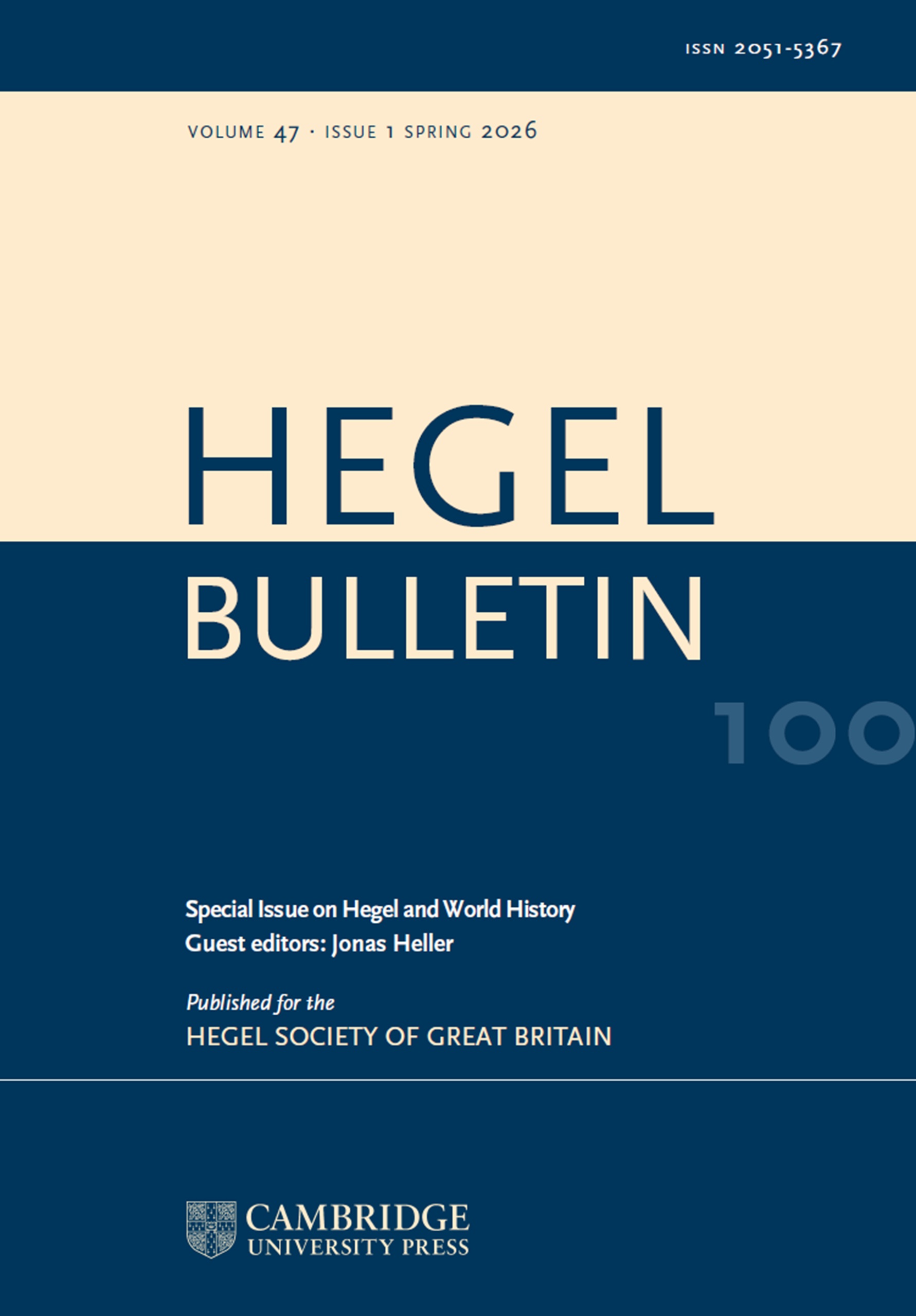
The Dialectic of Utility: Reconsidering Enlightenment in Hegel and Horkheimer/Adorno

In the Phenomenology of Spirit, Hegel places the concept of utility at the centre of his analysis of the Enlightenment period. Utility does not appear merely as a criterion of individual action, but describes a social context of mutual support, realized in a collective referred to by Hegel as a ‘troop’ (Trupp). In Adorno and Horkheimer’s critique of a reason fixated on utility, the Hegelian image of the ‘troop’ came to symbolize a repressive equality which removes the freedom of the individual and seals the failure of enlightenment. In contrast, this article demonstrates that Hegel’s concept of utility cannot be reduced to an attitude which instrumentalizes everything and everyone. In fact, utility refers to a mode of interaction which also takes account of the heterogeneity of each individual. Drawing on Hegel and going beyond his analysis, the article develops a post-Hegelian concept of utility as a formation of social practices that neither instrumentalizes people, nor simply represents an instantiation of social freedom, but rather establishes a constitutive relation between caring for oneself and being useful to others. From this perspective, the concept of utility is not only part of the problem of enlightenment, but also contributes to the endeavour to which Adorno and Horkheimer committed themselves: to work towards an affirmative understanding of enlightenment.
Aktuelles aus dem Forschungszentrum

Publikation
20.08.2026 | Buchkapitel

Abschied vom Neoliberalismus im Zeichen des Postliberalismus?

Biebricher, Thomas (2026): Abschied vom Neoliberalismus im Zeichen des Postliberalismus? In: Selk, Veith; Hofmann, Julian Nicolai (Hrsg.): Postliberalismus? Eine transatlantische Debatte. Berlin: Suhrkamp, S. 222-246.

weitere Infos ›
Publikation
20.08.2026 | Buchkapitel

Krise oder Verfall der Weltordnung? Liberale und postliberale Erklärungen internationalen Wandels

Daase, Christopher (2026): Krise oder Verfall der Weltordnung? Liberale und postliberale Erklärungen internationalen Wandels. In: Selk, Veith; Hofmann, Julian Nicolai (Hrsg.): Postliberalismus? Eine transatlantische Debatte. Berlin: Suhrkamp, S. 205-221.

weitere Infos ›
Publikation
19.08.2026 | Sammelband

Sokrates revised and revisited

Bohl, Judith K.; Brandis, Veronika; Pfeifer, Guido (Hrsg.) (2026): „Sokrates revised and revisited. Überlieferung, Diskurs, Inszenierung“. Heidelberg: Propylaeum. 

weitere Infos ›
Publikation
14.08.2026 | Buchkapitel

Vom rechtshistorischen Erkenntniswert antiker Tragödiendichtung: Überlegungen anhand Euripides’ Medeia

Pfeifer, Guido (2026): "Vom rechtshistorischen Erkenntniswert antiker Tragödiendichtung: Überlegungen anhand Euripides’ Medeia". In: Gsell, Beate; Rüfner, Thomas; Babusiaux, Ulrike (Hrsg.): Die unverzichtbare Wissenschaft – The Indispensable Science, Mohr Siebeck, S. 663-671.

weitere Infos ›
Publikation
01.08.2026 | Buchkapitel

"Das Andere in uns selbst" (Marcel Gauchet). Das Ideal gesellschaftlicher Autonomie und die Denkfigur der Alterität

Langner-Pitschmann, Annette (2026): „Das Andere in uns selbst“ (Marcel Gauchet). Das Ideal gesellschaftlicher Autonomie und die Denkfigur der Alterität. In: Schlette, Magnus et. al. (Hrsg.): Ordnung im Übergang Zur Funktion von Transzendenzbezügen in der Konstitution und Transformation politischer Gemeinschaft, Tübingen: Mohr Siebeck, S. 185-205.

weitere Infos ›
Veranstaltung
24.09.2026 | Frankfurt am Main

Die neuen Warlords. Gewaltdynamiken einhegen / Friedensgutachten 2026

Buchvorstellung

Die imperialistische Großmachtpolitik ändert die Vorzeichen von Krieg, Frieden und Sicherheit. Staaten agieren zunehmend wie Warlords und setzen Krieg als Mittel der Politik ein. Übergänge von Gewaltkonflikten zu Frieden werden als „Deals“ behandelt, Mittelmächte treten mit neuem Selbstbewusstsein, aber ambivalentem Kurs auf, und technologische Innovation verändert Kriege und erschwert die Regulierung. Zugleich befindet sich die internationale Kooperation in der Friedenssicherung in ihrer schwersten Krise. Das Friedensgutachten 2026 analysiert Optionen, dennoch Frieden zu fördern.

weitere Infos ›