
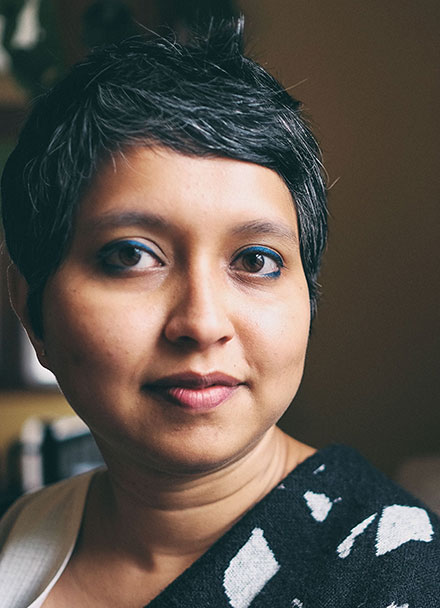
Photo by Stephen Dillon
Associate Professor of English and Chair of Film and Media Studies, Amherst College, Massachusetts, USA
Duration of stay: May – June 2022 and June – July 2025
In cooperation with Prof. Dr. Vinzenz Hediger
Pooja Rangan is a documentary scholar based in Amherst College, where she is Associate Professor of English and Chair of Film and Media Studies. Rangan is the author of the award-winning book Immediations: The Humanitarian Impulse in Documentary (Duke UP, 2017) and co-editor of Thinking with an Accent: Toward a New Object, Method, and Practice (forthcoming from UC Press, 2023). She is currently completing a book titled On Documentary Listening, and co-authoring a book with Brett Story on abolitionist documentary.
Research project:
At present, Dr. Rangan is at work on a new co-authored book with filmmaker and scholar Brett Story that examines the prison as the insidious logic underwriting the narrative codes and values that govern much of documentary meaning and circulation. Tentatively titled “Captive Cinema,” the book charts the production of “carceral common sense” within the field of documentary image-making whilst advancing, as an alternative, an abolitionist vision for future nonfiction film.
Publications (selection):
„The Documentary Audit. Listening and the Limits of Accountability“ (University of California Press, 2025)
„Thinking with an Accent: Toward a New Object, Method, and Practice“ (University of California Press, 2023)
“Inaudible Evidence: Counterforensic Listening in Contemporary Documentary Art,” in Deep Mediations, edited by Karen Redrobe and Jeff Scheible (Minneapolis: University of Minnesota Press, 2021; awarded Best Edited Collection by Society for Cinema and Media Studies, 2022)
“Four Propositions on True Crime and Abolition,” co-authored with Brett Story, World Records (Special Feature, 2021)
“Auditing the Call Center Voice: Accented Speech and Listening in Sonali Gulati’s Nalini by Day, Nancy by Night (2005),” in Vocal Projections: Voices in Documentary, edited by Annabelle Honess Roe and Maria Pramaggiore (London: Bloomsbury Academic, 2018), 29-44.
Immediations: The Humanitarian Impulse in Documentary (Duke University Press, 2017) (2019 Harry Levin Prize for Outstanding First Book from ACLA; PDF links to Introduction)
Events:
Mercator Lecture on Monday July 14th, 6 pm