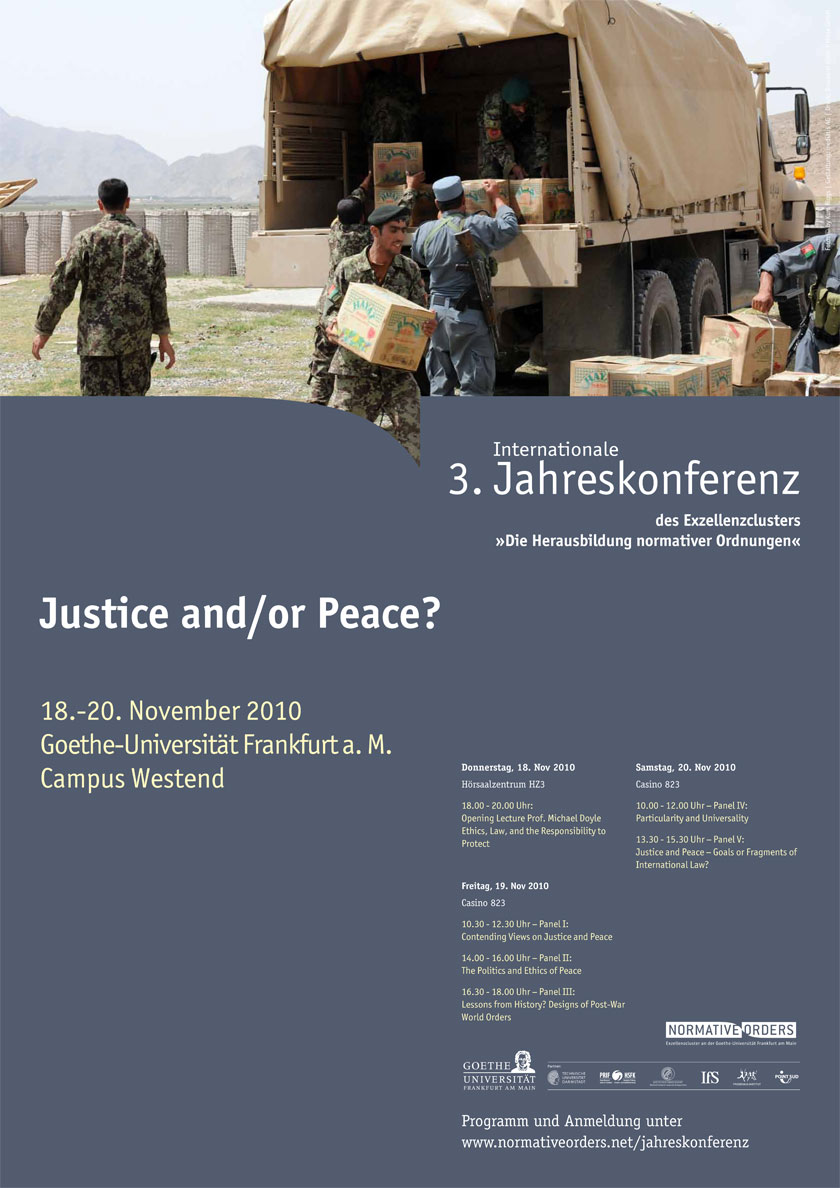
Justice and/or Peace
3. Internationale Jahreskonferenz des Exzellenzclusters
In ordinary language peace usually stands for ‘freedom from disturbance‘ or ‘a state or period in which there is no war‘. Justice, in turn, is generally associated with ‘the quality of being fair and reasonable‘. In ethical and moral discourse the two are often discussed together, suggesting an internal, if delicate relationship. Consider three different voices: When, in addressing the United Nations, Pope Benedict quotes the prophet Isaiah that ‘justice will bring about peace; right will produce calm and security‘ the mere invocation of peace and justice as mutually interdependent already portends that the realities of global life probably do not (yet) live up to Catholic normative standards. John Rawls is more explicit when he argues that a ‘liberal people tries to assure reasonable justice for all its citizens and for all peoples‘ and ‘can live with other people of like character in upholding justice and preserving peace‘. Yet the qualifiers ‘liberal‘ and ‘reasonable‘ immediately suggest that demanding normative standards have to be met if both justice and peace are to obtain. Finally, political realists like to quote Thucydides’ assertion that ‘the standard of justice depends on the equality of power to compel’. In their view, peace is mainly a function of power – ‘the strong do what they have the power to do and the weak accept what they have to accept’.
Quoting these very different perspectives on justice and peace not only provides an initial taste of the difference in disciplinary language games. It also hints at how definitions predetermine the relationship between peace and justice, i.e. whether it is conceived in terms of equivalence or hierarchy, mutual dependence or exclusivity. The title of this conference, ‘Justice and/or Peace?‘, is meant to capture these different dimensions. As in previous years we have aimed at a broad array of disciplines and perspectives, mixing contributions from members of the Cluster with scholars from outside Frankfurt. Of course, perspectives will differ and may even clash. This is to be expected – not only due to the subject matter but also to different responses to the standards of the normative order of scholarly exchange. However, as conference organisers we have taken all precautionary measures to ensure that this exchange will be conducted in a fair and peaceful manner! What remains is for all participants – speakers, chairs and audience – also to help to render it a successful and productive exchange.
Programm
Donnerstag, 18. November 2010
Hörsaalzentrum HZ3
18.00 Uhr: Begrüßung
18.15 Uhr: Eröffnungsvortrag
Prof. Michael W. Doyle (Columbia University): „Ethics, Law, and the Responsibility to Protect“
Freitag, 19. November 2010
Casino – Cas 823 Festsaal
10.00 Uhr: Offizielle Eröffnung
10.30 – 12.30 Uhr:
Panel I: Contending Views on Justice and Peace
Vortrag Prof. Harald Müller: „Justice and Peace: Good Things Do not Always go Together“
Vortrag Prof. Rainer Forst: „The Normative Order(s) of Justice and Peace“
12.30 Uhr: Mittagspause
14.00 – 16.00 Uhr:
Panel II: The Politics and Ethics of Peace
Vortrag Prof. Matthias Lutz-Bachmann: „War and Peace: Norms and Facts in a Globalized World“
Vortrag Prof. Pauline Kleingeld: „Kant on Justice and Morality and Peace“
16.00 Uhr: Kaffeepause
16.30 – 18.00 Uhr:
Panel III: Lessons from History? Designs of Post-War World Orders
Vortrag Prof. Luise Schorn-Schütte: „Religious Peace As a Political Problem in Early Modern Europe (16th to 17th Centuries)“
Vortrag Prof. Brendan Simms: „New Order of Confluence of Crises?“
Samstag, 20. November 2010
Casino – Cas 823 Festsaal
10.00 – 12.00 Uhr:
Panel IV: Particularity and Universality
Vortrag Prof. Cecelia Lynch: „Popular Casuistry and the Problem of Peace and/or Justice in Christian Ethics“
Votrag Prof. Mamadou Diawara: „Justice, in Whose Name: The Domestication of Copyright in Sub-Saharan Africa“
12.00 Uhr: Mittagspause
13.30 – 15.30 Uhr:
Panel V: Justice and Peace – Goals or Fragments of International Law?
Vortrag Prof. Andreas Paulus: „International Law between Fragmentation and Constitutionalization“
Votrag Prof. Stefan Kadelbach: „International order as an Idea – On strict rules and flexible principles“