

29.09.2022
Handbuch

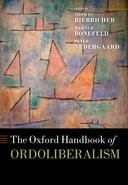
The Oxford Handbook of Ordoliberalism

Since the financial crisis of 2008, Ordoliberalism emerged from relative obscurity to become one of the crucial terms of analysis across a wide range of academic literatures and public discussion. In fact, it became the main reference for a number of issues, including assessments of the attempted resolution of the Eurozone crisis, arguments about German hegemony in Europe, debates over the future of economic liberalism and controversies about authoritarian liberalism. What is striking about Ordoliberalism is its pronounced ambiguity, as some view it as a more refined and potentially progressive variant of neoliberalism, while others cast it as a blueprint for a regime of austerity reigning over a society of competition with only rudimentary democratic institutions. And while Ordoliberalism is often portrayed as a quintessentially German tradition, its impact has not been confined to the German context. In short, Ordoliberalism is a phenomenon of arguably considerable influence that remains poorly understood, as it is mystified by its proponents and vilified by its critics. In this book the editors have compiled a selection of chapters, written by an international cast of experts on Ordoliberalism, that aim to elucidate and analyse the latter in all of its many facets. From the intellectual origins and prime exemplars to its main theoretical themes and practical applications up to the most recent debates taking place across a range of disciplines, this volume offers the first comprehensive account of Ordoliberalism for the English-speaking world.
Aktuelles aus dem Forschungszentrum

Veranstaltung
16./18.11.2026 | Frankfurt am Main

The Actuality of Critique in Times of Computational Ideology

Workshop

International Workshop. Convenors: Jean Lassègue (EHESS, CRNS), Katrin Becker (University of Luxembourg/Collège International de Philosophie) and Sabine Müller-Mall (Goethe University, Normative Orders)

weitere Infos ›
Veranstaltung
18.11.2026 | Frankfurt am Main

The Case for (Neo)colonialism: Neotrusteeship in International Relations as the ‘Imperial Mind’ of the ‘Colonial Present’

Ringvorlesungen, Vortrag

Vortrag von Nick Lemay-Hébert (Manchester University) im Rahmen der Ringvorlesung “Peace and Security in Post-Liberal Times”.

weitere Infos ›
Veranstaltung
25.11.2026 | Frankfurt

Deterrence in “Post-Liberal Times“

Ringvorlesungen, Vortrag

Vortrag von Maria Mälksoo (Copenhagen University) (Goethe-Universität/PRIF/Normative Orders) im Rahmen der Ringvorlesung “Peace and Security in Post-Liberal Times”.

weitere Infos ›
News
02.11.2026

Machtübergabe? Römerberggespräche über die Zukunft der liberalen Demokratie

Stirbt die Demokratie? Wie geht es dem Liberalismus? Die 60. Römerberggespräche im Chagallsaal des Schauspiel Frankfurt widmeten sich am 24. Oktober den gegenwärtigen Abgesängen auf und den Herausforderungen an liberale Demokratien.

weitere Infos ›
Publikation
30.10.2026 | Zeitschriftenartikel

Forum: The Killing of Public Figures: Towards an Integrated Research Agenda

Albarracín, Juan; Wolff, Jonas; Krain, Matthew et. al (2026): „Forum: The Killing of Public Figures: Towards an Integrated Research Agenda“. In: International Studies Perspectives, 2026, ekag015.

weitere Infos ›
News
27.10.2026

Erinnerung als Auftrag: Ehemaliger Staatsanwalt Gerhard Wiese berichtet über den Frankfurter Auschwitz-Prozess

Wie konnte es in der Bundesrepublik der 1960er-Jahre gelingen, die Verbrechen von Auschwitz vor Gericht zu verhandeln? Dr. h. c. Gerhard Wiese, der als junger Staatsanwalt zum Anklägerteam des Frankfurter Auschwitz-Prozesses gehörte, berichtete aus eigener Erfahrung über das Verfahren.

weitere Infos ›