

16.09.2025
Monographie

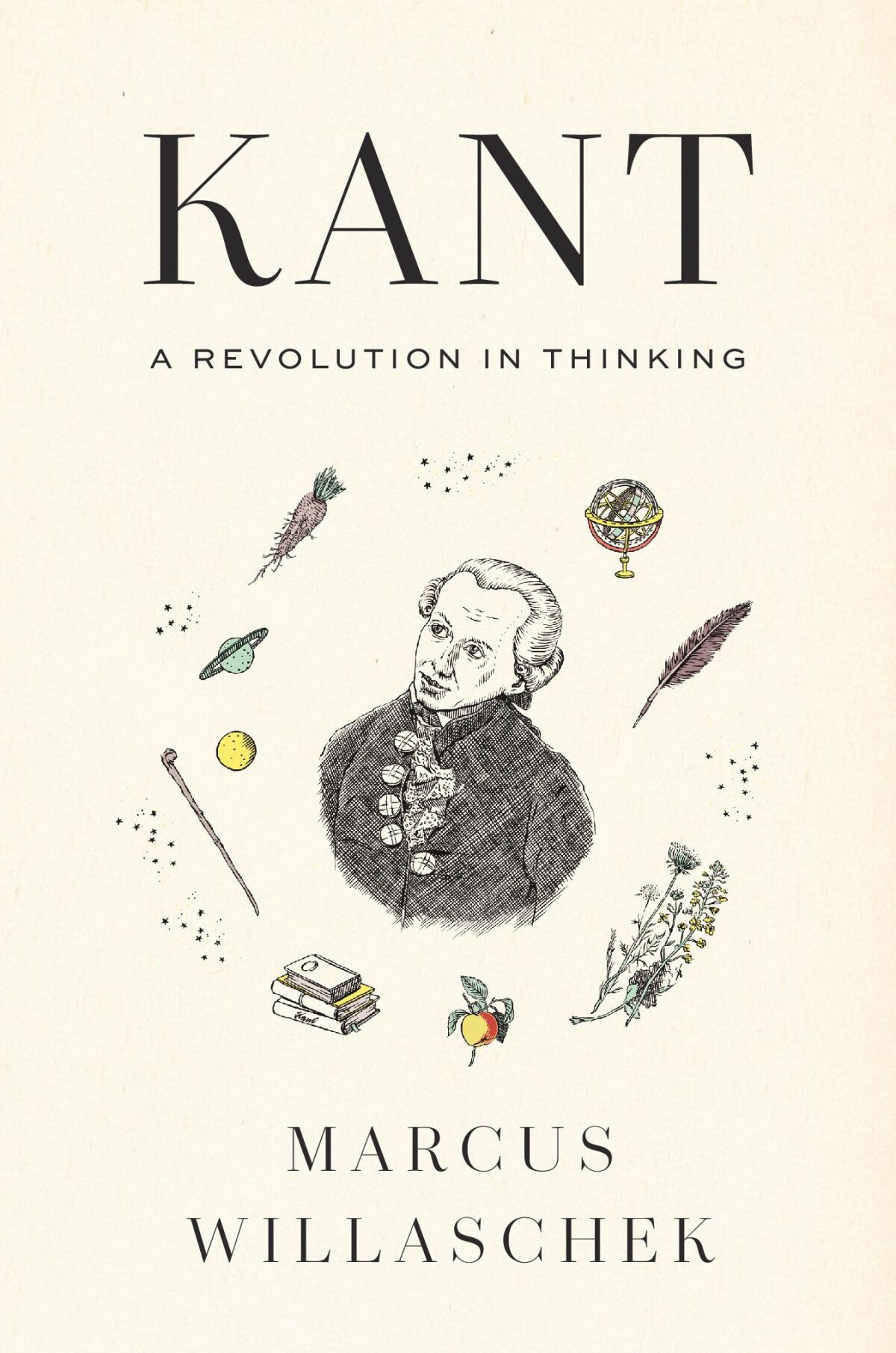
Kant. A Revolution in Thinking

About the book

Immanuel Kant is undoubtedly the most important philosopher of the modern era. His Critique of Pure Reason, “categorical imperative,” and conception of perpetual peace in the global order decisively influenced both intellectual history and twentieth-century politics, shaping everything from the German Constitution to the United Nations Charter.

Renowned philosopher Marcus Willaschek explains why, three centuries after Kant’s birth, his reflections on democracy, beauty, nature, morality, and the limits of human knowledge remain so profoundly relevant. Weaving biographical and historical context together with exposition of key ideas, Willaschek emphasizes three central features of Kant’s theory and method. First, Kant combines seemingly incompatible positions to show how their insights can be reconciled. Second, he demonstrates that it is not only human thinking that must adjust to the realities of the world; the world must also be fitted to the structures of our thinking. Finally, he overcomes the traditional opposition between thought and action by putting theory at the service of practice.

In Kant: A Revolution in Thinking, even readers having no prior acquaintance with Kant’s ideas or with philosophy generally will find an adroit introduction to the Prussian polymath’s oeuvre, beginning with his political arguments, expanding to his moral theory, and finally moving to his more abstract considerations of natural science, epistemology, and metaphysics. Along the way, Kant himself emerges from beneath his famed works, revealing a magnetic personality, a clever ironist, and a man deeply engaged with his contemporary world.
Aktuelles aus dem Forschungszentrum

News
13.11.2025

Goethe Lecture Offenbach zu ableistischer Diskriminierung

Regina Schidel hat im Rahmen der Goethe Lectures Offenbach eine Kritik ableistischer Diskriminierung präsentiert. In ihrem Vortrag „Ich kann, also bin ich?“ diskutiert sie praktische Ausprägungen und philosophische Herkünfte von Ableismus.

weitere Infos ›
Veranstaltung
10.02.2026 | Frankfurt am Main

Satanic Politics. Democracy after Liberalism

Ringvorlesungen, Vortrag

Vortrag von Michael Rosen (Harvard University) im Rahmen der Ringvorlesung "Am Scheidepunkt? Zur Krise der Demokratie" im Wintersemester 2025/2026

weitere Infos ›
Veranstaltung
04.02.2026 | Frankfurt am Main

Demokratien verteidigen. Zur Aktualität des Gewaltbegriffs bei Camus und Derrida

Ringvorlesungen, Vortrag

Vortrag von Christine Abbt (Universität St. Gallen) im Rahmen der Ringvorlesung "Am Scheidepunkt? Zur Krise der Demokratie" im Wintersemester 2025/2026

weitere Infos ›
Veranstaltung
29.01.2026

Civil Geopolitics and the Dilemmas of the Democratic State

Ringvorlesungen, Vortrag

Vortrag von David Owen (Universtiy of Southampton) im Rahmen der Ringvorlesung "Am Scheidepunkt? Zur Krise der Demokratie" im Wintersemester 2025/2026

weitere Infos ›
Veranstaltung
14.01.2026 | Frankfurt am Main

Vom Retten der Welt zum Vorbereiten auf den Kollaps: Neuorientierungen in katastrophischen Zeiten

Ringvorlesungen, Vortrag

Vortrag von Christine Hentschel (Universität Hamburg) im Rahmen der Ringvorlesung "Am Scheidepunkt? Zur Krise der Demokratie" im Wintersemester 2025/2026

weitere Infos ›
Veranstaltung
10.12.2025 | Frankfurt am Main

How Democracy Relies on the Future

Ringvorlesungen, Vortrag

Vortrag von Jonathan White (LSE) im Rahmen der Ringvorlesung "Am Scheidepunkt? Zur Krise der Demokratie" im Wintersemester 2025/2026

weitere Infos ›
Veranstaltung
26.11.2025 | Frankfurt am Main

Krise der Demokratietheorie? Eine soziologische Intervention

Ringvorlesungen, Vortrag

Vortrag von Jenni Brichzin (Universität der Bundeswehr München) im Rahmen der Ringvorlesung "Am Scheidepunkt? Zur Krise der Demokratie" im Wintersemester 2025/2026

weitere Infos ›
Veranstaltung
27./28.11.2025 | Frankfurt am Main

Reconsidering Legal Subjectivity In and Through the Anthropocene

Konferenz

Internationale Konferenz organisiert vom Wissenschaftsnetzwerk Recht im Anthropozän (RiA) in Kooperation mit dem Forschungszentrum Normative Ordnungen.

weitere Infos ›
News
23.10.2025

Vinzenz Hediger wird neuer Direktor der Cinémathèque suisse

Prof. Dr. Vinzenz Hediger wird ab Januar 2026 Direktor der Cinémathèque suisse in Lausanne. Seit 1948 bewahrt, restauriert und fördert die Cinémathèque suisse das schweizerische und internationale Filmerbe. Sie wird von der Internationalen Föderation der Filmarchive (FIAF) als eine der zehn bedeutendsten Kinematheken der Welt anerkannt – aufgrund des Umfangs, der Vielfalt und der Qualität ihrer Sammlungen.

weitere Infos ›