

04.05.2023
Handbuch

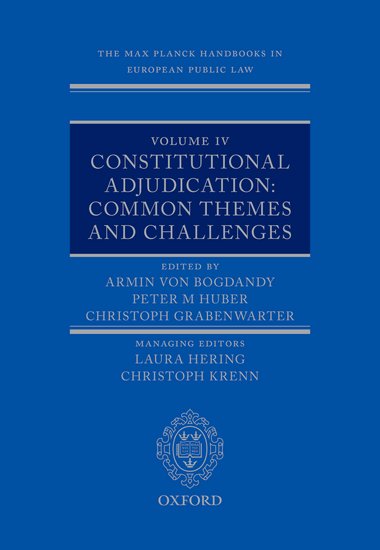
Constitutional Adjudication: Common Themes and Challenges (The Max Planck Handbooks in European Public Law Volume IV)

The Max Planck Handbooks in European Public Law series describes and analyzes the public law of the European legal space, an area that encompasses not only the law of the European Union but also the European Convention on Human Rights and, importantly, the domestic public laws of European states. Recognizing that the ongoing vertical and horizontal processes of European integration render legal comparison the task of our time for both scholars and practitioners, the project aims to foster a better understanding of the specific European legal pluralism and, ultimately, to contribute to the legitimacy and efficiency of European public law. The first volume of the series began this endeavour with an appraisal of the evolution of the state and its administration, offering both cross-cutting contributions and specific country reports. The third volume (the second in chronological terms) continues this approach with an in-depth appraisal of constitutional adjudication in various and diverse European countries. Fourteen country reports and two cross-cutting contributions investigate the antecedents, foundations, organization, procedure, and specific approach to constitutional issues throughout the Continent.

The fourth volume now compares European constitutional jurisdiction in the European legal space. It examines the structures of the organization, the appointment of judges, the procedures and the methods of argumentation and interpretation, their impact on state and society, their legitimacy as well as their role in the division of powers, and thus completes the picture following the country reports in Volume III. This comparative perspective is supplemented by an examination that illustrates the relationship with the ECJ, the ECtHR, and the Venice Commission as well as their (constitutional) function. Finally, Constitutional Adjudication: Common Themes and Challenges is devoted to the challenges constitutional jurisdiction in the European judicial area is currently facing. The historical, political, and theoretical foundations as well as the basic dogmatic features of constitutional jurisdiction are presented in such a way that the discussion about its role and further development in this legal space is sustainably stimulated.
Aktuelles aus dem Forschungszentrum

Publikation
08.01.2026 | Zeitschriftenartikel

The rural-urban divide in Europe

Riera, Pedro; Roßteutscher, Sigrid (Hrsg.) (2025): „The rural-urban divide in Europe: Assessing its impact on political attitudes and voting behavior“. In: Electoral Studies, Special Issue.

weitere Infos ›
Publikation
08.01.2026 | Zeitschriftenartikel

Gender Differences in Financial Advice

Bucher-Koenen, Tabea; Hackethal, Andreas; Koenen, Johannes; Laudenbach, Christine (2025): „Gender Differences in Financial Advice“. In: American Economic Review, 115 (12), pp. 4218–4252.

weitere Infos ›
News
05.01.2026

Wir trauern um Thomas M. Schmidt

Mit Thomas M. Schmidt, der am letzten Tag des Jahres 2025 verstorben ist, in dem wir erst wenige Monate zuvor seinen 65. Geburtstag mit einem Symposium begingen, verlieren wir einen der großen Religionsphilosophen unserer Zeit. Sein jäher Tod reißt eine Lücke in die Gemeinschaft der Forschenden, die wie er zu verstehen suchen, was die Rolle der Religion in den säkularen Gesellschaften unserer Zeit ist und sein kann. Zugleich wird er als der wunderbare Mensch fehlen, der er war.

weitere Infos ›
News
11.12.2025

Jonathan White über Zukunftsdenken in Demokratien

Zum zweiten Termin der Ringvorlesung "Am Scheidepunkt? Zur Krise der Demokratie". Der Politikwissenschaftler White diskutiert Sichtweisen auf die Zukunft in Demokratien. Ein Nachbericht

weitere Infos ›
News
04.12.2025

Die Krise der Demokratietheorie aus soziologischer Perspektive

Die Soziologin Jenny Brichzin hat mit ihrem Vortrag „Krise der Demokratietheorie? Eine soziologische Intervention“ unsere Ringvorlesung „Am Scheidepunkt? Zur Zukunft der Demokratietheorie“ eröffnet. Die Soziologin kritisiert, gesellschaftliches Zusammenleben werde in der Demokratietheorie bisher unzureichend thematisiert. Ein Nachbericht

weitere Infos ›
Publikation
03.12.2025 | Zeitschriftenartikel

The Archipelago Capitalism of Citizenship-By-Investment

Džankić, Jelena; Seyfettinoglu, Mira; Shachar, Ayelet; Vink, Maarten; Baaren, Luuk van der (2025): „The Archipelago Capitalism of Citizenship-By-Investment“. In: Comparative Political Studies, OnlineFirst.

weitere Infos ›
Publikation
01.12.2025

Non-Fiction Cinema in Postwar Europe

Hediger, Vinzenz (2025): „Preface: (Re)Building Europe through Cinema (Studies)”. In: Cesalkova, Lucia, et al. (eds.): Non-Fiction Cinema in Postwar Europe. Visual Culture and the Reconstruction of Public Space. Amsterdam University Press.

weitere Infos ›
News
21.11.2025

Freiwillig oder verpflichtend? Wehrdienst, Frieden und demokratische Verantwortung

Nachbericht zu den 58. Römerberggesprächen. Das Thema Wehrpflicht und die Frage, was ein demokratischer Staat von seinen Bürgerinnen und Bürgern verlangen darf, standen im Zentrum der 58. Römerberggespräche "Bedingt einsatzbereit? Wehrdienst und die Pflicht zum Dienst am Staat", die am 15. November in Kooperation mit dem Forschungszentrum Normative Ordnungen im Chagallsaal des Schauspiel Frankfurt stattfanden.

weitere Infos ›
Publikation
21.11.2025 | Buchkapitel

Die Möglichkeiten des Einsatzes von Multi-Party-Computation beim Datenaustausch zwischen Sicherheitsbehörden als Grundlage der Qualitätssicherung von KI-Anwendungen

Müllmann, Dirk; Spiecker gen. Döhmann, Indra (2025): „Die Möglichkeiten des Einsatzes von Multi-Party-Computation beim Datenaustausch zwischen Sicherheitsbehörden als Grundlage der Qualitätssicherung von KI-Anwendungen“. In: Honekamp, Wilfried; Kemme, Stefanie; Struck, Jens: Auswirkungen von Künstlicher Intelligenz auf die zukünftige Polizeiarbeit. Springer.

weitere Infos ›