

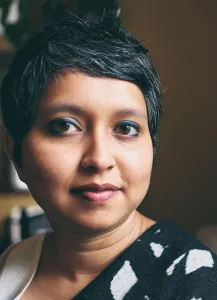
Associate Professor of English and Chair of Film and Media Studies, Amherst College, Massachusetts, USA
Research project title:
On Documentary Listening
Research abstract:
On Documentary Listening argues, contra the popular (and scholarly) refrain that documentary films “give voice” to silenced social perspectives, that documentaries don’t just receive and attend to the world; that the genre’s most common oral and aural conventions model normative listening habits and practices that actively filter, arrange, design, and build reality. The book frames documentary listening as a political act that distributes attentional and material resources, and contours relational and political prospects. The four chapters of the book („The Documentary Audit“; „Listening with an Accent“; „Listening in Crip Time“; „Listening like an Abolitionist“) each reflect on the implicit values and comportments embedded in common documentary listening habits, in pursuit of unlikely origins, forgotten chapters, and oppositional itineraries. Throughout, I listen otherwise for counterhabits that remain open to what is difficult, different, or radically strange.
Events
June 7: Lecture – „Listening in Crip Time: Toward New Forms of Documentary Trust“
June 13 & 14: „Contested Forms. A Workshop on Documentary, Trust and Conflict“
-
Biografische Angaben
Pooja Rangan is a documentary scholar based in Amherst College, where she is Associate Professor of English and Chair of Film and Media Studies. Rangan is the author of the award-winning book Immediations: The Humanitarian Impulse in Documentary (Duke UP, 2017) and co-editor of Thinking with an Accent: Toward a New Object, Method, and Practice (forthcoming from UC Press, 2023). She is currently completing a book titled On Documentary Listening, and co-authoring a book with Brett Story on abolitionist documentary.
-
Publikationen
“Inaudible Evidence: Counterforensic Listening in Contemporary Documentary Art,” in Deep Mediations, edited by Karen Redrobe and Jeff Scheible (Minneapolis: University of Minnesota Press, 2021; awarded Best Edited Collection by Society for Cinema and Media Studies, 2022)
“Four Propositions on True Crime and Abolition,” co-authored with Brett Story, World Records (Special Feature, 2021)
“Auditing the Call Center Voice: Accented Speech and Listening in Sonali Gulati’s Nalini by Day, Nancy by Night (2005),” in Vocal Projections: Voices in Documentary, edited by Annabelle Honess Roe and Maria Pramaggiore (London: Bloomsbury Academic, 2018), 29-44.
Immediations: The Humanitarian Impulse in Documentary (Duke University Press, 2017) (2019 Harry Levin Prize for Outstanding First Book from ACLA)