
Loading Events
  • This event has passed.
18.11.2024 | Frankfurt am Main
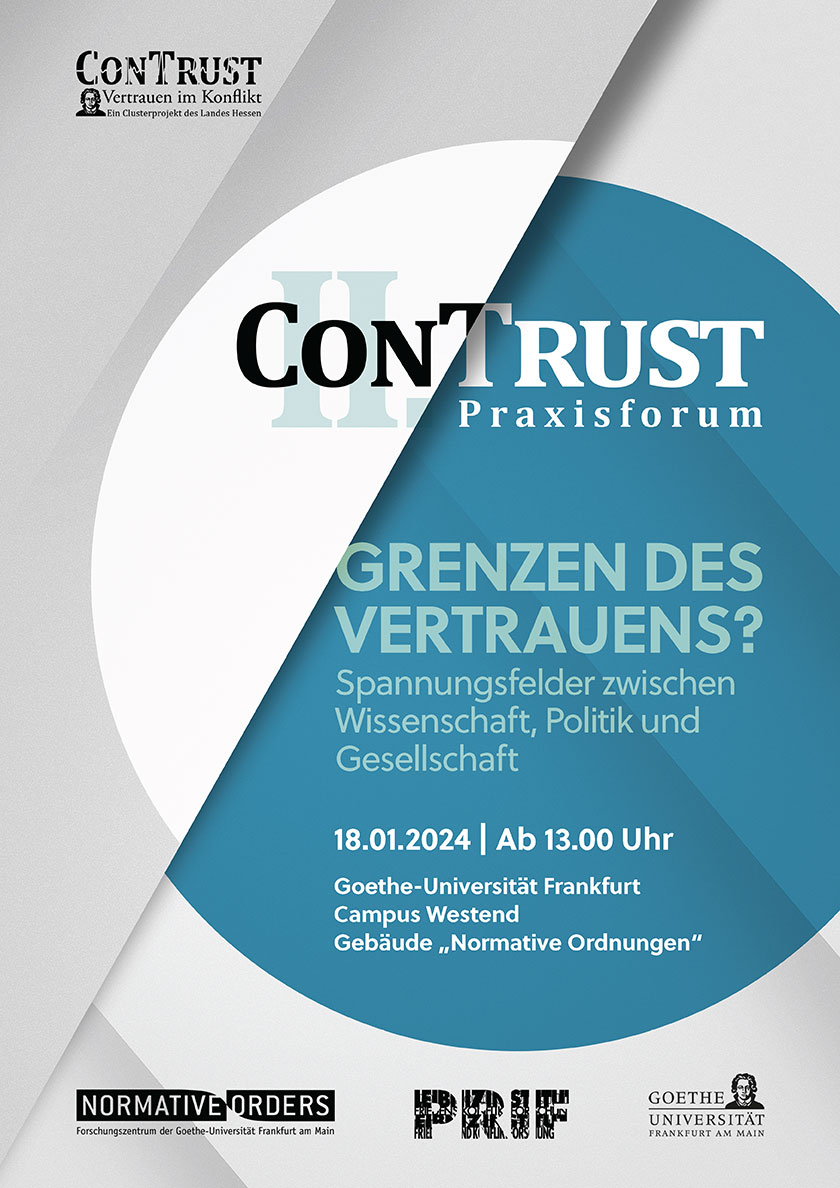
Practice Forum

Limits of trust? – Areas of tension between science, politics and society

Second ConTrust Practice Forum

Forum for exchange between science and practice, with Vera King, Andreas Schindel, Tobias Singelnstein, Tobias Wille, Nicole Deitelhoff, Florian Meesmann (Editorial Director MDR Aktuell), Ayse Asar, LL.M. (State Secretary in the Hessian Ministry of Science and Art) – requested and Rebecca C. Schmidt, among others

Democracy is currently facing a question of trust like it hasn’t for a long time: Do citizens still have sufficient trust that democratically elected politicians will represent their interests and do so in such a way that the many challenges of our time will be solved? If this fundamental trust is increasingly crumbling, then not only governments will falter, but ultimately also the democratic order as such. This kind of development is reflected, for example, in the rise of right-wing populist parties, some of which are openly anti-democratic, whose simple proposals for solutions are becoming increasingly unsuccessful. So how can democratic politics gain trust? And what role does the exchange with science play in this? After all, it is science that is supposed to provide reliable information and guidance. Can politics benefit from scientific findings in order to generate trust? Or is this hope in vain in the age of so-called alternative facts and discourse fragmented by social media?

The second practical forum of the research initiative “ConTrust: Trust in Conflict. Political coexistence under conditions of uncertainty”. As researchers with different disciplinary backgrounds, we want to enter into a constructive exchange with representatives from the media, politics and other areas of practice. Different formats offer the opportunity to discuss thematic approaches, formulate expectations, but also to engage in informal discussions.
News from the research center

Event
18.04.2026 | Frankfurt am Main

Das Prinzip Donald Trump und die Verrohung der Welt

Panel Discussion, Lecture

Ein neuer Politikstil macht international Karriere. Er ist gekennzeichnet von Vulgarität, Verrohung und erklärter Rechtsfeindschaft. Machtinteressen werden nicht mehr juristisch bemäntelt. Stattdessen wird das angebliche Recht des Stärkeren zur Staatsdoktrin gemacht – innenpolitisch wie außenpolitisch. Treibende Kraft hinter dieser Verrohung der politischen Sitten ist ein US-Präsident, der nicht nur die amerikanische Gesellschaft und Kultur, sondern auch die globale Ordnung nach seinen Vorstellungen und Interessen umgestaltet. Die Römerberggespräche wollen diesen Politikstil verstehen.

more information ›
Event
29.04.2026 | Frankfurt am Main

Kulturindustrie heute?

Panel Discussion

Das Gespräch „Kulturindustrie heute?“ widmet sich der Aktualität und Tragfähigkeit eines zentralen Begriffs der Kritischen Theorie. Die Filmwissenschaftlerin Gertrud Koch diskutiert im Rahmen der Gesprächsreihe "Frankfurter Schule" mit dem Filmkritiker Bert Rebhandl die gegenwärtigen Formen kultureller Produktion und Verbreitung vor dem Hintergrund von Digitalisierung, Plattformen und globalen Medienmärkten.

more information ›
Event
20.03.2026 | Frankfurt am Main

40 Jahre Schengen-Raum

Colloquium

Der 1984 geschlossene Schengen-Vertrag schuf einen heute 29 Staaten umfassenden Raum ohne Binnengrenzen, doch Migration über die Außengrenzen führte zuletzt zur Wiedereinführung von Kontrollen, auch durch die Bundesregierung ab 8. Mai 2025. Das Walter Hallstein-Kolloquium diskutiert die rechtliche Zulässigkeit, wirtschaftliche Folgen insbesondere für Arbeitsmigration und Arbeitsmarkt sowie die Zukunft des Schengen-Raums.

more information ›
News
12.02.2026

Satanist politics and the decline of reason in liberal democracies

For the last time in the winter semester 2025/26, the Research Center hosted the lecture series "Am Scheidepunkt. On the crisis of democracy". At the end, philosopher Michael Rosen from Harvard University presented his concept of "satanic politics" as a variant of the political interpretation of the world.

more information ›
News
09.02.2026

On the topicality of the concept of violence based on Camus and Derrida

Prof. Dr. Christine Abbt from the University of St. Gallen gave a lecture on democracies and the concept of violence as part of the lecture series "At the crossroads? On the crisis of democracy", she gave a lecture on democracies and the concept of violence. Under the title "Defending democracies. On the topicality of the concept of violence in Camus and Derrida", the philosopher discussed forms of violence and revolt and categorized them with regard to a democratic setting.

more information ›
Publication
04.02.2026 | Journal article

New Perspectives on Trust in International Conflicts

Wille, Tobias; Simon, Hendrik; Daase, Christopher; Deitelhoff, Nicole; Wheeler, Nicholas J.; Holmes, Marcus; Rathbun, Brian C.; Acharya, Amitav; Mitzen, Jennifer (2026): „New Perspectives on Trust in International Conflicts“. In: International Studies Review 28 (1), viaf027.

more information ›
News
02.02.2026

States competing for people - David Owen on civil geopolitics

As part of the lecture series "At the Crossroads - The Future of Democracy", David Owen from the University of Southampton presented his concept of civil geopolitics.

more information ›
News
20.01.2026

Christine Hentschel on reorientation in catastrophic times

As part of the lecture series "At the crossroads? On the crisis of democracy", the sociologist spoke about living in and dealing with catastrophic times. Against the backdrop of the destruction of living conditions, wars, permanent crises and threats to democracy, Hentschel addressed the infiltration of the catastrophic into everyday social life and a changing activist and literary approach to the future.

more information ›
Publication
08.01.2026 | Journal article

Gender Differences in Financial Advice

Bucher-Koenen, Tabea; Hackethal, Andreas; Koenen, Johannes; Laudenbach, Christine (2025): „Gender Differences in Financial Advice“. In: American Economic Review, 115 (12), pp. 4218–4252.

more information ›