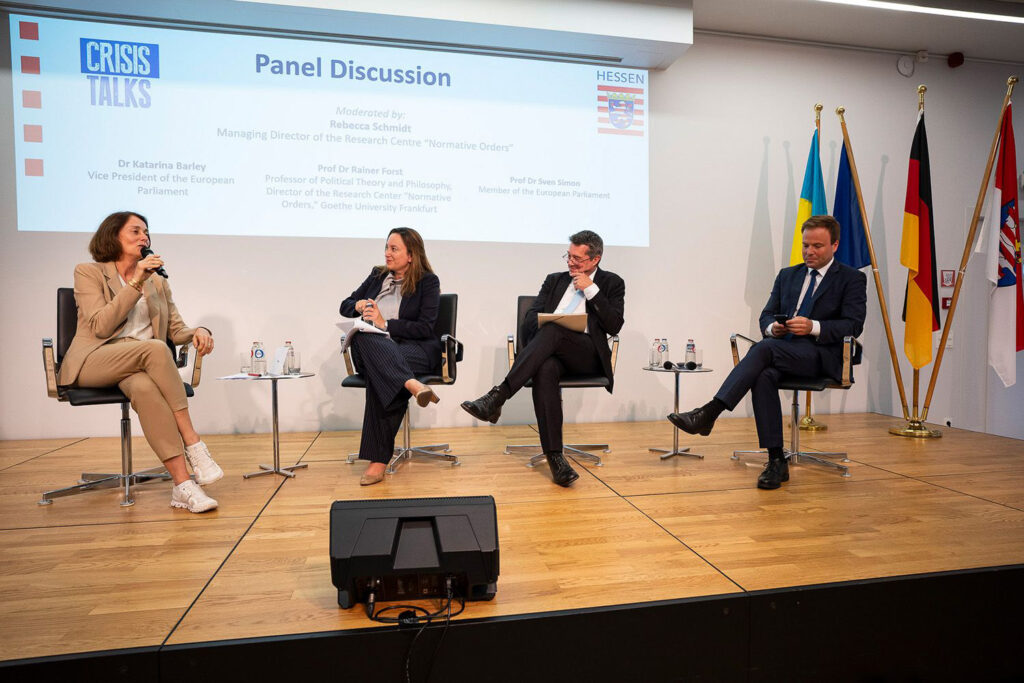
Crisis Talks


Crises have historically been an important driver of change and progress in the EU. In crisis situations, the EU, which is characterized by great heterogeneity and geared towards consensual opinion-forming, has so far mostly been able to create common perceptions, overcome blockades and shape integration. In the Crisis Talks series, the Leibniz Research Alliance “Crises in a Globalized World”, together with Research Centre Normative Orders at Goethe University Frankfurt am Main, is exploring the question of how Europe should deal with its current and past crises.


The discussion series has been organized by the Leibniz Research Alliance “Crises in a Globalized World” and the Hessian State Representation to the EU in Brussels since June 2015. The Leibniz Europe Office and the Research Center for Normative Orders at Goethe University Frankfurt are also involved. PRIF has been the lead coordinator of the Leibniz Research Alliance “Crises in a Globalized World” since 2013.
The events usually take place at the Representation of the State of Hesse to the European Union, Rue Montoyer 21, Brussels, 1000.

Impressions
News from the research center

Event
24.09.2026 | Frankfurt am Main

Die neuen Warlords. Gewaltdynamiken einhegen / Friedensgutachten 2026

Book Presentation

Die imperialistische Großmachtpolitik ändert die Vorzeichen von Krieg, Frieden und Sicherheit. Staaten agieren zunehmend wie Warlords und setzen Krieg als Mittel der Politik ein. Übergänge von Gewaltkonflikten zu Frieden werden als „Deals“ behandelt, Mittelmächte treten mit neuem Selbstbewusstsein, aber ambivalentem Kurs auf, und technologische Innovation verändert Kriege und erschwert die Regulierung. Zugleich befindet sich die internationale Kooperation in der Friedenssicherung in ihrer schwersten Krise. Das Friedensgutachten 2026 analysiert Optionen, dennoch Frieden zu fördern.

weitere Infos ›
Publication
23.07.2026 | Journal article

Governing the Subject of Populism

Biebricher, Thomas: "Governing the Subject of Populism". In: European Journal of Social Theory, OnlineFirst.

more information ›
Publication
15.07.2026 | Monograph

Das Recht der Gewalt. Warum Waffen allein keinen Frieden schaffen

Simon, Hendrik (2026): Das Recht der Gewalt. Warum Waffen allein keinen Frieden schaffen. Ditzingen: Reclam.

more information ›
Publication
10.07.2026 | Anthology

Schnittstellen im Gesundheitsrecht

Kießling, Andrea (Hrsg.) (2026): „Schnittstellen im Gesundheitsrecht“. Nomos.

more information ›
News
19.06.2026

International symposium honours the lifework of Jürgen Habermas

On Friday 19 June 2026, the Research Centre Normative Orders, in collaboration with Suhrkamp Verlag, paid tribute to the late Jürgen Habermas with an international symposium at Goethe University Frankfurt.

more information ›
Publication
13.06.2026 | Monograph

Identitätsbasierte Führung: Vom ICH zum WIR. Als Führungskraft gesunde und leistungsstarke Gruppen, Teams und Organisationen fördern

van Dick, Rolf; Kratzer, Benedik E., Steffens, Niklas K., Kerschreiter, Rudolf (2026): „Identitätsbasierte Führung: Vom ICH zum WIR. Als Führungskraft gesunde und leistungsstarke Gruppen, Teams und Organisationen fördern“. Springer Berlin.

more information ›
Publication
28.05.2026 | Monograph

Rethinking World Order: Political Ordering as Global Ecology

Hellmann, Gunther; Jacobi, Daniel (Hrsg.) (2026): „Rethinking World Order: Political Ordering as Global Ecology”. Bristol University Press

more information ›
Publication
21.05.2026 | Working Paper

EU Law’s Future in a Fraying International Legal Order

Armin von Bogdandy (2026)

more information ›
Publication
19.05.2026 | Journal article

Inclusive messaging from leadership reduces discriminatory attitudes and norms: A mixed-methods social identity analysis of a fitness facility

Cruwys, Tegan; Rathbone, Joanne. A.; Quayle, Anika; Butalia, Radhika; Hardacre, Stephanie. L.; van Dick, Rolf (2026): „Inclusive messaging from leadership reduces discriminatory attitudes and norms: A mixed-methods social identity analysis of a fitness facility”. In: British Journal of Social Psychology, 65.

more information ›