09.02.2026

On the topicality of the concept of violence based on Camus and Derrida

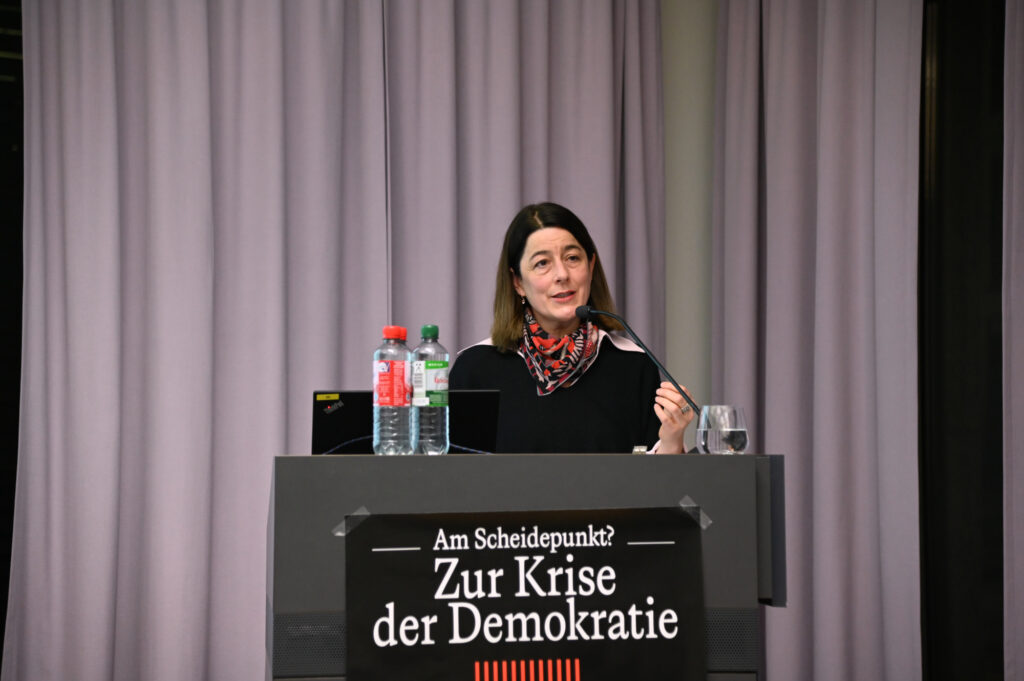
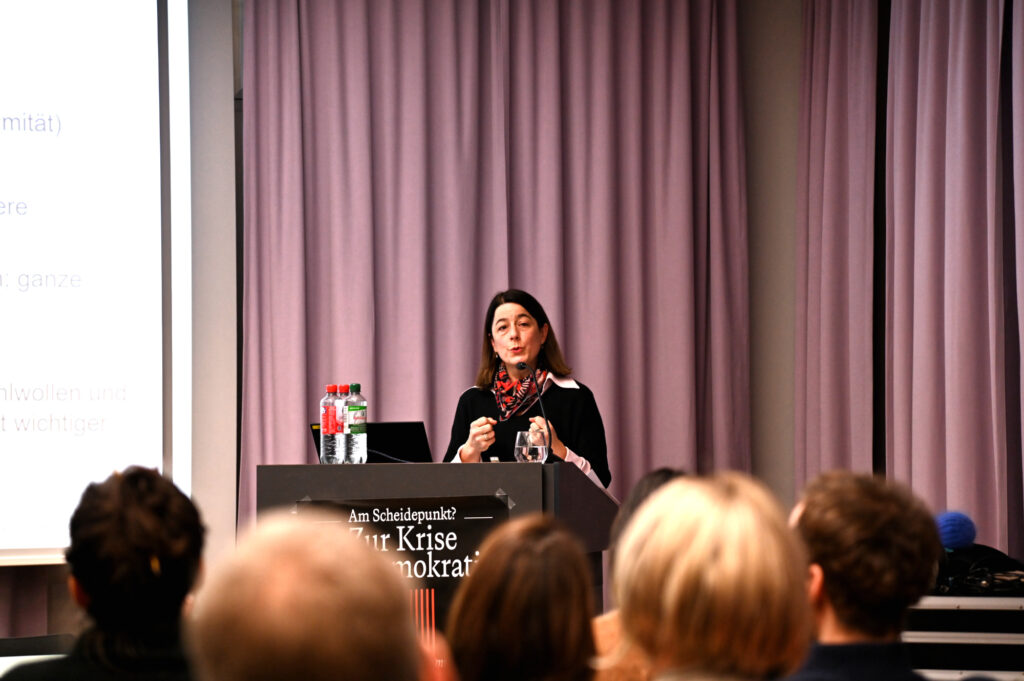
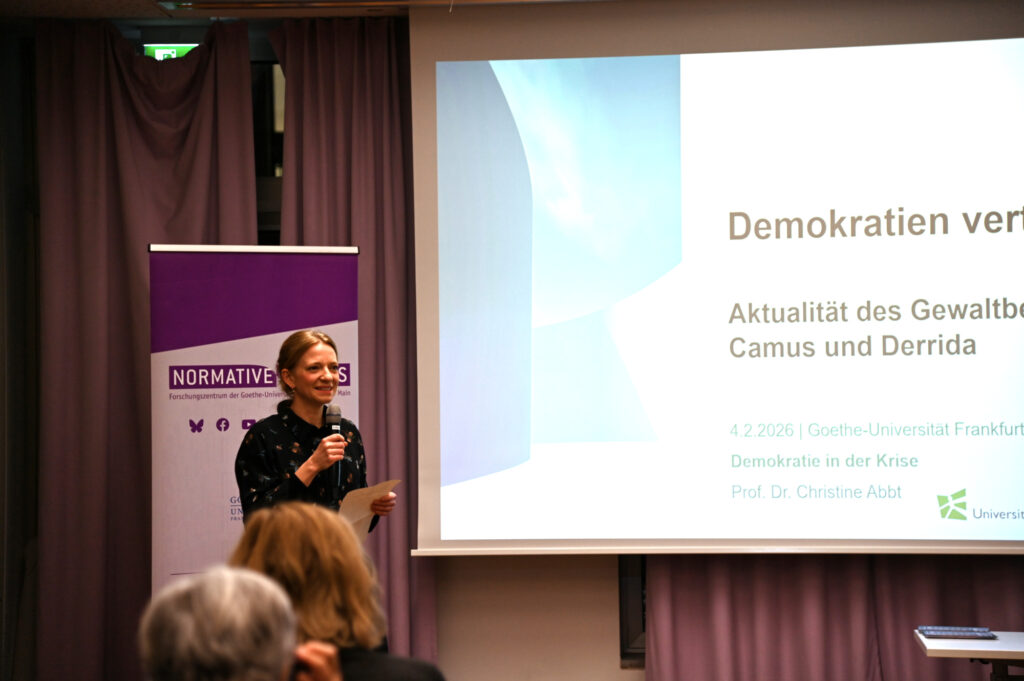
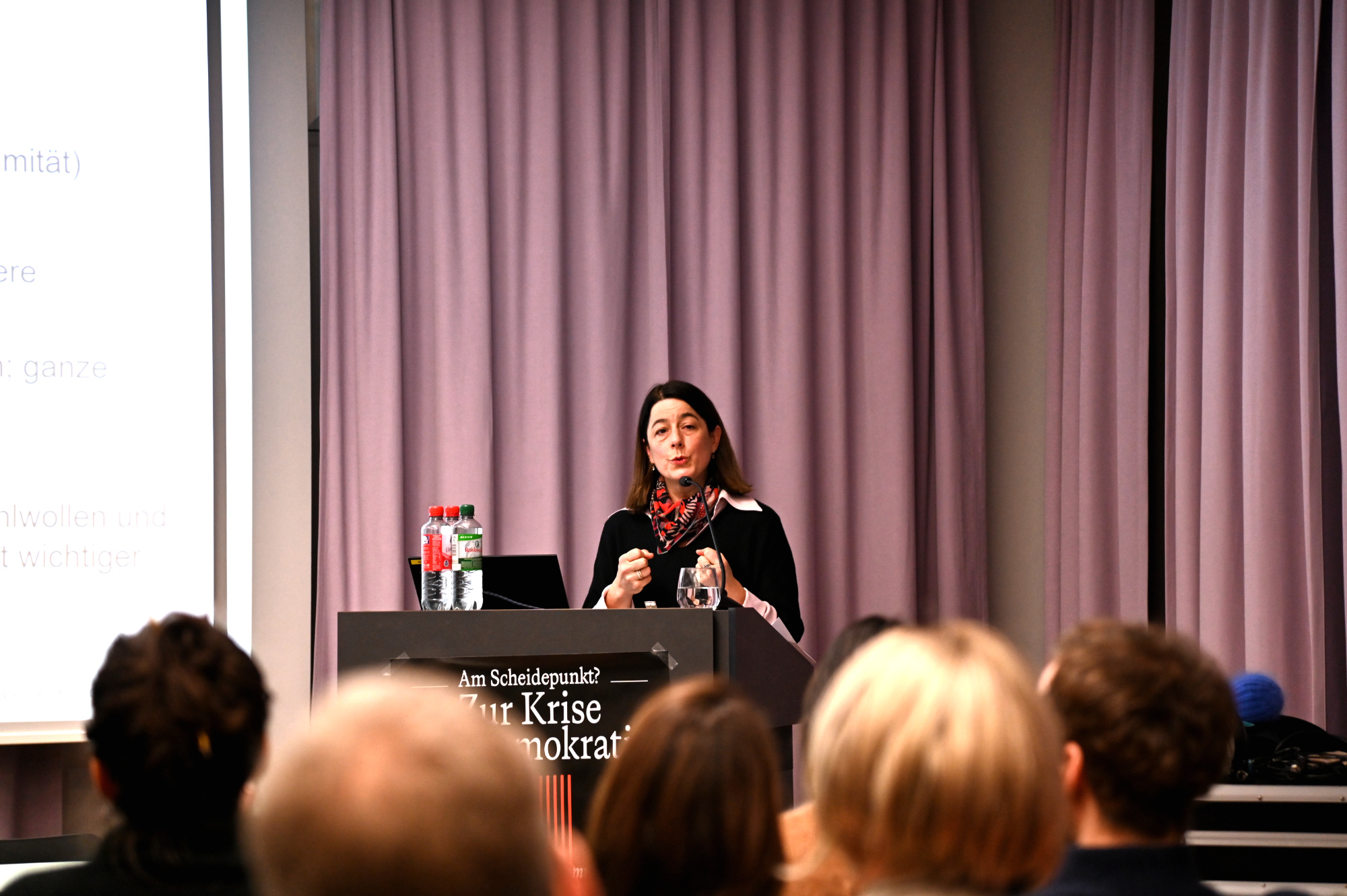
Prof. Dr. Christine Abbt from the University of St. Gallen gave a lecture on democracies and the concept of violence as part of the lecture series “At the crossroads? On the crisis of democracy”, she gave a lecture on democracies and the concept of violence. Under the title “Defending democracies. On the topicality of the concept of violence in Camus and Derrida”, the philosopher discussed forms of violence and revolt and categorized them with regard to a democratic setting.

Abbt began her presentation by focusing on democracy itself. She categorized democracy as an interplay of process and result orientation as well as voluntariness. Important cornerstones of democracy are co-determination, principles, rights and attitudes as well as popular rule on the basis of a free will to belong. With Derrida, she then specified that democracies are characterized by their being-in-coming. There are various tensions – for example freedom/equality, procedure/result, law/justice – which are a characteristic of democracy and cannot be resolved. Rather, according to Abbt with Derrida, they are “tensely related to each other”.
Starting from this premise, Abbt dealt with the defense of democracies by discussing how to deal with totalitarian will to power. To this end, the philosopher used the example of Bertolt Brecht’s “Tales of Mr. Keuner”, among others. Counter-strategies against totalitarianism could be very small and minimal. In fact, these forms are needed so that there can also be larger forms of resistance, whereby an exclusively passive form of resistance is also not enough. Rather, micro and macro levels of forms of resistance must be considered in context. The defense would then consist of allowing the goal of totalitarianism – the eradication of the other – to fail.

This brought Abbt to the primary question of her lecture: Is there a democratic way to defend oneself with violence? First of all, it must be established that violence in democracies is not simply suspended, but that its quality has changed. It is therefore a question of finding a form of violence that can be linked to law and justice in a tense relationship and thus does not resemble totalitarian violence. To explore such a form of violence, Abbt primarily referred to Albert Camus and his concept of revolt from the book “Man in Revolt”. Revolt is to be distinguished from revolution. It is based on the insight into the absurd, as it is both negatively oriented, rejecting, saying no, but nevertheless contains a positive element of defending oneself. Violence in revolt is bound to limits of solidarity that cannot be crossed; unlike in revolution, the end never justifies the means of using violence. Violence is “necessary and unjustifiable”, said Abbot with regard to Camus.

Abbt derived some fundamental characteristics of this type of violence from his study of Camus. Among other things, it is a counter-violence, linked back to something common, includes the willingness to die and kill and contains a ban on torture, mockery, humiliation or capital punishment, as the revolt ends where the power of the other is prevented.

A democratic possibility of violence is therefore a form of “in-between”. Violence, law and justice are neither identical nor opposites. They are tensely related to each other. Abbt made this explicitly clear by distinguishing them from totalitarian, liberal and anarchist orders. Defending democracies then meant resisting policies of hostility, entering into revolt along with its characteristics and always aligning violence with the above-mentioned principles and never understanding it as a legitimate form. Furthermore, the revolt must be self-motivated and must not be forced.
News from the research center

Event
25./26.06.2026 | Frankfurt

Shifting Regimes, Changing Orders

Conference

Conference as part of WDC2026 in collaboration with Deutsche Gesellschaft für Designtheorie und -forschung (DGTF), Kunstgewerbemuseum/Design Campus SKD and Design and Democracy

more information ›
Event
06./07.05.2026 | Frankfurt am Main

Liberalism and the Masses: Revisiting José Ortega y Gasset’s Political Thought

Conference

Two-day Conference with Keynotes by Alan Kahan (University of Versailles/St. Quentin) and Javier Zamora Bonilla (Complutense University of Madrid)

more information ›
Event
04.05.2026 | Frankfurt

Meinungsfreiheit, Meinungsvielfalt und Verantwortung für die Demokratie: Wie gestalten Medien neue Räume für Debatten und Teilhabe?

Panel Discussion

Im Rahmen der Woche der Meinungsfreiheit 2026 laden die World Design Capital Frankfurt RheinMain 2026 in Kooperation mit dem Börsenverein des Deutschen Buchhandels, dem Hessischen Rundfunk, der Stiftung Polytechnische Gesellschaft und dem Forschungszentrum Normative Ordnungen der Goethe-Universität herzlich zu einer Diskussionsveranstaltung am 4. Mai 2026 in den WDC-Hub im Museum Angewandte Kunst Frankfurt ein.

more information ›
Event
29.04.2026 | Frankfurt am Main

Kulturindustrie heute?

Panel Discussion

Das Gespräch „Kulturindustrie heute?“ widmet sich der Aktualität und Tragfähigkeit eines zentralen Begriffs der Kritischen Theorie. Die Filmwissenschaftlerin Gertrud Koch diskutiert im Rahmen der Gesprächsreihe "Frankfurter Schule" mit dem Filmkritiker Bert Rebhandl die gegenwärtigen Formen kultureller Produktion und Verbreitung vor dem Hintergrund von Digitalisierung, Plattformen und globalen Medienmärkten.

more information ›
Event
12.05.2026 | Frankfurt am Main

Zwischen Transformation und Abolitionismus

Book Presentation

Buchvorstellung mit Christine Graebsch, Katrin Höffler, Jochen Bung & Ronen Steinke

more information ›
Event
28./29.05.2026 | Frankfurt am Main

Global Health Justice: Principles and Practice

Conference

Following the research focus of the Global Health Justice Postdoctoral Programme, funded by Höppsche Stiftung, the "Global Health Justice: Principles and Practice" conference places a particular emphasis on themes such as the human right to health, political activism and health justice issues, and problems of structural injustice and vulnerable populations in health care. Keynote lectures by Jonathan Wolff and Kanchana Mahadevan. The Global Health Justice Programme and this conference are supported by the Höppsche Stiftung in Villmar.

more information ›
Event
14.07.2026 | Frankfurt am Main

Democracy Over Time and the Climate Crisis

Lecture Series

Vortrag von Anja Karnein (Binghamton). Die Vortragsreihe untersucht Fragen der Klimakrise als Herausforderungen für demokratische Gesellschaften und konzentriert sich auf Themen wie politische Legitimität, Widerstand gegen fossile Brennstoffe und die Interessen künftiger Generationen. Sie wird organisiert von Prof. Dr. Darrel Moellendorf und Dr. Lukas Sparenborg.

more information ›
Event
10.06.2026 | Frankfurt am Main

Capital Investment, Inequality, and State Power in a Time of Climate Emergency

Lecture, Lecture Series

The lecture series examines questions of the climate crisis as challenges for democratic
societies and focuses on issues of political legitimacy, fossil fuel resistance, and the interests
of future generations.

more information ›
Event
13.05.2026 | Frankfurt am Main

Failed States and Cloudy skies: Tipping Points, Overshoot and Permanent Emergency, after America

Lecture Series

The lecture series examines questions of the climate crisis as challenges for democratic
societies and focuses on issues of political legitimacy, fossil fuel resistance, and the interests
of future generations.

more information ›