

Fellow

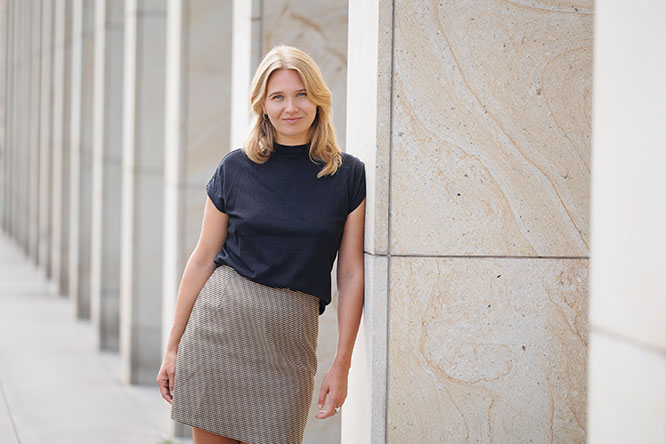
Sonja Riegler

Photo: © Joseph Krpelan

Postdoctoral Fellow at Goethe University

Duration of stay: October 2025 to August 2026

In cooperation with Prof. Dr. Rainer Forst

Funded by Claus Wisser Postdoc Program

Sonja Riegler’s research lies at the intersection of social and political philosophy, feminist epistemology, feminist philosophy of science, and Critical Race Studies. She recently completed her PhD in Philosophy at the University of Vienna. Her dissertation, A Functionalist Approach to Ignorance, supervised by Martin Kusch and Linda Martín Alcoff, develops a novel framework for analyzing socially relevant forms of ignorance, with a central case study on the largely overlooked history of “guest worker” migration to Austria. Her current project advances a critical epistemology of bureaucracy, introducing bureaucracy as a crucial yet underexplored topic in political epistemology, with a particular focus on knowledge practices, forms of expertise, and power asymmetries in bureaucratic encounters.

Research project: How Bureaucracy Knows: Toward a Critical Epistemology of Forms, Rules, and Expertise

Despite its centrality to governance, bureaucracy remains a largely neglected topic in political epistemology. While sociology and political science have analyzed bureaucratic organization and practice in detail (e.g., Weber 1907; Blau 2000; Goodsell 2004; Graeber 2015; Zacka 2017), political epistemologists have paid little attention to the forms of expertise that underpin bureaucratic knowledge and to the epistemic authority exercised by bureaucrats and those who interact with them. This project introduces bureaucracy as a crucial yet underexplored topic in political epistemology (PE), aiming to bring core philosophical questions about expertise, authority, and rule-following into conversation with the everyday epistemic and political dynamics of bureaucratic practice. It develops a new conceptual framework for understanding how knowledge, ignorance, and power operate in bureaucratic institutions. Specifically, I investigate bureaucratic expertise as a distinct form of institutional practical knowledge, contrasting it with scientific expertise, and explore how epistemic authority is unevenly distributed between bureaucrats and service users. Drawing on the philosophical literature on rule following (Wittgenstein 1969, Daston 2022, Graeber 2015) and work in the sociology of classification (e.g., Hacking 1984) and standardization (Scott 1998), the project also investigates how bureaucrats’ epistemic and moral agency is shaped by institutional rules, professional norms, and value commitments.


Events

7.11.2025 “A Functionalist Approach to Ignorance”, Talk at Workshop on Novel Approaches in Epistemologies of Ignorance, TU Dresden (organized by Jana Stern)

13.11.2025 “Group Ignorance in Science – An Interactionist Account”, Talk at SW*IP Jahrestagung 2025, Wissenschaft, Philosophie und Öffentlichkeit

18.11.2025 “Bureaucracy and Expertise”, Talk at Forschungskolloqium Rainer Forst

22.1.2026 Talk and Organization of Workshop on Feminist Epistemology, with Frieder Vogelmann and Katharina Hoppe, University of Vienna

March 2026: Referentin bei der Österreichischen Philosophie Olympiade, Bundeswettbewerb

  • Publikationen

    Riegler, Sonja & Veigl, Sophie: “Meaning Dominance: When Polysemy Creates Hermeneutical Oppression”, submitted to Social Epistemology (R&R) Riegler, Sonja (forthcoming): “Interference By Whom? Advocating for Experience-Based Forms of Expertise in Debates on Epistemic Paternalism”, in: Samarzija, H, McKenna, R (Eds.), The European Face of Political Epistemology, Basingstoke: Palgrave MacMillan Riegler, Sonja (2023): “A Space Yet to Be Filled (By Whom?) – Ignorance as an Institutional and Interpersonal Practice”, in: Heinrich K, Robles F (Eds.), Addressing Amnesia, Performing Trauma, Vienna: Edition Angewandte, 100-108 Riegler, Sonja (2022): “Wissen im Widerspruch, Wissen als Widerspruch – Umriss einer ambivalenten Beziehung“, in: Adrienne N, Gabriel M, Gmainer-Pranzl F (Hrsg.): Das Politische der Wissenschaft, Band 18, Berlin: Peter Lang Verlag, 331-347

News from the research center

Event
08.07.2026 | Frankfurt am Main

Krisenhafter Wandel der Gegenwart. Einige soziologische Beobachtungen

Lecture

Der Vortrag von Prof. Dr. Steffen Mau beschäftigt sich mit den Krisensymptomen des liberalen Gesellschaftmodells. Krisenhafter sozialer Wandel ist dadurch zu charakterisieren, dass er nicht allmählich, sondern abrupt vor sich geht und zur Destabilisierung bestehender Institutionen, Ordnungen und Normen führt. Zugleich sollte er von den Menschen auch als krisenhaft erlebt werden und mit Orientierungslosigkeit, Vertrauensverlust und erhöhten Spannungen einhergehen. Der Vortrag findet im Rahmen der Kantorowicz Lectures in Political Language statt.

more information ›
Event
18.04.2026 | Frankfurt am Main

Das Prinzip Donald Trump und die Verrohung der Welt

Panel Discussion, Lecture

Ein neuer Politikstil macht international Karriere. Er ist gekennzeichnet von Vulgarität, Verrohung und erklärter Rechtsfeindschaft. Machtinteressen werden nicht mehr juristisch bemäntelt. Stattdessen wird das angebliche Recht des Stärkeren zur Staatsdoktrin gemacht – innenpolitisch wie außenpolitisch. Treibende Kraft hinter dieser Verrohung der politischen Sitten ist ein US-Präsident, der nicht nur die amerikanische Gesellschaft und Kultur, sondern auch die globale Ordnung nach seinen Vorstellungen und Interessen umgestaltet. Die Römerberggespräche wollen diesen Politikstil verstehen.

more information ›
Event
29.04.2026 | Frankfurt am Main

Kulturindustrie heute?

Panel Discussion

Das Gespräch „Kulturindustrie heute?“ widmet sich der Aktualität und Tragfähigkeit eines zentralen Begriffs der Kritischen Theorie. Die Filmwissenschaftlerin Gertrud Koch diskutiert im Rahmen der Gesprächsreihe "Frankfurter Schule" mit dem Filmkritiker Bert Rebhandl die gegenwärtigen Formen kultureller Produktion und Verbreitung vor dem Hintergrund von Digitalisierung, Plattformen und globalen Medienmärkten.

more information ›
Event
20.03.2026 | Frankfurt am Main

40 Jahre Schengen-Raum

Colloquium

Der 1984 geschlossene Schengen-Vertrag schuf einen heute 29 Staaten umfassenden Raum ohne Binnengrenzen, doch Migration über die Außengrenzen führte zuletzt zur Wiedereinführung von Kontrollen, auch durch die Bundesregierung ab 8. Mai 2025. Das Walter Hallstein-Kolloquium diskutiert die rechtliche Zulässigkeit, wirtschaftliche Folgen insbesondere für Arbeitsmigration und Arbeitsmarkt sowie die Zukunft des Schengen-Raums.

more information ›
News
12.02.2026

Satanist politics and the decline of reason in liberal democracies

For the last time in the winter semester 2025/26, the Research Center hosted the lecture series "Am Scheidepunkt. On the crisis of democracy". At the end, philosopher Michael Rosen from Harvard University presented his concept of "satanic politics" as a variant of the political interpretation of the world.

more information ›
News
09.02.2026

On the topicality of the concept of violence based on Camus and Derrida

Prof. Dr. Christine Abbt from the University of St. Gallen gave a lecture on democracies and the concept of violence as part of the lecture series "At the crossroads? On the crisis of democracy", she gave a lecture on democracies and the concept of violence. Under the title "Defending democracies. On the topicality of the concept of violence in Camus and Derrida", the philosopher discussed forms of violence and revolt and categorized them with regard to a democratic setting.

more information ›
Publication
04.02.2026 | Journal article

New Perspectives on Trust in International Conflicts

Wille, Tobias; Simon, Hendrik; Daase, Christopher; Deitelhoff, Nicole; Wheeler, Nicholas J.; Holmes, Marcus; Rathbun, Brian C.; Acharya, Amitav; Mitzen, Jennifer (2026): „New Perspectives on Trust in International Conflicts“. In: International Studies Review 28 (1), viaf027.

more information ›
News
02.02.2026

States competing for people - David Owen on civil geopolitics

As part of the lecture series "At the Crossroads - The Future of Democracy", David Owen from the University of Southampton presented his concept of civil geopolitics.

more information ›
News
20.01.2026

Christine Hentschel on reorientation in catastrophic times

As part of the lecture series "At the crossroads? On the crisis of democracy", the sociologist spoke about living in and dealing with catastrophic times. Against the backdrop of the destruction of living conditions, wars, permanent crises and threats to democracy, Hentschel addressed the infiltration of the catastrophic into everyday social life and a changing activist and literary approach to the future.

more information ›