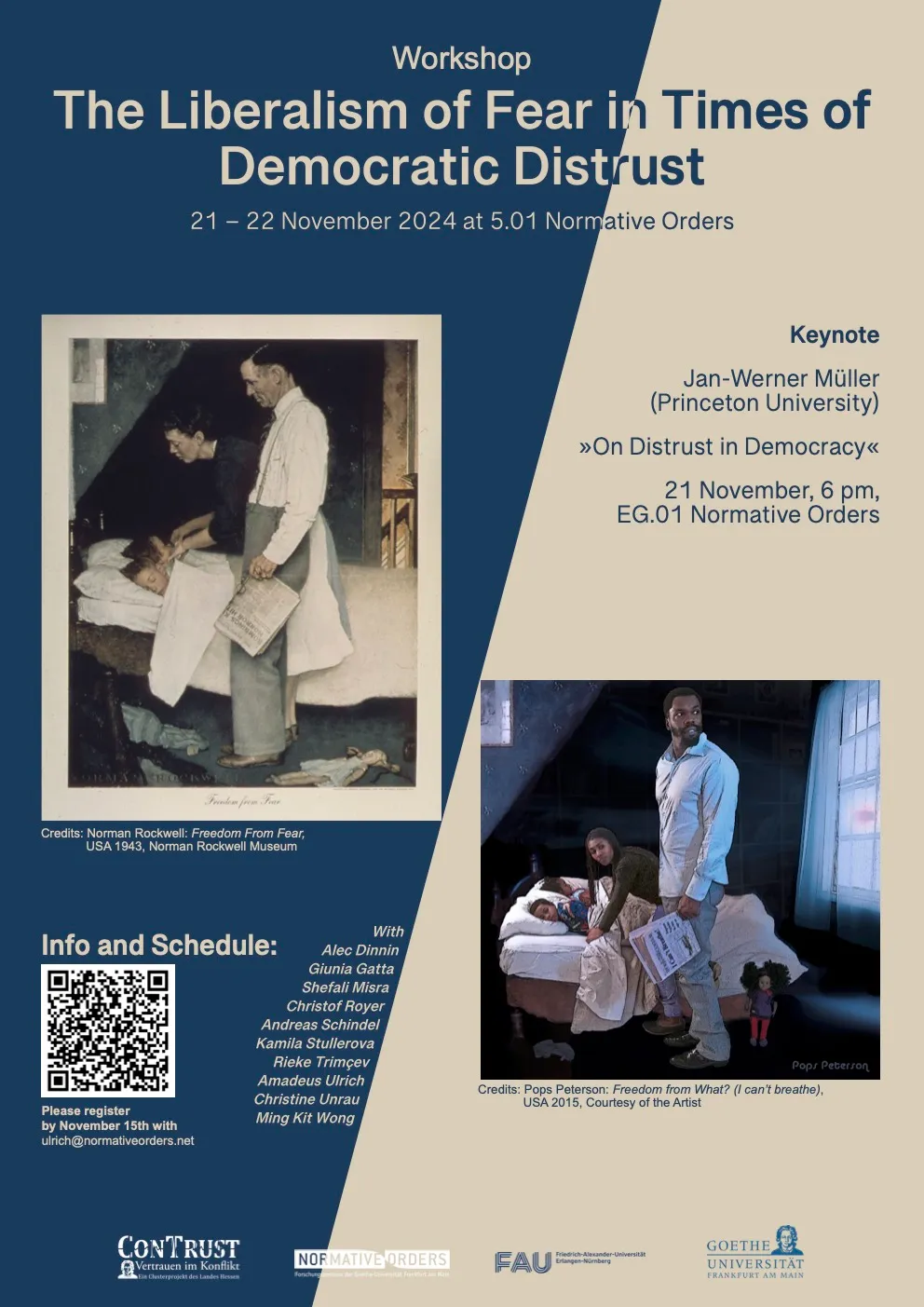

The Liberalism of Fear in Times of Democratic Distrust
Workshop with Keynote
“By now it is only too well known,” wrote Judith N. Shklar in her first book, After Utopia, “that democracy is not inevitable, that it may be destroyed from within, and that even the most successful constitutional democracies are not the models of social perfection that the Enlightenment had dreamed about.” In her later writings on the liberalism of fear, the sense of injustice, and American political thought, Shklar has undertaken manifold analyses of the auto-destructive dynamics within liberal democracies. One may, for example, think of her reflections on snobbery, social inequality, and the perils of personalized politics in Ordinary Vices, her focus on phenomena such as “passive injustice” in The Faces of Injustice, or her examination of the ambiguities of “citizenship as standing” in American Citizenship. All of these phenomena can be sources of distrust in a democratic system that, as Shklar noted, is always characterized by a fine balance between trust and distrust. In fact, many of her writings can be read as an exercise of judgment aimed at distinguishing productive and destructive potentials of democratic distrust.
Yet in many ways, her critique of utopianism and transformative ideals of engaged citizenship as well as her claim that the liberalism of fear and democracy are in a mere “marriage of convenience” have overshadowed the versatility of her analyses of the workings and value of democracy, both as an institutional system and a form of everyday life. Scholars who are rereading her work have only recently begun to pay more heed to the democratic theory of her liberalism. This workshop ties into this trend. It takes a more in-depth look at Shklar as a democratic theorist and at the democratic theory of the liberalism of fear as it may be developed with and beyond her. At a time of uncertainty when liberal democracy finds itself under serious pressure from authoritarian populism, polarization, and ideological illusions of the heart and the head, her political thought holds out the promise to offer some alternative resources for democratic theory.
But what are these resources? The workshop brings together experts on the liberalism of fear and theorists of democracy to address this question from multiple angles. For example, we will discuss why Shklar held that distrust and the reflexive “fear of fear” can be productive forces to defend democratic institutions. Besides, we examine one of her most important ideas, namely that, as she put it in The Faces of Injustice, “democracy should respect the sense of injustice and grant it considerable scope.” In her view, victims of injustice have a right to be heard. But what are the potentials and problems of focusing on victimhood in democratic theory? How can we be sure about whose voices to trust, both for moral and epistemic reasons?
In the face of a widely diagnosed “crisis of democracy,” calls for more trust and social cohesion are commonplace. In his keynote ‘On Distrust in Democracy’ on the first day of the workshop, Prof. Dr. Jan-Werner Müller (Princeton University) will ask in what sense democracy is a matter of trust. Might distrust and skepticism also have their place in democratic politics? And if so, what should these attitudes be like not to undermine and even strengthen democracies and the processes through which conflicts and disagreement are dealt with? Müller is one of the most important political theorists of his generation. He works on the history of modern political thought, liberalism and its critics, populism, the elements of what he calls the “critical infrastructure” of democracies, and the normative dimensions of European integration. He has been teaching in the Politics Department of Princeton University since 2005, where he also founded the Forum for the History of Political Thought. Before, he held fellowships at All Souls College and the European Studies Centre in Oxford. Some of his most well-known publications include Constitutional Patriotism (Princeton UP), Contesting Democracy (Yale UP), What Is Populism? (University of Pennsylvania Press), Furcht und Freiheit (Suhrkamp) and Democracy Rules (FSG and Penguin).
The keynote will be chaired by Prof. Dr. Rainer Forst.
Registration by November 15th at ulrich@normativeorders.net
SCHEDULE
Thursday 21st November
13:30 – 14:00
Arrival at Building ‘Normative Ordnungen’, Room 5.01
14:00 – 14:15
Welcome & Introduction
Rieke Trimçev (Erlangen) and Amadeus Ulrich (Frankfurt)
14:15 – 15:45
Panel I
Kamila Stullerova (Aberystwyth): ‘The Democracy of Fear: On Judith Shklar’s Engagement of Fear as a Way of Addressing Democracies’ Illiberal Tendencies’
Andreas Schindel (Frankfurt): ‘Fear and Compassion: Shklar’s Political Psychology’
Discussant: Greta Wagner (Frankfurt)
15:45 – 16:00
Coffee break
16:00 – 17:30
Panel II
Guinia Gatta (Bocconi): ‘On Democracy’s Convenience: Thinking with Shklar about Liberalism, Standing, and Voice’
Shefali Misra (St. Michael’s College, hybrid): ‘The Liberalism of the Fear of Irrationality’
Discussant: Sandra Seubert (Frankfurt)
17:30 – 18:00
Coffee break
18:00 – 19:45
Keynote lecture (in the Building ‘Normative Ordnungen’, Room EG.01)
Jan-Werner Müller (Princeton): ‘On Distrust in Democracy’
Chair: Rainer Forst (Frankfurt)
More here…
Friday 22nd November
09:00 – 10:30
Panel III
Christine Unrau (Duisburg-Essen): ‘The Only Unforgivable Sin? Thinking with Shklar about Hypocrisy, Suspicion and the Public Display of Emotions’
Christof Royer (Vienna): ‘Shklar and the “Free Speech vs Critical Social Justice” Debate’
Discussant: Jan-Werner Müller (Princeton)
10:30 – 10:45
Coffee break
10:45 – 12:15
Panel IV
Alec Dinnin (Frankfurt): ‘Dystopian Distrust: Shklar, Orwell, and the Undoing of Democracy’
Ming Kit Wong (Oxford): ‘A Non-Utopian Tradition: Judith Shklar and the Historiography of American Liberal Democracy’
Discussant: Chiara Destri (Frankfurt)
12:15 – 13.30
Lunch
13:30 – 15:00
Panel V
Amadeus Ulrich (Frankfurt): ‘Democratic Misanthropy’
Rieke Trimçev (Erlangen): ‘The Sense of Injustice as the Principle of Liberal Democracy’
Discussant: Veith Selk (Darmstadt)