African Boats and Scenes of Mourning in the Postcolonial Black Atlantic
Lecture by Ayo Coly (Dartmouth) with a screening of “The Pirogue” (2013).
Lecture series: Racism in the police - empirical findings, methodological approaches and controversies Lecture by: Prof. Dr. Astrid Jacobsen (IKRIS / Police Academy of Lower Saxony) Reports from people affected by racism about unprovoked police checks, humiliation or problematic use of force by the police continue unabated. They occupy the public debate; numerous political initiatives […]
Lecture as part of the series "Shaping the future - between climate change, technology and social responsibility" Lecture by Prof. Dr. Gabriele Britz (Professor of Public Law at Goethe University, former judge of the Federal Constitutional Court) As part of the exhibition "FIXING FUTURES: Planetary Futures between Speculation and Control", the MGGU - Museum Giersch […]
Vortrag von Jeffrey Kopstein Professor der Politikwissenschaft an der University of California, Irvine) über die Gefahr einer Erosion des Staates und Wege gegen den Trend zur Zerstörung.
Lecture & Film "Black Atlantic Cinema" Lecture: Femi Shaka (Port Harcourt) Paul Gilroy's seminal work, The Black Atlantic (1993), is cardinal to an understanding of the "ideas of the nation, nationality, national belonging, and nationalism" as experienced by blacks in the diaspora. But as Zeleza (2005) noted, "Gilroy's central concern was to deconstruct the idea […]
Impuls von Prof. Dr. Nicole Deitelhoff mit anschließender Podiumsdiskussion
Book presentation DUE TO THE EXPECTED HEAT AND THE SEVERE WEATHER WARNING FROM THE GERMAN WEATHER SERVICE, WE UNFORTUNATELY HAVE TO CANCEL THE EVENT. IT WILL BE RESCHEDULED IN THE FALL. Lecture by Prof. Dr. Stefanie Schüler-Springorum (spokesperson of the RISC Berlin site) followed by a discussion with Prof. Dr. Dr. Michel Friedman (lawyer and […]
Lecture & Film "Black Atlantic Cinema" Lecture: Jessica Gordon-Burroughs (Edinburgh) Lecture: Diasporic Aesthetics, Intermedial Dialogues. The films of Nicolás Guillé Landrián Afro-Cuban filmmaker and artist Nicolás Guillén Landrián's final cinematic work in exile, Inside Downtown, co-directed with Jorge Egusquiza, has barely been discussed in the growing critical literature on his oeuvre. This omission points to […]
Lecture series: Racism in the police - empirical findings, methodological approaches and controversies Leonie Fuchs (NaDiRa / DeZIM Institute) Reports from people affected by racism about unprovoked police checks, humiliation or problematic use of force by the police continue unabated. They occupy the public debate; numerous political initiatives have been fighting for clarification, in some […]
Ein neuer Politikstil macht international Karriere. Er ist gekennzeichnet von Vulgarität, Verrohung und erklärter Rechtsfeindschaft. Machtinteressen werden nicht mehr juristisch bemäntelt. Stattdessen wird das angebliche Recht des Stärkeren zur Staatsdoktrin gemacht – innenpolitisch wie außenpolitisch. Treibende Kraft hinter dieser Verrohung der politischen Sitten ist ein US-Präsident, der nicht nur die amerikanische Gesellschaft und Kultur, sondern auch die globale Ordnung nach seinen Vorstellungen und Interessen umgestaltet. Die Römerberggespräche wollen diesen Politikstil verstehen.
more information ›Das Gespräch „Kulturindustrie heute?“ widmet sich der Aktualität und Tragfähigkeit eines zentralen Begriffs der Kritischen Theorie. Die Filmwissenschaftlerin Gertrud Koch diskutiert im Rahmen der Gesprächsreihe "Frankfurter Schule" mit dem Filmkritiker Bert Rebhandl die gegenwärtigen Formen kultureller Produktion und Verbreitung vor dem Hintergrund von Digitalisierung, Plattformen und globalen Medienmärkten.
more information ›Der 1984 geschlossene Schengen-Vertrag schuf einen heute 29 Staaten umfassenden Raum ohne Binnengrenzen, doch Migration über die Außengrenzen führte zuletzt zur Wiedereinführung von Kontrollen, auch durch die Bundesregierung ab 8. Mai 2025. Das Walter Hallstein-Kolloquium diskutiert die rechtliche Zulässigkeit, wirtschaftliche Folgen insbesondere für Arbeitsmigration und Arbeitsmarkt sowie die Zukunft des Schengen-Raums.

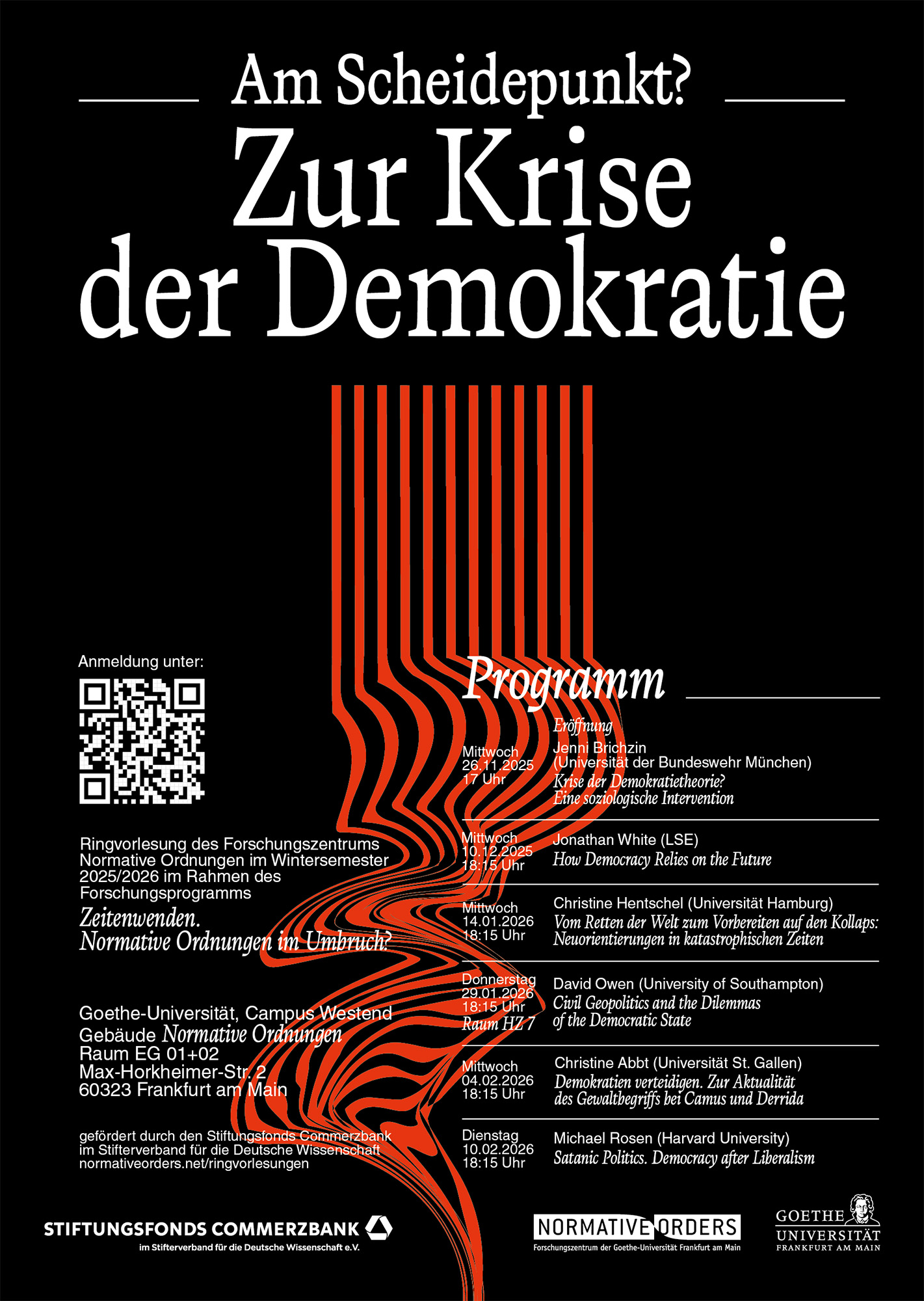
more information ›For the last time in the winter semester 2025/26, the Research Center hosted the lecture series "Am Scheidepunkt. On the crisis of democracy". At the end, philosopher Michael Rosen from Harvard University presented his concept of "satanic politics" as a variant of the political interpretation of the world.
more information ›Prof. Dr. Christine Abbt from the University of St. Gallen gave a lecture on democracies and the concept of violence as part of the lecture series "At the crossroads? On the crisis of democracy", she gave a lecture on democracies and the concept of violence. Under the title "Defending democracies. On the topicality of the concept of violence in Camus and Derrida", the philosopher discussed forms of violence and revolt and categorized them with regard to a democratic setting.
more information ›Wille, Tobias; Simon, Hendrik; Daase, Christopher; Deitelhoff, Nicole; Wheeler, Nicholas J.; Holmes, Marcus; Rathbun, Brian C.; Acharya, Amitav; Mitzen, Jennifer (2026): „New Perspectives on Trust in International Conflicts“. In: International Studies Review 28 (1), viaf027.
more information ›As part of the lecture series "At the Crossroads - The Future of Democracy", David Owen from the University of Southampton presented his concept of civil geopolitics.
more information ›As part of the lecture series "At the crossroads? On the crisis of democracy", the sociologist spoke about living in and dealing with catastrophic times. Against the backdrop of the destruction of living conditions, wars, permanent crises and threats to democracy, Hentschel addressed the infiltration of the catastrophic into everyday social life and a changing activist and literary approach to the future.
more information ›Bucher-Koenen, Tabea; Hackethal, Andreas; Koenen, Johannes; Laudenbach, Christine (2025): „Gender Differences in Financial Advice“. In: American Economic Review, 115 (12), pp. 4218–4252.
more information ›