
Loading Events
  • This event has passed.
16.12.2024 | Frankfurt
Conference

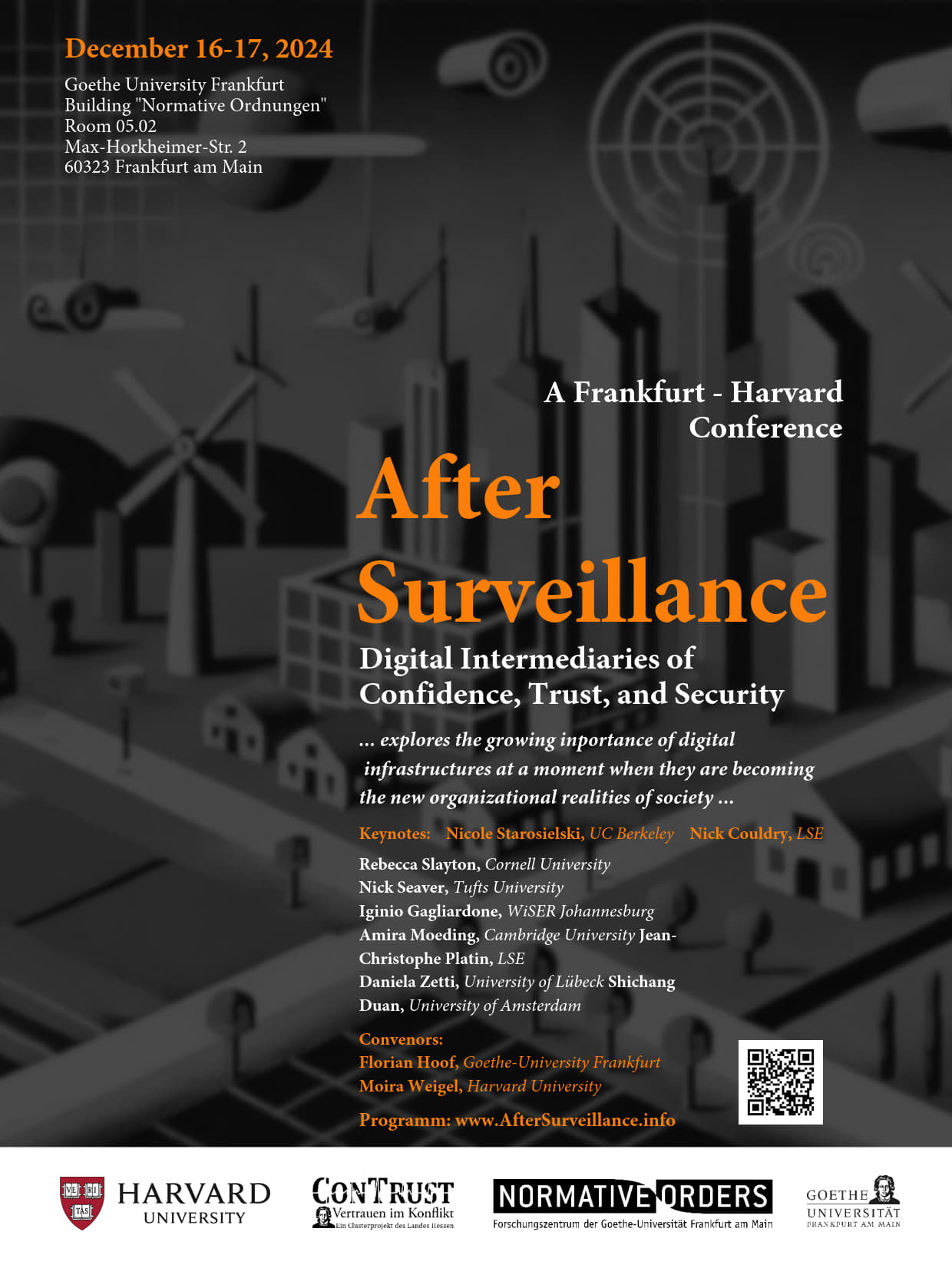
After Surveillance. Digital Intermediaries of Trust, Confidence, and Security

Conference with two keynotes by Nicole Starosielski, UC Berkeley and Nick Couldry, LSE

Surveillance capitalism, platform capitalism, data colonialism. Over the past decade, scholars have coined a spate of new terms that attempt to periodize our present. But what if data extraction capitalism as we know it has already peaked? What if its seemingly powerful and robust digital platforms, logistical infrastructures, and market dominance do not herald a new era, but rather a transitional period marked by security breaches, precarious business models, waste of energy, and loss of trust? What if we think of our current situation as repercussions of the long 20th century and its Western modes of logistics, distribution, and audience research, but one that is slowly fading away? What comes next as they give way to new global digital fabrics that operate on their own terms? How does society’s reliance on digital media and networks translate into new, distributed forms of accountability and trust? And what are the theoretical implications of approaching today’s global digital society as unstable, crisis-ridden, and transitional?

“After Surveillance” explores the growing importance of digital intermediaries and mediation processes at a moment when they are becoming the new organizational realities of society. The conference brings together new comparative and global approaches to theorizing digital intermediaries in their own terms as ways of creating, maintaining, and disrupting coherence and trust. This perspective connects to a rich interdisciplinary field in media studies, infrastructure studies, and social theory. Concepts such as logistical media (Hockenberry et al. 2021; Peters 2015), digital media distribution (McDonald et al. 2021), (media) infrastructures (Parks & Starosielski 2015; Larkin 2008, Edwards 2002), maintenance (Graham & Thrift 2007), cultures of risk, trust and security (Goerzen and Coleman, 2022; Bodó 2021; Galison 2010; MacKenzie 2001), or coproduction (Jasanoff 2004) offer ways of understanding digital intermediaries as media that organize and mediate (Beyes et al. 2022; Hoof & Boell 2019) while also emphasizing the ephemerality of such entanglements.

In this regard, “After Surveillance” focuses on the basic socio-material structures that underpin and shape how digital entanglements are organized, how they are kept trustworthy and secure-or not. It pays attention to how digital technologies are refracted, deployed, mediated by, and mediate existing social forms and practices. Specifically, the conference will explore: intermediaries of trust-building and securitization; geographies and discourses of digital (mis)trust; socio-material imbrications of digital technology in pre-existing institutions and relations; new conceptual frameworks for describing current developments and processes; new proposals for historicizing, naming, and periodizing the present. The focus on digital intermediaries offers new ways of analyzing and understanding how institutions, infrastructures, discourses, standards, technologies, business practices, and networks give way to new global geographies, and how digital entanglements are kept entangled, but also how this gives rise to fundamental threads that shape the conditions of our lives.

The conference is jointly funded and organized by Goethe University Frankfurt and Harvard University and will take place on December 16-17 in Frankfurt.

More on the event on its website aftersurveillance.info

Organizers
Harvard University, ConTrust and Normative Orders
News from the research center

Event
18.04.2026 | Frankfurt am Main

Das Prinzip Donald Trump und die Verrohung der Welt

Panel Discussion, Lecture

Ein neuer Politikstil macht international Karriere. Er ist gekennzeichnet von Vulgarität, Verrohung und erklärter Rechtsfeindschaft. Machtinteressen werden nicht mehr juristisch bemäntelt. Stattdessen wird das angebliche Recht des Stärkeren zur Staatsdoktrin gemacht – innenpolitisch wie außenpolitisch. Treibende Kraft hinter dieser Verrohung der politischen Sitten ist ein US-Präsident, der nicht nur die amerikanische Gesellschaft und Kultur, sondern auch die globale Ordnung nach seinen Vorstellungen und Interessen umgestaltet. Die Römerberggespräche wollen diesen Politikstil verstehen.

more information ›
Event
29.04.2026 | Frankfurt am Main

Kulturindustrie heute?

Panel Discussion

Das Gespräch „Kulturindustrie heute?“ widmet sich der Aktualität und Tragfähigkeit eines zentralen Begriffs der Kritischen Theorie. Die Filmwissenschaftlerin Gertrud Koch diskutiert im Rahmen der Gesprächsreihe "Frankfurter Schule" mit dem Filmkritiker Bert Rebhandl die gegenwärtigen Formen kultureller Produktion und Verbreitung vor dem Hintergrund von Digitalisierung, Plattformen und globalen Medienmärkten.

more information ›
Event
20.03.2026 | Frankfurt am Main

40 Jahre Schengen-Raum

Colloquium

Der 1984 geschlossene Schengen-Vertrag schuf einen heute 29 Staaten umfassenden Raum ohne Binnengrenzen, doch Migration über die Außengrenzen führte zuletzt zur Wiedereinführung von Kontrollen, auch durch die Bundesregierung ab 8. Mai 2025. Das Walter Hallstein-Kolloquium diskutiert die rechtliche Zulässigkeit, wirtschaftliche Folgen insbesondere für Arbeitsmigration und Arbeitsmarkt sowie die Zukunft des Schengen-Raums.

more information ›
News
12.02.2026

Satanist politics and the decline of reason in liberal democracies

For the last time in the winter semester 2025/26, the Research Center hosted the lecture series "Am Scheidepunkt. On the crisis of democracy". At the end, philosopher Michael Rosen from Harvard University presented his concept of "satanic politics" as a variant of the political interpretation of the world.

more information ›
News
09.02.2026

On the topicality of the concept of violence based on Camus and Derrida

Prof. Dr. Christine Abbt from the University of St. Gallen gave a lecture on democracies and the concept of violence as part of the lecture series "At the crossroads? On the crisis of democracy", she gave a lecture on democracies and the concept of violence. Under the title "Defending democracies. On the topicality of the concept of violence in Camus and Derrida", the philosopher discussed forms of violence and revolt and categorized them with regard to a democratic setting.

more information ›
Publication
04.02.2026 | Journal article

New Perspectives on Trust in International Conflicts

Wille, Tobias; Simon, Hendrik; Daase, Christopher; Deitelhoff, Nicole; Wheeler, Nicholas J.; Holmes, Marcus; Rathbun, Brian C.; Acharya, Amitav; Mitzen, Jennifer (2026): „New Perspectives on Trust in International Conflicts“. In: International Studies Review 28 (1), viaf027.

more information ›
News
02.02.2026

States competing for people - David Owen on civil geopolitics

As part of the lecture series "At the Crossroads - The Future of Democracy", David Owen from the University of Southampton presented his concept of civil geopolitics.

more information ›
News
20.01.2026

Christine Hentschel on reorientation in catastrophic times

As part of the lecture series "At the crossroads? On the crisis of democracy", the sociologist spoke about living in and dealing with catastrophic times. Against the backdrop of the destruction of living conditions, wars, permanent crises and threats to democracy, Hentschel addressed the infiltration of the catastrophic into everyday social life and a changing activist and literary approach to the future.

more information ›
Publication
08.01.2026 | Journal article

Gender Differences in Financial Advice

Bucher-Koenen, Tabea; Hackethal, Andreas; Koenen, Johannes; Laudenbach, Christine (2025): „Gender Differences in Financial Advice“. In: American Economic Review, 115 (12), pp. 4218–4252.

more information ›