

Former Fellow

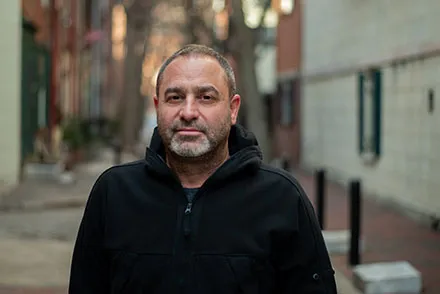
Ra’anan Alexandrowicz

Photo by Zachary Reese

Duration of stay: 29 January – 20 February 2025

In cooperation with Prof. Dr. Vinzenz Hediger

Funded by University of Pennsylvania Center for Experimental Ethnography and ConTrust

Ra’anan Alexandrowicz is an Israeli filmmaker and writer now living in Philadelphia, PA. His award-winning work seeks to make the invisible visible and challenge political and formal conventions. Ra’anan’s most recent film is The Viewing Booth, an in-depth study of how a young pro-Israeli American viewer sees images of abuse of Palestinian rights, which premiered at the 2020 Berlin Film Festival. He is best known for The Law in These Parts (2011), which exposes the existence of a parallel legal system in Israel that applies only to Palestinians living under Israeli military occupation, and which received the Grand Jury Prize at the Sundance Film Festival and a Peabody Award. His earlier documentaries, The Inner Tour (2001), which follows a group of Palestinians on a bus tour through the state of Israel, and Martin (1999), which tells the controversial story of a Dachau concentration camp survivor, were shown at the Berlin Film Festival and in MoMA’s New Directors/New Films. Alexandrowicz’s sole fiction feature, James’ Journey to Jerusalem (2003), a dark comedy about a devout young African man who attempts a pilgrimage to the Holy Land, premiered in Cannes’ Directors’ Fortnight and at the Toronto Film Festival, and received several international awards.

Research project: 1 Land 2 Cinemas

In 1896 two unrelated events happened. In Vienna Theodore Herzel published the essay Der Judenstaat. In Paris, the Lumiere Brothers released their invention the Cinematograph. Since then, the history of the Israeli Palestinian conflict has been entangled with the history of cinema. From the emergence of early Zionist cinema, through the first decades of Israeli cinema, continuing with the film units of the Palestine Liberation organization and all the way to the unchecked release of images from the current war- over the last century two separate cinematic traditions developed in Palestine/Israel. Sometimes negating and sometimes complimenting each other, Israeli and Palestinian cinemas make up a unique case in which there are two separate cinemas for one land. The 1L2C research team, will explore cinematic objects[1] and historical facts, deconstruct and evaluate narratives and myths that enable it. The team will study and scrutinize the two cinema histories, follow the parallels and reflections and ask ourselves, if cinema is a reflection of the painful reality of the conflict or one of the drivers of it?


[1] The term Cinema is used here in an expansive way. Cinematic objects include type of moving image in any form and mode of viewership. From features and documentary films, through news, old “Super 8” home movies, all the way to YouTube and TikTok videos. Short, long, viral or buried in archives and never yet seen all are part of the medium for the purpose of this research.

Events

The Record and the Narrative. The Documentary Cinema of Ra’anan Alexandrowicz

Tuesday, February 11, 2025, 8 p.m.
The Law in These Parts

Wednesday, February 12, 2025, 4 p.m.
The Inner Tour

Wednesday, February, 12, 2025, 6:15 p.m.
The Viewing Booth

  • Publikationen

    The Viewing Booth (2020), The Law in These Parts (2012), James‘ Journey to Jerusalem (2004), The Inner Tour (2000)

News from the research center

Event
18.04.2026 | Frankfurt am Main

Das Prinzip Donald Trump und die Verrohung der Welt

Panel Discussion, Lecture

Ein neuer Politikstil macht international Karriere. Er ist gekennzeichnet von Vulgarität, Verrohung und erklärter Rechtsfeindschaft. Machtinteressen werden nicht mehr juristisch bemäntelt. Stattdessen wird das angebliche Recht des Stärkeren zur Staatsdoktrin gemacht – innenpolitisch wie außenpolitisch. Treibende Kraft hinter dieser Verrohung der politischen Sitten ist ein US-Präsident, der nicht nur die amerikanische Gesellschaft und Kultur, sondern auch die globale Ordnung nach seinen Vorstellungen und Interessen umgestaltet. Die Römerberggespräche wollen diesen Politikstil verstehen.

more information ›
Event
29.04.2026 | Frankfurt am Main

Kulturindustrie heute?

Panel Discussion

Das Gespräch „Kulturindustrie heute?“ widmet sich der Aktualität und Tragfähigkeit eines zentralen Begriffs der Kritischen Theorie. Die Filmwissenschaftlerin Gertrud Koch diskutiert im Rahmen der Gesprächsreihe "Frankfurter Schule" mit dem Filmkritiker Bert Rebhandl die gegenwärtigen Formen kultureller Produktion und Verbreitung vor dem Hintergrund von Digitalisierung, Plattformen und globalen Medienmärkten.

more information ›
Event
20.03.2026 | Frankfurt am Main

40 Jahre Schengen-Raum

Colloquium

Der 1984 geschlossene Schengen-Vertrag schuf einen heute 29 Staaten umfassenden Raum ohne Binnengrenzen, doch Migration über die Außengrenzen führte zuletzt zur Wiedereinführung von Kontrollen, auch durch die Bundesregierung ab 8. Mai 2025. Das Walter Hallstein-Kolloquium diskutiert die rechtliche Zulässigkeit, wirtschaftliche Folgen insbesondere für Arbeitsmigration und Arbeitsmarkt sowie die Zukunft des Schengen-Raums.

more information ›
News
12.02.2026

Satanist politics and the decline of reason in liberal democracies

For the last time in the winter semester 2025/26, the Research Center hosted the lecture series "Am Scheidepunkt. On the crisis of democracy". At the end, philosopher Michael Rosen from Harvard University presented his concept of "satanic politics" as a variant of the political interpretation of the world.

more information ›
News
09.02.2026

On the topicality of the concept of violence based on Camus and Derrida

Prof. Dr. Christine Abbt from the University of St. Gallen gave a lecture on democracies and the concept of violence as part of the lecture series "At the crossroads? On the crisis of democracy", she gave a lecture on democracies and the concept of violence. Under the title "Defending democracies. On the topicality of the concept of violence in Camus and Derrida", the philosopher discussed forms of violence and revolt and categorized them with regard to a democratic setting.

more information ›
Publication
04.02.2026 | Journal article

New Perspectives on Trust in International Conflicts

Wille, Tobias; Simon, Hendrik; Daase, Christopher; Deitelhoff, Nicole; Wheeler, Nicholas J.; Holmes, Marcus; Rathbun, Brian C.; Acharya, Amitav; Mitzen, Jennifer (2026): „New Perspectives on Trust in International Conflicts“. In: International Studies Review 28 (1), viaf027.

more information ›
News
02.02.2026

States competing for people - David Owen on civil geopolitics

As part of the lecture series "At the Crossroads - The Future of Democracy", David Owen from the University of Southampton presented his concept of civil geopolitics.

more information ›
News
20.01.2026

Christine Hentschel on reorientation in catastrophic times

As part of the lecture series "At the crossroads? On the crisis of democracy", the sociologist spoke about living in and dealing with catastrophic times. Against the backdrop of the destruction of living conditions, wars, permanent crises and threats to democracy, Hentschel addressed the infiltration of the catastrophic into everyday social life and a changing activist and literary approach to the future.

more information ›
Publication
08.01.2026 | Journal article

Gender Differences in Financial Advice

Bucher-Koenen, Tabea; Hackethal, Andreas; Koenen, Johannes; Laudenbach, Christine (2025): „Gender Differences in Financial Advice“. In: American Economic Review, 115 (12), pp. 4218–4252.

more information ›