
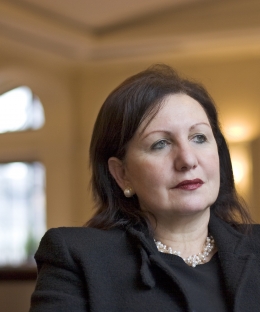
Eugene Meyer Professor of Political Science and Philosophy at Yale University
Research project:
“Democratic Sovereignty and Transnational Law”
After Seyla Benhabib dealt with the theoretical foundation of human rights during her first stay as a fellow of the Cluster of Excellence at the Forschungskolleg in 2010, she is now exploring the question of whether democracies can still be described as sovereign in the face of transnational orders. In particular, the question of how universal principles of human rights can be reconciled with democratic civil rights comes to the fore. Her current research is to be incorporated into a new book. In it, the philosopher wants to show that transnational norms of human rights ultimately strengthen rather than weaken democratic sovereignty.
Events (selection):
4 June 2014, 7.30 pm
Lecture as part of the centenary celebrations of Goethe University Frankfurt am Main
“Der ethisch-politische Horizont der Kritischen Theorie: Gestern und heute”
Venue: Goethe University Frankfurt am Main
Campus Westend, HZ 5
Organizer: Cluster of Excellence “The Formation of Normative Orders”
13 June 2014
Lecture at the retreat of the Principal Investigators of the Cluster of Excellence “The Formation of Normative Orders”
“From the ‘Right to Have Rights’ to the ‘Critique of Humanitarian Reason’ against the Cynical Turn in Human Rights Discourse”
Location: Forschungskolleg Humanwissenschaften der Goethe-Universität Frankfurt am Main
Organizer: Cluster of Excellence “The Formation of Normative Orders”
June 30, 2014, 7.30 pm
“Die Ungehaltenen”
Reading with Deniz Utlu. Introduction by Seyla Benhabib. An evening about literature, migration and human dignity
Location: Galerie Bernhard Knaus Fine Art
Niddastr. 84, 1st floor, Frankfurt am Main
-
Biografische Angaben
Seyla Benhabib has been a member of the American Academy of Arts and Sciences since 1995. From 2006 to 2007, she was president of the American Philosophical Association (Eastern Division). She is a member of the editorial advisory board of the journal "Ethics & International Affairs" and co-editor of "Blätter für deutsche und internationale Politik". In addition to teaching at Harvard University and the New School for Social Research, among others, she has undertaken numerous research stays in Europe. In 2009, for example, she accepted an invitation to the Wissenschaftskolleg zu Berlin. As a member of the Scientific Advisory Board, the philosopher has special ties to the Cluster of Excellence. Among the prizes Seyla Benhabib has been awarded is the Ernst Bloch Prize in 2009, which the jury recognized as a "world-class political philosopher". In 2012, she received the Dr. Leopold Lucas Prize from the University of Tübingen. The Tübingen Faculty of Protestant Theology, which awards this prize, emphasized that at the heart of Seyla Benhabib's thinking is the discourse-ethical justification and implementation of a "human right to hospitality". On May 19, she was awarded the Meister Eckhart Prize at the University of Cologne. Here, the jury honored Seyla Benhabib's intellectual advances in establishing a transnational understanding of law. Like few philosophers, she is facing up to the new responsibility that is emerging in the age of "post-national constellations". The laudatory speech was given by Rainer Forst, Professor of Political Theory and Philosophy and Co-Speaker of the Cluster of Excellence. -
Publikationen
Critique, Norm and Utopia. A Study of the Normative Foundations of Critical Theory, New York: Columbia University Press 1986 (dt.: Kritik, Norm und Utopie, Fischer Verlag 1992). Situating the Self. Gender, Community and Postmodernism in Contemporary Ethics, Cambridge: Polity Press 1992 (dt.: Selbst im Kontext, Suhrkamp Verlag 1995). zusammen mit Judith Butler, Drucilla Cornell and Nancy Fraser: Feminist Contentions: A Philosophical Exchange, London: Routledge 1994 (dt.: Der Streit um Differenz, Fischer Verlag 1993). The Reluctant Modernism of Hannah Arendt, Lanham, Maryland 1996; neu veröffentlicht in 2002 (dt.: Hannah Arendt und die melancholische Denkerin der Moderne, Suhrkamp Verlag 2006). The Claims of Culture. Equality and Diversity in the Global Era, Princeton University Press 2002. The Rights of Others. Aliens, Citizens and Resident, Cambridge University Press 2004 (dt.: Die Rechte der Anderen, Suhrkamp Verlag 2008). Another Cosmopolitanism. Hospitality, Sovereignty and Democratic Iterations, Oxford University Press in 2006 (dt.: Kosmopolitismus und Demokratie, Campus Verlag 2008). Dignity in Adversity. Human Rights in Troubled Times, Polity Press 2011. Equality and Difference. Human Dignity and Popular Sovereignty in the Mirror of Political Modernity (Lucas prize Lecture in English and German: Mohr Siebeck Publishers, 2013). The Democratic Disconnect. Citizenship and Accountability in the Transatlantic Community, with David Cameron et. al., Transatlantic Academy, Washington DC, 2013.