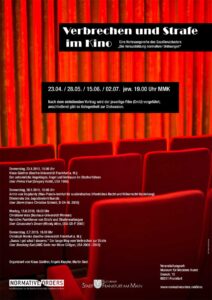
Crime and punishment in the movies

2015

The successful lecture series “Law and Violence in Cinema” of the Cluster of Excellence “The Formation of Normative Orders” will be continued in the coming summer semester. This time, the focus will be on the most common or at least most expected reaction to the violent violation of the law. That a crime must be followed by a punishment seems to be an unquestionable, self-evident norm in almost all societies past and present. Even if it is not always, and in some cases rarely, fulfilled, its abolition would trigger massive fears and insecurity. Film is one of the artistic media that can be used to question this taken-for-grantedness on the basis of individual cases and stories, or at least to show how tortuous, conflict-ridden, uncertain, lengthy and contradictory the path from crime to punishment can be, and what happens to the people involved along the way. Even if the villain gets what he deserves at the end of the movie plot, the better films at least leave their viewers with food for thought. The films selected here are able to achieve this with stories about sinister or monstrous criminals, about government and war crimes and about the coincidence that prevents punishment in the end.

Free admission, without registration

Thursday, 23.4.2015, 19.00 h

Klaus Günther (Co-Speaker of the Cluster of Excellence “The Formation of Normative Orders” and Professor of Legal Theory, Criminal Law and Criminal Procedure Law at Goethe University Frankfurt am Main): The uncanny defendant. Fear and trust in criminal proceedings

about Primal Fear (Gregory Hoblit, USA 1996)

Thursday, 28.5.2015, 19.00 h

Armin von Bogdandy (Director of the Max Planck Institute for Comparative Public Law and International Law Heidelberg and Partner Investigator of the Cluster of Excellence “The Formation of Normative Orders”): Dilemmas of the Yugoslavia Tribunal

about Storm (Hans-Christian Schmid, D-DK-NL 2009)

Monday, 15.6.2015, 19.00 h

Christiane Voss (Professor of Philosophy of Audiovisual Media at the Bauhaus-Universität Weimar): Narrative Functions of Punishment and Expectations of Punishment

about Cassandra’s Dream (Woody Allen, USA-GB-F 2007)

Thursday, 2.7.2015, 7 p.m.

Christoph Menke (Principal Investigator of the Cluster of Excellence “The Formation of Normative Orders” and Professor of Philosophy at Goethe University Frankfurt am Main): “Guess I got what I deserve.” The long road from crime to punishment

about Breaking Bad (AMC series by Vince Gilligan, USA 2008 – 2013)

Museum of Modern Art
Domstraße 10
60311 Frankfurt am Main

Organization: Prof. Dr. Klaus Günther, Prof. Dr. Angela Keppler, Prof. Dr. Martin Seel

Organizer: Cluster of Excellence “The Formation of Normative Orders” with the Cultural Office of the City of Frankfurt am Main

News from the research center

News
18.05.2026

Videopodcast-Reihe „Our Planet, Our Health“ gestartet

Mit „Our Planet, Our Health“ startet eine neue Videopodcast-Reihe zu Fragen globaler Gesundheitsgerechtigkeit. Die Reihe, gehostet von Dr. Romina Rekers, ist eine Initiative des Global Health Justice Postdoctoral Programme (GHJ), gefördert von der Höppschen Stiftung.

more information ›
Publication
12.05.2026 | Online article

Disinhibited Informalization: Talk Radio, Bro Podcasts and the Aesthetics of Populism

This essay by Johannes Völz is a revised and updated translation of “Enthemmte Informalisierung: Talk Radio, Bro-Podcasts und die Ästhetik des Populismus,” WestEnd: Neue Zeitschrift für Sozialforschung 22.2 (2025): 3–24. It is published here as part of the b2o Review’s “Stop the Right” dossier.

more information ›
Event
20.05.2026 | Frankfurt am Main

Von der Selbstermächtigung zum sozialen Widerstand

Lecture

Vortrag von Prof. Dr. Axel Honneth (Frankfurt am Main / New York Columbia University) mit anschließender Diskussion im Rahmen des Rechtstheoretischen Mittwochsseminars von Klaus Günther, Dan Wielsch und Benno Zabel.

more information ›
Event
19.05.2026 | Frankfurt

Speculative Truth Regimes

Panel Discussion

Event with Adam Kahlil (New Red Order) and Toby Lee (NYU) as part of the Series Visual Truth Regimes, organized by Laliv Melamed (Goethe University Frankfurt, Normative Orders), Felix Trautmann (Institut für Sozialforschung; HBK Braunschweig) and Franziska Wildt (Institut für Sozialforschung).

more information ›
Event
25./26.06.2026 | Frankfurt

Shifting Regimes, Changing Orders

Conference

Conference as part of WDC2026 in collaboration with Deutsche Gesellschaft für Designtheorie und -forschung (DGTF), Kunstgewerbemuseum/Design Campus SKD and Design and Democracy

more information ›
Event
28./29.05.2026 | Frankfurt am Main

Global Health Justice: Principles and Practice

Conference

Following the research focus of the Global Health Justice Postdoctoral Programme, funded by Höppsche Stiftung, the "Global Health Justice: Principles and Practice" conference places a particular emphasis on themes such as the human right to health, political activism and health justice issues, and problems of structural injustice and vulnerable populations in health care. Keynote lectures by Jonathan Wolff and Kanchana Mahadevan. The Global Health Justice Programme and this conference are supported by the Höppsche Stiftung in Villmar.

more information ›
Event
14.07.2026 | Frankfurt am Main

Democracy Over Time and the Climate Crisis

Lecture Series

Vortrag von Anja Karnein (Binghamton). Die Vortragsreihe untersucht Fragen der Klimakrise als Herausforderungen für demokratische Gesellschaften und konzentriert sich auf Themen wie politische Legitimität, Widerstand gegen fossile Brennstoffe und die Interessen künftiger Generationen. Sie wird organisiert von Prof. Dr. Darrel Moellendorf und Dr. Lukas Sparenborg.

more information ›
Event
10.06.2026 | Frankfurt am Main

Capital Investment, Inequality, and State Power in a Time of Climate Emergency

Lecture, Lecture Series

The lecture series examines questions of the climate crisis as challenges for democratic
societies and focuses on issues of political legitimacy, fossil fuel resistance, and the interests
of future generations.

more information ›