Lecture series cinema
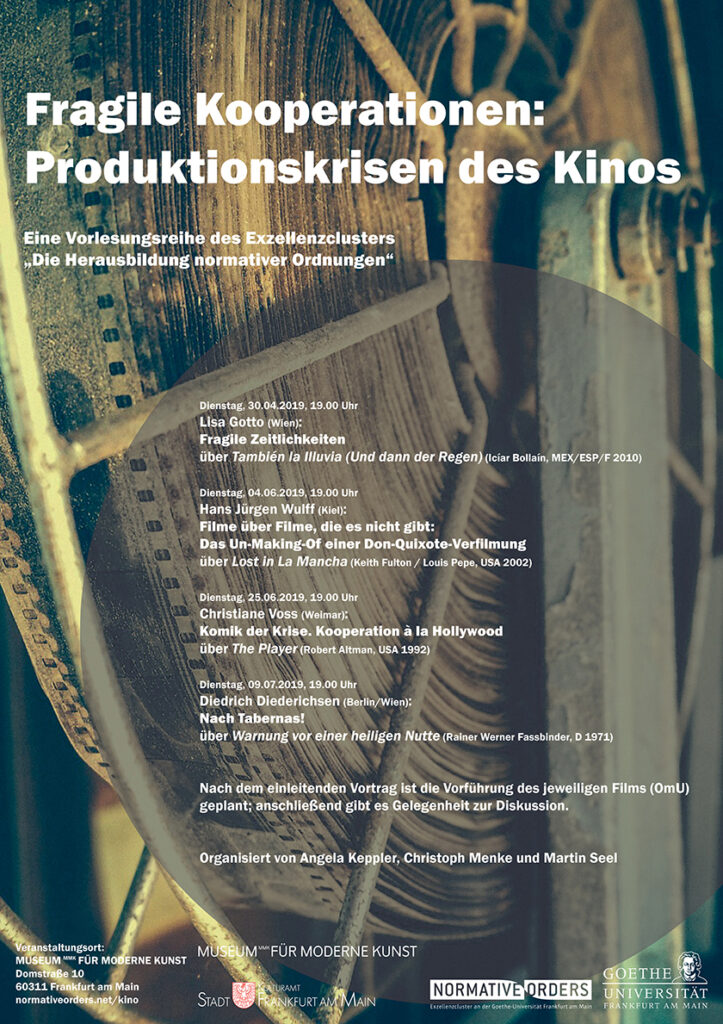
Fragile collaborations: Production crises of the cinema (2019)
The film series takes the diagnosis of a “fragility of normative orders” as an opportunity to examine the crisis nature of such orders in the microcosm of the actors involved in the production of films. This is done using the example of feature films that deal with the failure or miscarriage of such productions in fictional and documentary forms. The production of feature films is visualized as a cooperative project with considerable potential for conflict and a highly uncertain outcome. What happens during the planning and realization of film productions proves to be a theatrum mundi on a small scale, in which the dissonant interplay of forces of the larger world is reflected. The exhibition explores how the susceptibility to crisis of creative processes manifests the polarity of integration and disintegration in social conditions. The presentation of each film will be introduced by a lecture, followed by an opportunity for discussion.
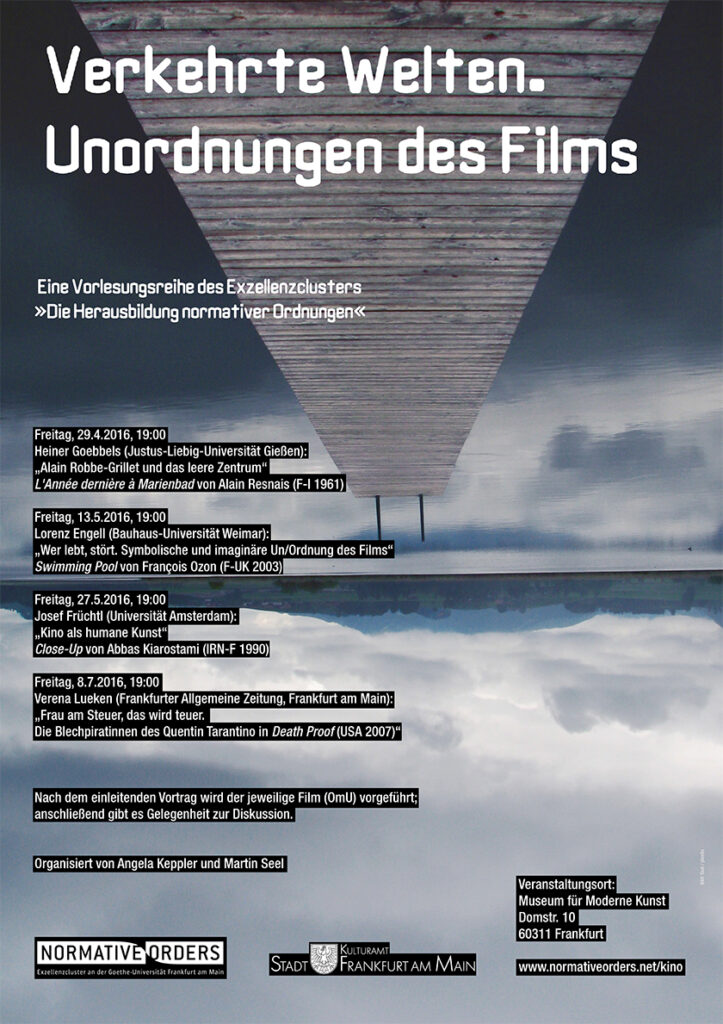
Upside-down worlds. Disorders of the film (2016)
It is not only in the social and political world, but also in the arts, that procedural orders emerge time and again that provide a standard for the production and reception of corresponding works for a while – albeit often only for a short time – and are in greater or lesser tension with the normative conditions of the respective societies. This also applies to the development of feature films. Every single one of these films is created – and thus stands – in the context of genres and their conventions, to which it relates even and especially when it breaks with them. The lecture series is dedicated to these upheavals in the form of cinematic design. It demonstrates how innovative films can invert the hitherto familiar worlds of film. Selected examples will be used to demonstrate and discuss how they disrupt established orders of narrative and at the same time shake and question the order of life outside the cinema.
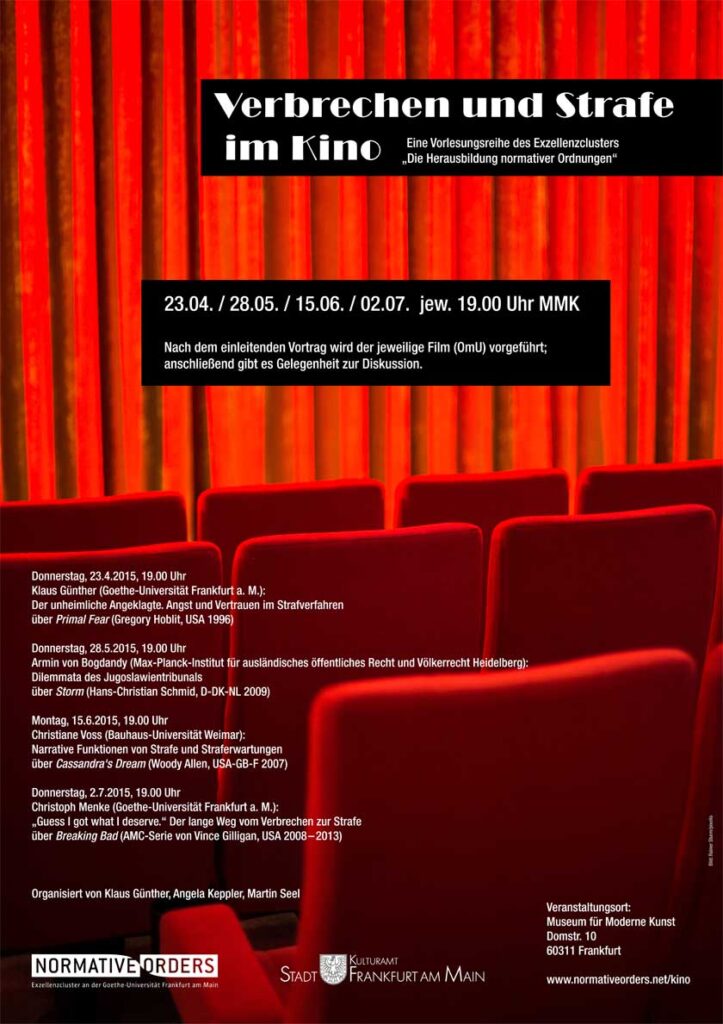
Crime and punishment in the movies (2015)
The successful lecture series “Law and Violence in Cinema” of the Cluster of Excellence “The Formation of Normative Orders” will be continued in the coming summer semester. This time, the focus will be on the most common or at least most expected reaction to the violent violation of the law. That a crime must be followed by a punishment seems to be an unquestionable, self-evident norm in almost all societies past and present. Even if it is not always, and in some cases rarely, fulfilled, its abolition would trigger massive fears and insecurity. Film is one of the artistic media that can be used to question this taken-for-grantedness on the basis of individual cases and stories, or at least to show how tortuous, conflict-ridden, uncertain, lengthy and contradictory the path from crime to punishment can be, and what happens to the people involved along the way. Even if the villain gets what he deserves at the end of the movie plot, the better films at least leave their viewers with food for thought. The films selected here are able to achieve this with stories about sinister or monstrous criminals, about government and war crimes and about the coincidence that prevents punishment in the end.
Law and violence in cinema (2014)
A lecture series of the Cluster of Excellence “The Formation of Normative Orders” on the occasion of the 100th anniversary of Goethe University Frankfurt am Main
The depiction of violence has been a leitmotif of cinema from the very beginning. It takes on very different functions in different genres. The question of the law of violence and the violence of law has always been an important strand in cinematic narratives. Many feature films that tell of acts, events and conditions of open or latent violence pose the question of the legitimacy of the social orders in which violence arises and fades through the way they are told. They deal with the intimacy of law and violence. Law-making violence is staged in the same way as violence in the enforcement or application of law and order. Another central motif is the apparent or actual diffusion of the difference between legal and non-legal violence within societies governed by the rule of law. In all of these relationships, cinema exposes the role of the law as an unstable, fragile or only ostensible protection against social violence – and thus the fragility of the normative orders that it represents in each case.
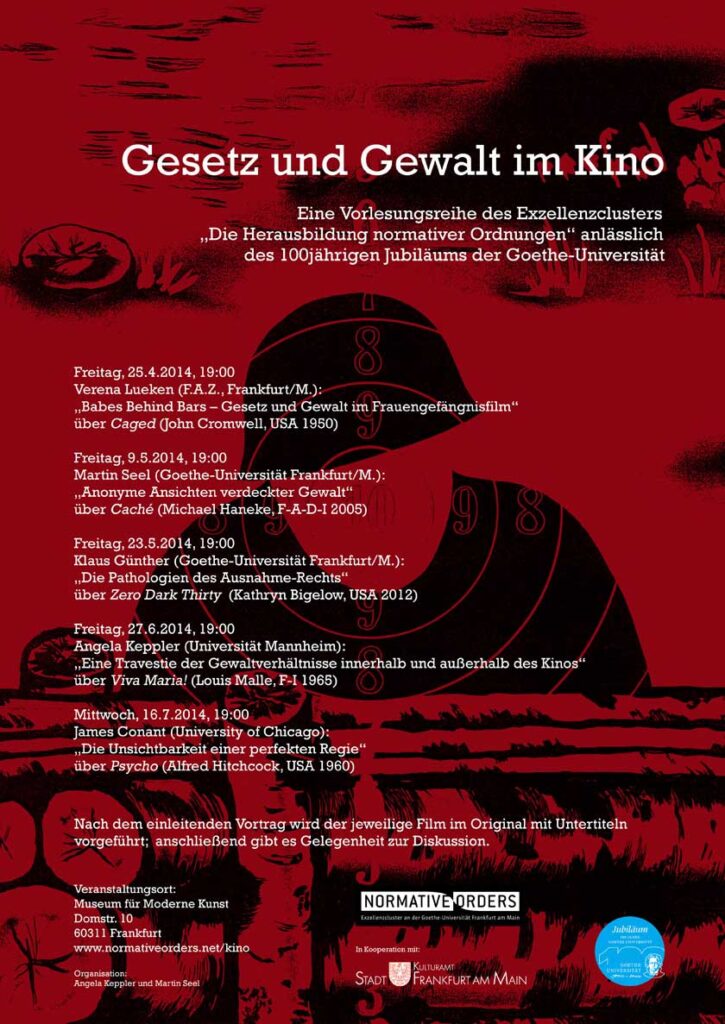
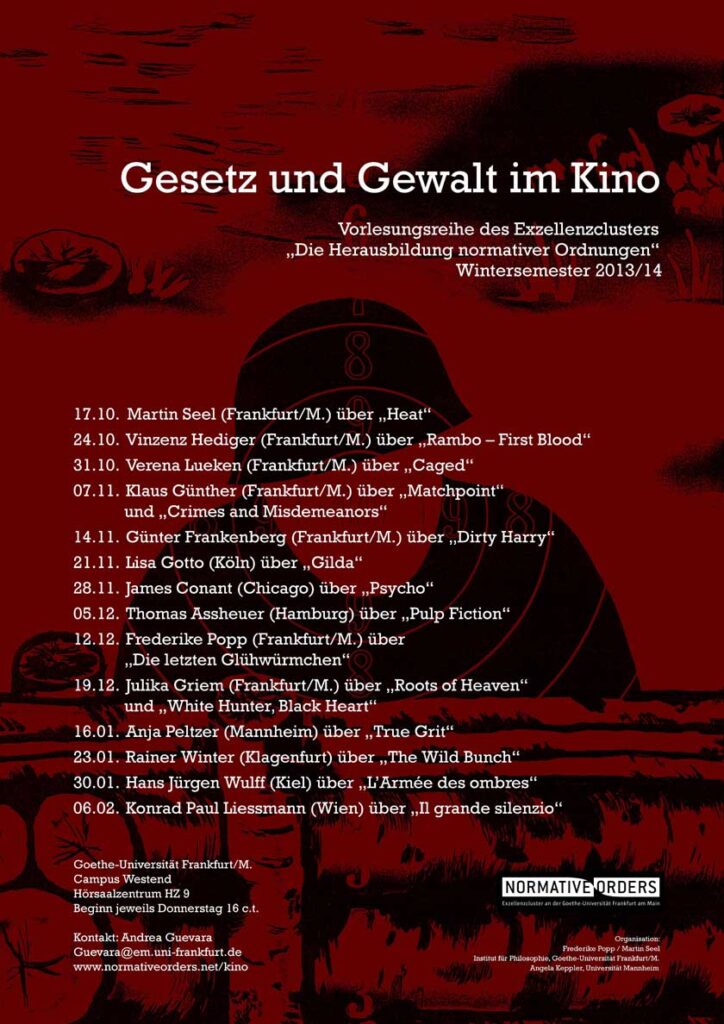
Law and violence in cinema (2013-14)
Many feature films that tell of acts, events and conditions of open or latent violence question the legitimacy of the social orders in which violence arises and fades through the way they are told. They deal with the intimacy of law and violence. The classic film genres in which the connection and contrast between law and violence is played out in ever new variations include the western, film noir and its offshoots in police films, but also the war film, insofar as it takes the legitimacy of military operations as its theme.
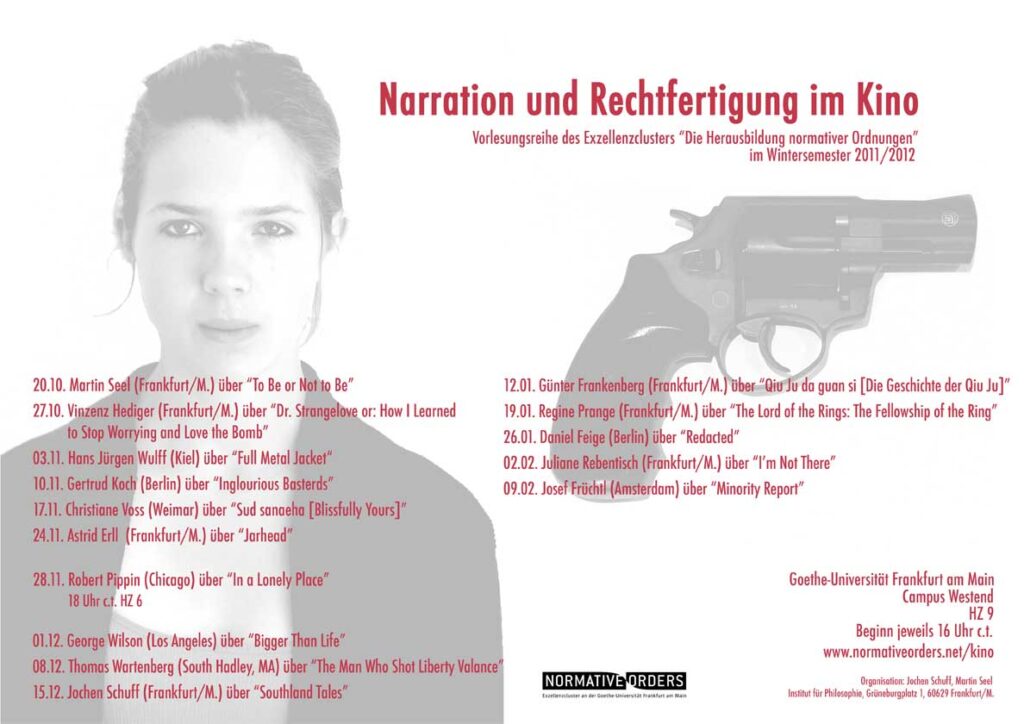
Narration and justification in cinema (2011-12)
In the context of the research project “Justification Narratives: The Example of Contemporary Cinema”, the lecture series is dedicated to the question of how narrative and justification relate to each other in different epochs and genres of cinema. Using more or less classic films as examples, the individual lectures will discuss whether and how cinematic narratives contribute – or can contribute – in their own way to the legitimization and/or delegitimization of normative attitudes and orders.