

04.02.2026
Journal article

New Perspectives on Trust in International Conflicts

Abstract
This forum proposes to rethink the specific conditions and dynamics under which trust can endogenously emerge in international conflicts. Traditionally, International Relations (IR) scholars have viewed trust and conflict as opposites or antagonists, with trust being seen as essential to overcoming conflict, and conflict seen as corrosive of trust. However, this framing is of limited use when it comes to understanding the complex role of trust in an increasingly heterogeneous and conflictual international system. In this forum, the contributors discuss the extent to which trust can emerge from and be strengthened within conflict. Conflict requires high-stakes decisions with uncertain outcomes. It helps actors learn about their interests and identities, as well as those of their counterparts. Conflict also fosters social bonds through shared experiences of successfully dealing with it. This approach complements existing research that has primarily focused on how trust, whether pre-existing or exogenously generated, can contribute to conflict resolution.
News from the research center

Publication
04.02.2026 | Journal article

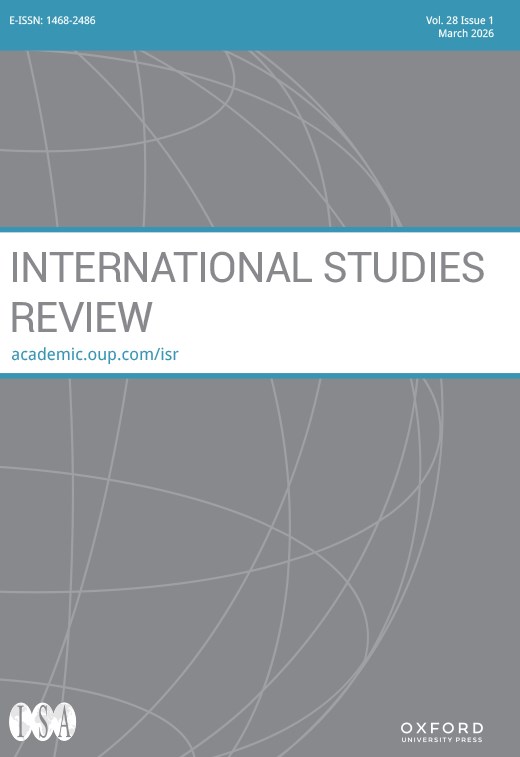
New Perspectives on Trust in International Conflicts

Wille, Tobias; Simon, Hendrik; Daase, Christopher; Deitelhoff, Nicole; Wheeler, Nicholas J.; Holmes, Marcus; Rathbun, Brian C.; Acharya, Amitav; Mitzen, Jennifer (2026): „New Perspectives on Trust in International Conflicts“. In: International Studies Review 28 (1), viaf027.

more information ›
News
02.02.2026

States competing for people - David Owen on civil geopolitics

As part of the lecture series "At the Crossroads - The Future of Democracy", David Owen from the University of Southampton presented his concept of civil geopolitics.

more information ›
News
20.01.2026

Christine Hentschel on reorientation in catastrophic times

As part of the lecture series "At the crossroads? On the crisis of democracy", the sociologist spoke about living in and dealing with catastrophic times. Against the backdrop of the destruction of living conditions, wars, permanent crises and threats to democracy, Hentschel addressed the infiltration of the catastrophic into everyday social life and a changing activist and literary approach to the future.

more information ›
Publication
08.01.2026 | Journal article

Gender Differences in Financial Advice

Bucher-Koenen, Tabea; Hackethal, Andreas; Koenen, Johannes; Laudenbach, Christine (2025): „Gender Differences in Financial Advice“. In: American Economic Review, 115 (12), pp. 4218–4252.

more information ›
Publication
19.12.2025 | Anthology

Faszination und Freiheit 

Günther, Klaus; Zabel, Benno (Hrsg.) (2025): Faszination und Freiheit - Gegenwartsdiagnosen im Anschluss an Christoph Menkes Theorie der Befreiung, Weilerswist (Velbrück Wissenschaft).

more information ›
Publication
12.12.2025 | Anthology

Zwischen Transformation und Abolitionismus. Das Strafrecht und die Vielfalt der Alternativen

Tobias Singelnstein, Christoph Burchard (2025)

more information ›
Publication
12.12.2025 | Chapter

Was bleibt von der Verantwortung jenseits der Strafe übrig?

Günther, Klaus (2025): „Was bleibt von der Verantwortung jenseits der Strafe übrig?“. In: Zabel Benno; Singelnstein; Tobias und Burchard, Christoph (Hrsg.): Zwischen Transformation und Abolitionismus. Das Strafrecht und die Vielfalt der Alternativen. Velbrück Wissenschaft, S. 207-241.

more information ›
News
11.12.2025

Jonathan White on future thinking in democracies

On the second date of the lecture series "At the crossroads? On the crisis of democracy". Political scientist White discusses views on the future of democracies. A follow-up report

more information ›
News
04.12.2025

The crisis of democratic theory from a sociological perspective

Sociologist Jenny Brichzin's lecture "Crisis of Democratic Theory? A sociological intervention" opened our lecture series "At the crossroads? On the future of democratic theory". The sociologist criticized the fact that social coexistence has so far been insufficiently addressed in democratic theory. A follow-up report

more information ›