

16.09.2025
Monograph

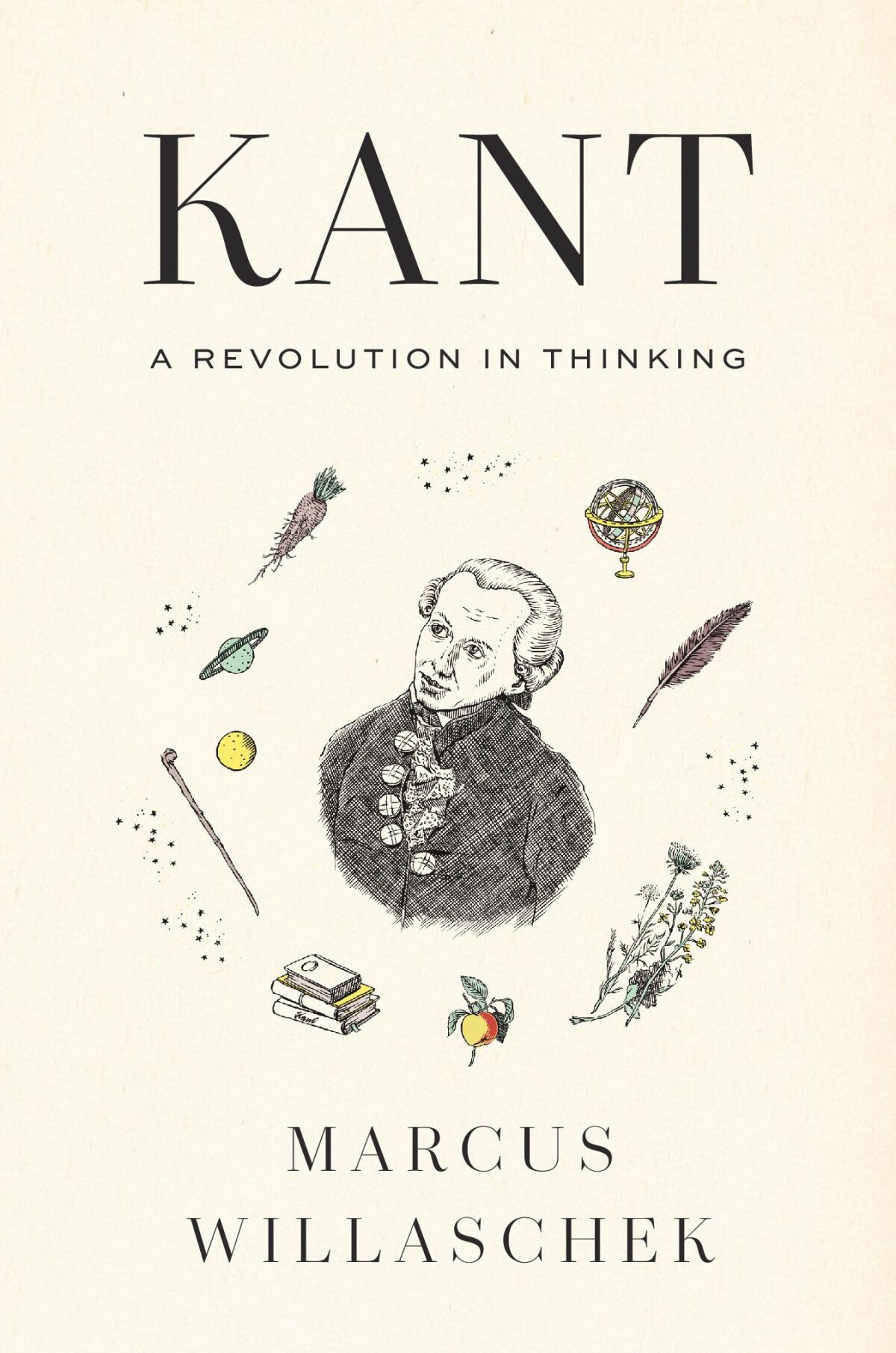
Kant. A Revolution in Thinking

About the book

Immanuel Kant is undoubtedly the most important philosopher of the modern era. His Critique of Pure Reason, “categorical imperative,” and conception of perpetual peace in the global order decisively influenced both intellectual history and twentieth-century politics, shaping everything from the German Constitution to the United Nations Charter.

Renowned philosopher Marcus Willaschek explains why, three centuries after Kant’s birth, his reflections on democracy, beauty, nature, morality, and the limits of human knowledge remain so profoundly relevant. Weaving biographical and historical context together with exposition of key ideas, Willaschek emphasizes three central features of Kant’s theory and method. First, Kant combines seemingly incompatible positions to show how their insights can be reconciled. Second, he demonstrates that it is not only human thinking that must adjust to the realities of the world; the world must also be fitted to the structures of our thinking. Finally, he overcomes the traditional opposition between thought and action by putting theory at the service of practice.

In Kant: A Revolution in Thinking, even readers having no prior acquaintance with Kant’s ideas or with philosophy generally will find an adroit introduction to the Prussian polymath’s oeuvre, beginning with his political arguments, expanding to his moral theory, and finally moving to his more abstract considerations of natural science, epistemology, and metaphysics. Along the way, Kant himself emerges from beneath his famed works, revealing a magnetic personality, a clever ironist, and a man deeply engaged with his contemporary world.
News from the research center

News
09.02.2026

On the topicality of the concept of violence based on Camus and Derrida

Prof. Dr. Christine Abbt from the University of St. Gallen gave a lecture on democracies and the concept of violence as part of the lecture series "At the crossroads? On the crisis of democracy", she gave a lecture on democracies and the concept of violence. Under the title "Defending democracies. On the topicality of the concept of violence in Camus and Derrida", the philosopher discussed forms of violence and revolt and categorized them with regard to a democratic setting.

more information ›
Publication
04.02.2026 | Journal article

New Perspectives on Trust in International Conflicts

Wille, Tobias; Simon, Hendrik; Daase, Christopher; Deitelhoff, Nicole; Wheeler, Nicholas J.; Holmes, Marcus; Rathbun, Brian C.; Acharya, Amitav; Mitzen, Jennifer (2026): „New Perspectives on Trust in International Conflicts“. In: International Studies Review 28 (1), viaf027.

more information ›
News
02.02.2026

States competing for people - David Owen on civil geopolitics

As part of the lecture series "At the Crossroads - The Future of Democracy", David Owen from the University of Southampton presented his concept of civil geopolitics.

more information ›
News
20.01.2026

Christine Hentschel on reorientation in catastrophic times

As part of the lecture series "At the crossroads? On the crisis of democracy", the sociologist spoke about living in and dealing with catastrophic times. Against the backdrop of the destruction of living conditions, wars, permanent crises and threats to democracy, Hentschel addressed the infiltration of the catastrophic into everyday social life and a changing activist and literary approach to the future.

more information ›
Publication
08.01.2026 | Journal article

Gender Differences in Financial Advice

Bucher-Koenen, Tabea; Hackethal, Andreas; Koenen, Johannes; Laudenbach, Christine (2025): „Gender Differences in Financial Advice“. In: American Economic Review, 115 (12), pp. 4218–4252.

more information ›
Publication
19.12.2025 | Anthology

Faszination und Freiheit 

Günther, Klaus; Zabel, Benno (Hrsg.) (2025): Faszination und Freiheit - Gegenwartsdiagnosen im Anschluss an Christoph Menkes Theorie der Befreiung, Weilerswist (Velbrück Wissenschaft).

more information ›
Publication
12.12.2025 | Anthology

Zwischen Transformation und Abolitionismus. Das Strafrecht und die Vielfalt der Alternativen

Tobias Singelnstein, Christoph Burchard (2025)

more information ›
Publication
12.12.2025 | Chapter

Was bleibt von der Verantwortung jenseits der Strafe übrig?

Günther, Klaus (2025): „Was bleibt von der Verantwortung jenseits der Strafe übrig?“. In: Zabel Benno; Singelnstein; Tobias und Burchard, Christoph (Hrsg.): Zwischen Transformation und Abolitionismus. Das Strafrecht und die Vielfalt der Alternativen. Velbrück Wissenschaft, S. 207-241.

more information ›
News
11.12.2025

Jonathan White on future thinking in democracies

On the second date of the lecture series "At the crossroads? On the crisis of democracy". Political scientist White discusses views on the future of democracies. A follow-up report

more information ›