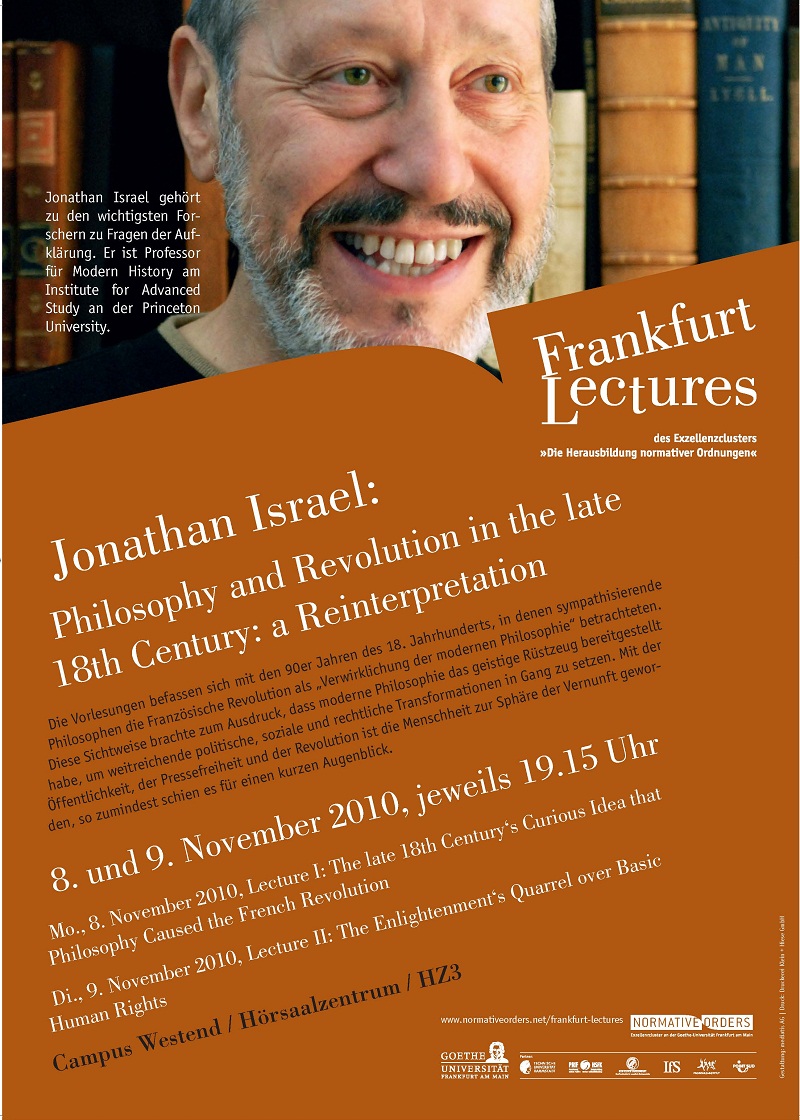

Jonathan Israel: Philosophy and Revolution in the late 18th Century: a Reinterpretation
Jonathan Israel (professor of Modern History at the Institute for Advanced Study, Princeton)
I: The late 18th century’s Curious Idea that Philosophy caused the French Revolution
II: The Enlightenment’s Quarrel over Basic Human Rights
Although it seems strange to us today, it was common in the years around 1790 for philosophers sympathetic to the French Revolution to speak of it as the realization of ‘modern philosophy’. When examined, this perception can be seen to possess appreciable cultural and political significance. What was meant was that modern philosophy, considered in all its aspects implied a vast mobilization of intellectual and cultural impulses and these could be seen as having provided the mental apparatus that engineered the vast transformation political, social and legal that Europe and the entire world was undergoing. ‘ The French Revolution the work of philosophy, but what a leap from the cogito, ergo sum to the first resounding of the à la Bastille in the Palais Royal. ‘ Given Lichtenberg’s approach to scientific and philosophical questions, we may presume that he meant by this that it needed a shift to a systematically rational view of reality on many levels for human ideals and needs to come to be expressed and legislated for in the way that transpired in 1789. Thinking in terms of basic human rights was obviously one such dimension; another was the virtual destruction of confessional and theological differences as a meaningful divide between humans. But the most important change was the idea that the state exists to promote the interests of the majority conceived as equals. ‘What a development! ‘, exclaimed Wekhrlin, in 1791: the torch of philosophy has finally been taken up in society and the ‘rights of reason and of Man’ transferred to the sphere of reality. ‘The true principles of society have been researched and enlightened’, and the public understanding has been brought to grasp ‘the general good’. In short, the century of the Enlightenment was one in which human life had ceased to be the plaything of politics and religion!’ With the public sphere, freedom of the press and the Revolution, humanity had become, or so it briefly seemed, the sphere of ‘reason’.