

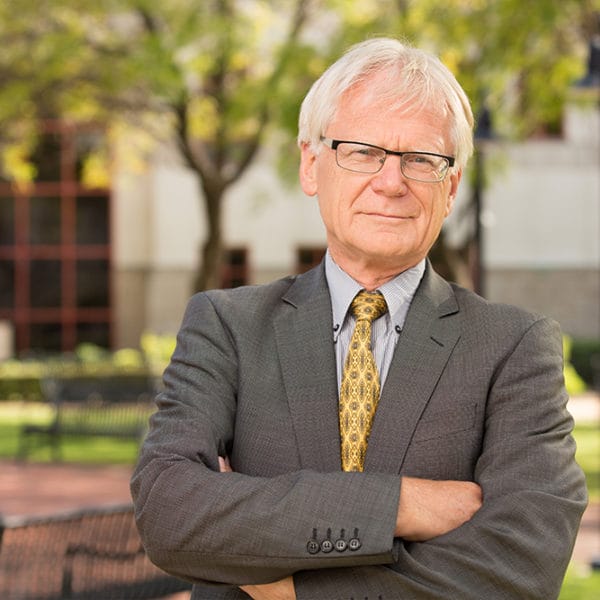
Professor of Philosophy of Religion, Claremont Graduate University, USA
Research project:
“Deus praesens: God and the present in philosophical theology”
Project description:
In a major strand of Western philosophical theology, God and the present are dynamically linked. The present cannot be thought without God, and God cannot be thought without his presence. Only a present God deserves to be called “God”, and a God who is not present cannot be God. Without God’s presence nothing would be possible, and nothing would be actual, nothing would be there and no one else would be present. If there is a God, then God is to be thought in such a way that God is present to every presence. But what does this mean? How is God’s presence different from other presences? How does this go together with the widespread feeling that God is not present, but absent, not accessible, but hidden? What do we understand by “presence” and “the present”, and how does this relate to presence (Anwesenheit) and absence (Abwesenheit), to givenness and perceivability, to accessibility and hiddenness? These are some of the questions I want to pursue during my stay at the FKH. (Ingolf Dalferth)
Events:
November 5, 2020, 11 a.m.
Fellow Colloquium at the Forschungskolleg Humanwissenschaften of the Goethe University
“In God We Trust”
November 12, 2020, 7 pm
Evening lecture
The illusion of immediacy. On a misunderstood mode of the lifeworld
-
Biografische Angaben
Ingolf Dalferth is Danforth Professor of Philosophy of Religion at Claremont Graduate University and Professor Emeritus at the Faculty of Theology at the University of Zurich. From 1998 to 2012 he was Director of the Institute for Hermeneutics and Philosophy of Religion at the University of Zurich. He has been honored with numerous invitations to renowned research institutions, including as Hulsean Lecturer at the University of Cambridge, Samuel Ferguson Lecturer at Manchester University, Bapsybanoo Marchioness of Winchester Lecturer at the University of Oxford, Fellow at the Collegium Helveticum in Zurich and at the Wissenschaftskolleg zu Berlin. The University of Copenhagen and the University of Uppsala awarded him honorary doctorates. Dalferth is or was editor of many journals and book series, including Theologische Literaturzeitung, Hermeneutische Untersuchungen zur Theologie, Philosophy of Religion and Theology and Claremont Studies in Religion. -
Publikationen
– Sünde: Die Entdeckung der Menschlichkeit. Leipzig: Evangelische Verlagsanstalt 2020. – Die Kunst des Verstehens. Grundzüge einer Hermeneutik der Kommunikation durch Texte. Tübingen: Mohr Siebeck 2018. – Creatures of Possibility: The Theological Basis of Human Freedom. Grand Rapids, MI: Baker Academic 2016. – Transzendenz und säkulare Welt, Tübingen: Mohr Siebeck 2015 (engl.: Transcendence and the Secular World: Life in orientation to ultimate presence, übersetzt von Jo Bennet, Tübingen: Mohr Siebeck 2018). – Radikale Theologie. Glauben im 21. Jahrhundert. Leipzig: Evangelische Verlagsanstalt 2010 (engl.: Radical Theology: An Essay on Faith and Theology in the Twenty-First Century. Minneapolis, MN: Fortress Press 2016). – Hoffnung (Grundthemen der Philosophie). Berlin: de Gruyter 2016. – Selbstlose Leidenschaften. Christlicher Glaube und menschliche Passionen. Tübingen: Mohr Siebeck 2013. – Malum. Theologische Hermeneutik des Bösen. Tübingen: Mohr Siebeck 2008. – Die Wirklichkeit des Möglichen. Hermeneutische Religionsphilosophie. Tübingen: Mohr Siebeck 2003