

Fellow

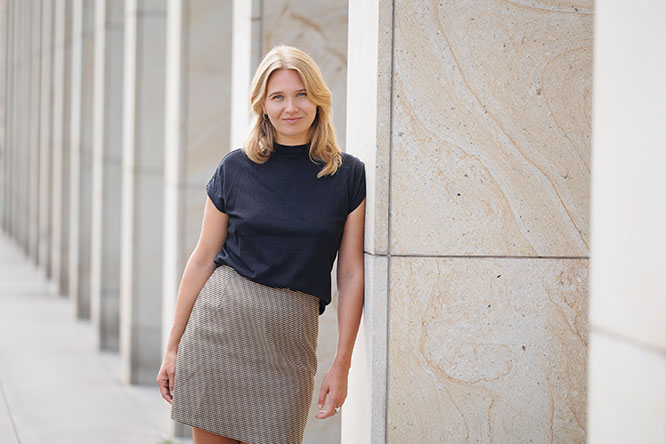
Sonja Riegler

Photo: © Joseph Krpelan

Postdoctoral Fellow at Goethe University

Duration of stay: October 2025 to August 2026

In cooperation with Prof. Dr. Rainer Forst

Funded by Claus Wisser Postdoc Program

Sonja Riegler’s research lies at the intersection of social and political philosophy, feminist epistemology, feminist philosophy of science, and Critical Race Studies. She recently completed her PhD in Philosophy at the University of Vienna. Her dissertation, A Functionalist Approach to Ignorance, supervised by Martin Kusch and Linda Martín Alcoff, develops a novel framework for analyzing socially relevant forms of ignorance, with a central case study on the largely overlooked history of “guest worker” migration to Austria. Her current project advances a critical epistemology of bureaucracy, introducing bureaucracy as a crucial yet underexplored topic in political epistemology, with a particular focus on knowledge practices, forms of expertise, and power asymmetries in bureaucratic encounters.

Research project: How Bureaucracy Knows: Toward a Critical Epistemology of Forms, Rules, and Expertise

Despite its centrality to governance, bureaucracy remains a largely neglected topic in political epistemology. While sociology and political science have analyzed bureaucratic organization and practice in detail (e.g., Weber 1907; Blau 2000; Goodsell 2004; Graeber 2015; Zacka 2017), political epistemologists have paid little attention to the forms of expertise that underpin bureaucratic knowledge and to the epistemic authority exercised by bureaucrats and those who interact with them. This project introduces bureaucracy as a crucial yet underexplored topic in political epistemology (PE), aiming to bring core philosophical questions about expertise, authority, and rule-following into conversation with the everyday epistemic and political dynamics of bureaucratic practice. It develops a new conceptual framework for understanding how knowledge, ignorance, and power operate in bureaucratic institutions. Specifically, I investigate bureaucratic expertise as a distinct form of institutional practical knowledge, contrasting it with scientific expertise, and explore how epistemic authority is unevenly distributed between bureaucrats and service users. Drawing on the philosophical literature on rule following (Wittgenstein 1969, Daston 2022, Graeber 2015) and work in the sociology of classification (e.g., Hacking 1984) and standardization (Scott 1998), the project also investigates how bureaucrats’ epistemic and moral agency is shaped by institutional rules, professional norms, and value commitments.


Events

7.11.2025 “A Functionalist Approach to Ignorance”, Talk at Workshop on Novel Approaches in Epistemologies of Ignorance, TU Dresden (organized by Jana Stern)

13.11.2025 “Group Ignorance in Science – An Interactionist Account”, Talk at SW*IP Jahrestagung 2025, Wissenschaft, Philosophie und Öffentlichkeit

18.11.2025 “Bureaucracy and Expertise”, Talk at Forschungskolloqium Rainer Forst

22.1.2026 Talk and Organization of Workshop on Feminist Epistemology, with Frieder Vogelmann and Katharina Hoppe, University of Vienna

March 2026: Referentin bei der Österreichischen Philosophie Olympiade, Bundeswettbewerb

  • Publikationen

    Riegler, Sonja & Veigl, Sophie: “Meaning Dominance: When Polysemy Creates Hermeneutical Oppression”, submitted to Social Epistemology (R&R) Riegler, Sonja (forthcoming): “Interference By Whom? Advocating for Experience-Based Forms of Expertise in Debates on Epistemic Paternalism”, in: Samarzija, H, McKenna, R (Eds.), The European Face of Political Epistemology, Basingstoke: Palgrave MacMillan Riegler, Sonja (2023): “A Space Yet to Be Filled (By Whom?) – Ignorance as an Institutional and Interpersonal Practice”, in: Heinrich K, Robles F (Eds.), Addressing Amnesia, Performing Trauma, Vienna: Edition Angewandte, 100-108 Riegler, Sonja (2022): “Wissen im Widerspruch, Wissen als Widerspruch – Umriss einer ambivalenten Beziehung“, in: Adrienne N, Gabriel M, Gmainer-Pranzl F (Hrsg.): Das Politische der Wissenschaft, Band 18, Berlin: Peter Lang Verlag, 331-347

News from the research center

Event
20.04.2026 | Brussels

Militärische KI verantwortungsvoll nutzen und Regulierung neu denken

Panel Discussion, Lecture

Künstliche Intelligenz findet im Militär immer breiteren Einsatz, von Logistik und Training über Missionsplanung und Zielidentifikation bis hin zu autonomen Waffensystemen. Gleichzeitig wächst die Bedeutung von Mikroprozessoren immer stärker, der Zugang zu seltenen Erden und Chips wird zur zentralen Ressource. KI kann das Kampfgeschehen beschleunigen und damit destabilisierend wirken. Der Wettlauf um neue Fähigkeiten birgt jedoch auch Eskalationsrisiken. Wir laden Sie ein, diese Themen im nächsten Crisis Talk gemeinsam mit unseren hochkarätigen Podiumsgästen zu diskutieren.

more information ›
Event
28./29.05.2026 | Frankfurt am Main

Global Health Justice: Principles and Practice

Conference

Following the research focus of the Global Health Justice Postdoctoral Programme, the "Global Health Justice: Principles and Practice" conference places a particular emphasis on themes such as the human right to health, political activism and health justice issues, and problems of structural injustice and vulnerable populations in health care. Keynote lectures by Jonathan Wolff and Kanchana Mahadevan.

more information ›
Publication
26.03.2026 | Monograph

The Cambridge History of Latin American Law in Global Perspective

Duve, Thomas; Herzog, Tamar (eds.): The Cambridge History of Latin American Law in Global Perspective, Cambridge: Cambridge University Press, 2024 (portugiesisch 2025; spanisch 2026).

more information ›
Publication
26.03.2026 | Monograph

Rechtsgeschichte des frühneuzeitlichen Hispanoamerika

Duve, Thomas; Egío, José Luis  (2023): Rechtsgeschichte des frühneuzeitlichen Hispanoamerika, Berlin: De Gruyter, 2023.

more information ›
Event
18.04.2026 | Frankfurt am Main

Das Prinzip Donald Trump und die Verrohung der Welt

Panel Discussion, Lecture

Ein neuer Politikstil macht international Karriere. Er ist gekennzeichnet von Vulgarität, Verrohung und erklärter Rechtsfeindschaft. Machtinteressen werden nicht mehr juristisch bemäntelt. Stattdessen wird das angebliche Recht des Stärkeren zur Staatsdoktrin gemacht – innenpolitisch wie außenpolitisch. Treibende Kraft hinter dieser Verrohung der politischen Sitten ist ein US-Präsident, der nicht nur die amerikanische Gesellschaft und Kultur, sondern auch die globale Ordnung nach seinen Vorstellungen und Interessen umgestaltet. Die Römerberggespräche wollen diesen Politikstil verstehen.

more information ›
Event
14.07.2026 | Frankfurt am Main

Democracy Over Time and the Climate Crisis

Lecture Series

Vortrag von Anja Karnein (Binghamton). Die Vortragsreihe untersucht Fragen der Klimakrise als Herausforderungen für demokratische Gesellschaften und konzentriert sich auf Themen wie politische Legitimität, Widerstand gegen fossile Brennstoffe und die Interessen künftiger Generationen. Sie wird organisiert von Prof. Dr. Darrel Moellendorf und Dr. Lukas Sparenborg.

more information ›
Event
10.06.2026 | Frankfurt am Main

Capital Investment, Inequality, and State Power in a Time of Climate Emergency

Lecture, Lecture Series

The lecture series examines questions of the climate crisis as challenges for democratic
societies and focuses on issues of political legitimacy, fossil fuel resistance, and the interests
of future generations.

more information ›
Event
13.05.2026 | Frankfurt am Main

Failed States and Cloudy skies: Tipping Points, Overshoot and Permanent Emergency, after America

Lecture Series

The lecture series examines questions of the climate crisis as challenges for democratic
societies and focuses on issues of political legitimacy, fossil fuel resistance, and the interests
of future generations.

more information ›
Event
22.04.2026

Political Legitimacy, Authoritarianism, and Climate Change

Lecture, Lecture Series

Lecture by Ross Mittiga (SOAS London). The lecture series examines questions of the climate crisis as challenges for democratic societies and focuses on issues of political legitimacy, fossil fuel resistance, and the interests of future generations. It is organized by Prof. Dr. Darrel Moellendorf and Dr. Lukas Sparenborg.

more information ›