
07.09.2026
Monograph

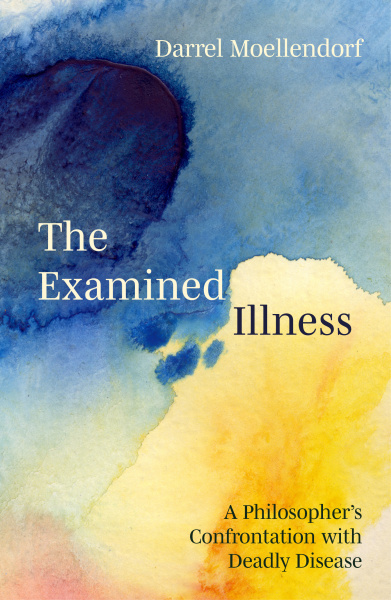
The Examined Illness. A Philosopher’s Confrontation with Deadly Disease

A visceral personal memoir of being seriously unwell – and the consolations of philosophy during sickness.

Being a patient is part of being alive. Disease and serious illness often strike randomly, and when they do, we quickly become subject to the impersonal forces of biochemistry and pharmacology. We rarely think about sickness beforehand and are often totally unprepared for it when it happens. Suddenly, there we are, subject to a standard treatment protocol.

Darrel Moellendorf learned this by experience during a month confined to a solitary and sterile hospital room where he received a life-saving stem cell transplant. His room was somebody’s workspace, his schedule was somebody’s work routine, his immune system was systematically crushed, and his prognosis was out of his hands. There was no assurance that it would all work out.

Having spent thirty years teaching philosophy to college students, He was facing the biggest test of all—perhaps the final exam. These are his reflections before, during, and after his cancer treatment, written in real time. He writes, “My brain was sometimes addled by the chemotherapy that sapped my energy and destroyed my immune system, but I wrote out of the conviction that living well includes living well with disease, and eventually living well facing death.” This memoir expresses the conviction that the virtues of patience, courage, trust, and hope serve us well. A measure of good humor also can’t hurt.
News from the research center

Publikation
07.09.2026 | Monograph

The Examined Illness. A Philosopher's Confrontation with Deadly Disease

Moellendorf, Darrel (2026): The Examined Illness: A Philosopher Confronts Deadly Disease, Bristol: intellect.

weitere Infos ›
Publikation
20.08.2026 | Chapter

Abschied vom Neoliberalismus im Zeichen des Postliberalismus?

Biebricher, Thomas (2026): Abschied vom Neoliberalismus im Zeichen des Postliberalismus? In: Selk, Veith; Hofmann, Julian Nicolai (Hrsg.): Postliberalismus? Eine transatlantische Debatte. Berlin: Suhrkamp, S. 222-246.

weitere Infos ›
Publikation
20.08.2026 | Chapter

Krise oder Verfall der Weltordnung? Liberale und postliberale Erklärungen internationalen Wandels

Daase, Christopher (2026): Krise oder Verfall der Weltordnung? Liberale und postliberale Erklärungen internationalen Wandels. In: Selk, Veith; Hofmann, Julian Nicolai (Hrsg.): Postliberalismus? Eine transatlantische Debatte. Berlin: Suhrkamp, S. 205-221.

weitere Infos ›
Publikation
19.08.2026 | Anthology

Sokrates revised and revisited

Bohl, Judith K.; Brandis, Veronika; Pfeifer, Guido (Hrsg.) (2026): „Sokrates revised and revisited. Überlieferung, Diskurs, Inszenierung“. Heidelberg: Propylaeum. 

weitere Infos ›
Publikation
14.08.2026 | Chapter

Vom rechtshistorischen Erkenntniswert antiker Tragödiendichtung: Überlegungen anhand Euripides’ Medeia

Pfeifer, Guido (2026): "Vom rechtshistorischen Erkenntniswert antiker Tragödiendichtung: Überlegungen anhand Euripides’ Medeia". In: Gsell, Beate; Rüfner, Thomas; Babusiaux, Ulrike (Hrsg.): Die unverzichtbare Wissenschaft – The Indispensable Science, Mohr Siebeck, S. 663-671.

weitere Infos ›
Publikation
01.08.2026 | Chapter

"Das Andere in uns selbst" (Marcel Gauchet). Das Ideal gesellschaftlicher Autonomie und die Denkfigur der Alterität

Langner-Pitschmann, Annette (2026): „Das Andere in uns selbst“ (Marcel Gauchet). Das Ideal gesellschaftlicher Autonomie und die Denkfigur der Alterität. In: Schlette, Magnus et. al. (Hrsg.): Ordnung im Übergang Zur Funktion von Transzendenzbezügen in der Konstitution und Transformation politischer Gemeinschaft, Tübingen: Mohr Siebeck, S. 185-205.

weitere Infos ›
Veranstaltung
24.09.2026 | Frankfurt am Main

Die neuen Warlords. Gewaltdynamiken einhegen / Friedensgutachten 2026

Book Presentation

Die imperialistische Großmachtpolitik ändert die Vorzeichen von Krieg, Frieden und Sicherheit. Staaten agieren zunehmend wie Warlords und setzen Krieg als Mittel der Politik ein. Übergänge von Gewaltkonflikten zu Frieden werden als „Deals“ behandelt, Mittelmächte treten mit neuem Selbstbewusstsein, aber ambivalentem Kurs auf, und technologische Innovation verändert Kriege und erschwert die Regulierung. Zugleich befindet sich die internationale Kooperation in der Friedenssicherung in ihrer schwersten Krise. Das Friedensgutachten 2026 analysiert Optionen, dennoch Frieden zu fördern.

weitere Infos ›
Publikation
23.07.2026 | Journal article

Governing the Subject of Populism

Biebricher, Thomas: "Governing the Subject of Populism". In: European Journal of Social Theory, OnlineFirst.

weitere Infos ›
Publikation
15.07.2026 | Monograph

Das Recht der Gewalt. Warum Waffen allein keinen Frieden schaffen

Simon, Hendrik (2026): Das Recht der Gewalt. Warum Waffen allein keinen Frieden schaffen. Ditzingen: Reclam.

weitere Infos ›