

01.06.2025
Journal article

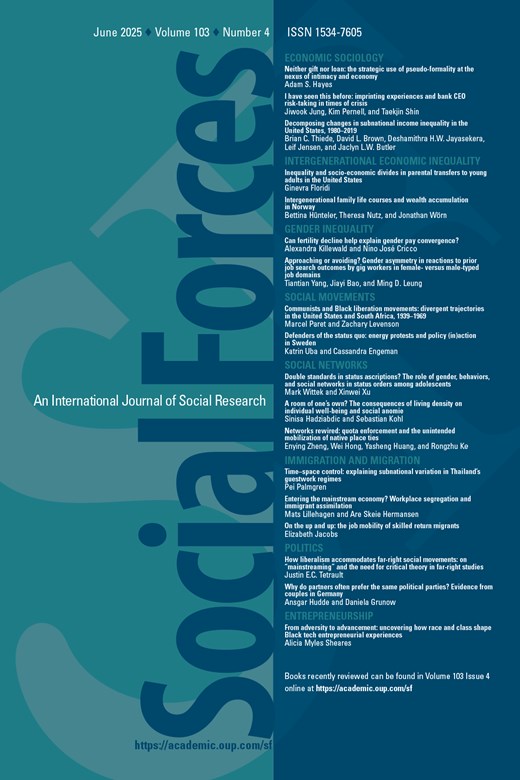
Why do partners often prefer the same political parties?

Abstract

Research has demonstrated that couples have similar partisan preferences, a finding associated with political polarization. However, it remains debated to what extent different mechanisms contribute to this homogamy. Analyzing dyadic panel data from the German Socio-Economic Panel 1984–2020, we distinguish analytically between (1) direct political matching (i.e., partner selection on matching party preferences); (2) indirect political matching (i.e., social structural homogamy with political homogamy as a by-product); and (3) couples’ political alignment over time, to explain party preference similarity. First, we study matching among recently formed couples using an innovative method that compares real-world couples with three types of counterfactuals: couples that are matched (1) randomly, (2) by multidimensional social structural characteristics, and (3) by maximizing similarity in party preference. Second, we study couples’ political alignment over the course of relationships, tracking real-world couples over time and controlling for macro-level changes in the party-political landscape. Results indicate substantial political homogamy among recently formed couples, which is best explained by political matching (i.e., direct selection based on partisan preferences). Effects of social structural homogamy appear weak in comparison and rather stable across cohorts. Couples further align in their partisan preferences over time, but this effect is countered by an increasing heterogeneity of the German political landscape.

News from the research center

Publication
19.08.2026 | Anthology

Sokrates revised and revisited

Bohl, Judith K.; Brandis, Veronika; Pfeifer, Guido (Hrsg.) (2026): „Sokrates revised and revisited. Überlieferung, Diskurs, Inszenierung“. Heidelberg: Propylaeum. 

more information ›
Publication
14.08.2026 | Chapter

Vom rechtshistorischen Erkenntniswert antiker Tragödiendichtung: Überlegungen anhand Euripides’ Medeia

Pfeifer, Guido (2026): "Vom rechtshistorischen Erkenntniswert antiker Tragödiendichtung: Überlegungen anhand Euripides’ Medeia". In: Gsell, Beate; Rüfner, Thomas; Babusiaux, Ulrike (Hrsg.): Die unverzichtbare Wissenschaft – The Indispensable Science, Mohr Siebeck, S. 663-671.

more information ›
Publication
01.08.2026 | Chapter

"Das Andere in uns selbst" (Marcel Gauchet). Das Ideal gesellschaftlicher Autonomie und die Denkfigur der Alterität

Langner-Pitschmann, Annette (2026): „Das Andere in uns selbst“ (Marcel Gauchet). Das Ideal gesellschaftlicher Autonomie und die Denkfigur der Alterität. In: Schlette, Magnus et. al. (Hrsg.): Ordnung im Übergang Zur Funktion von Transzendenzbezügen in der Konstitution und Transformation politischer Gemeinschaft, Tübingen: Mohr Siebeck, S. 185-205.

more information ›
Event
24.09.2026 | Frankfurt am Main

Die neuen Warlords. Gewaltdynamiken einhegen / Friedensgutachten 2026

Book Presentation

Die imperialistische Großmachtpolitik ändert die Vorzeichen von Krieg, Frieden und Sicherheit. Staaten agieren zunehmend wie Warlords und setzen Krieg als Mittel der Politik ein. Übergänge von Gewaltkonflikten zu Frieden werden als „Deals“ behandelt, Mittelmächte treten mit neuem Selbstbewusstsein, aber ambivalentem Kurs auf, und technologische Innovation verändert Kriege und erschwert die Regulierung. Zugleich befindet sich die internationale Kooperation in der Friedenssicherung in ihrer schwersten Krise. Das Friedensgutachten 2026 analysiert Optionen, dennoch Frieden zu fördern.

more information ›
Publication
23.07.2026 | Journal article

Governing the Subject of Populism

Biebricher, Thomas: "Governing the Subject of Populism". In: European Journal of Social Theory, OnlineFirst.

more information ›
Publication
15.07.2026 | Monograph

Das Recht der Gewalt. Warum Waffen allein keinen Frieden schaffen

Simon, Hendrik (2026): Das Recht der Gewalt. Warum Waffen allein keinen Frieden schaffen. Ditzingen: Reclam.

more information ›
Publication
10.07.2026 | Anthology

Schnittstellen im Gesundheitsrecht

Kießling, Andrea (Hrsg.) (2026): „Schnittstellen im Gesundheitsrecht“. Nomos.

more information ›
News
19.06.2026

International symposium honours the lifework of Jürgen Habermas

On Friday 19 June 2026, the Research Centre Normative Orders, in collaboration with Suhrkamp Verlag, paid tribute to the late Jürgen Habermas with an international symposium at Goethe University Frankfurt.

more information ›
Publication
13.06.2026 | Monograph

Identitätsbasierte Führung: Vom ICH zum WIR. Als Führungskraft gesunde und leistungsstarke Gruppen, Teams und Organisationen fördern

van Dick, Rolf; Kratzer, Benedik E., Steffens, Niklas K., Kerschreiter, Rudolf (2026): „Identitätsbasierte Führung: Vom ICH zum WIR. Als Führungskraft gesunde und leistungsstarke Gruppen, Teams und Organisationen fördern“. Springer Berlin.

more information ›