

Loading Events
  • This event has passed.
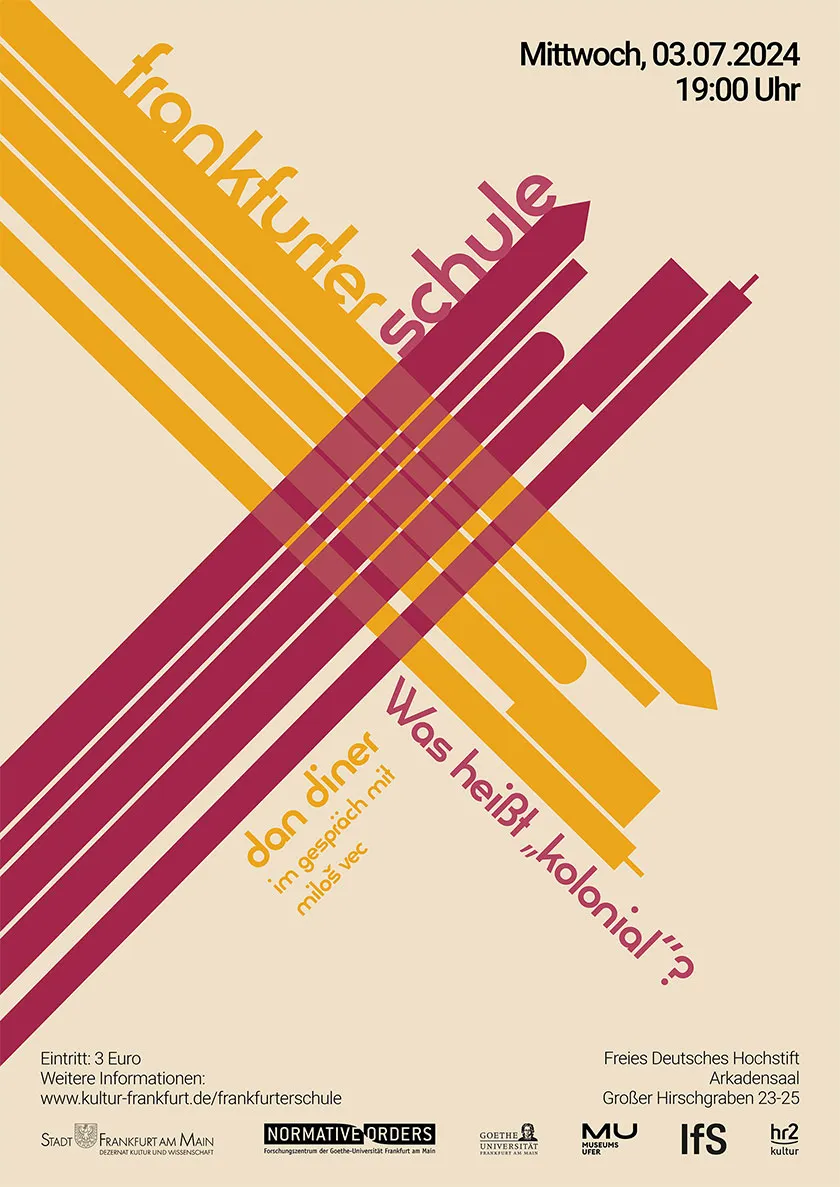
03.07.2024 | Frankfurt am Main
Lecture

What does “colonial” mean? On the significance of a historical qualification

Dan Diner (Professor Emeritus of Modern History at the Hebrew University of Jerusalem) in conversation with Miloš Vec (Professor of Legal and Constitutional History at the University of Vienna)

Today, the word “colonial” is used in so many different ways that it can be described as a veritable semantic inflation. Originally used for ‘overseas’ conditions of superiority and subordination, it has expanded to include a myriad of relationships of domination – both internal and external. The attribute “colonial” thus loses its original analytical meaning and degenerates into an all-purpose buzzword. The epistemic arsenal of the “social” and “national”, which originated in the 19th century and was essentially used to interpret hierarchically structured lifeworlds, is displaced. In the process, the core of real colonial constellations, such as those associated with the “discoveries” of European expansion in the early modern period and the conquests emanating from Europe in the age of colonialism in the 19th century, are lost. The event aims to address this extremely topical subject with the intention of enlightenment. The focus is on the history, concept and political use of phenomena associated with the “colonial”. Past and present thus enter into a dialog of knowledge.

Admission 3 Euro

Further information: www.kultur-frankfurt.de

About the “Frankfurt Schoolseries
Social norms, manifested in institutions and orders, form the foundation of our social and political coexistence. In the first half of the 20th century, the so-called Frankfurt School set out to take a holistic and (ideologically) critical look at these norms and their contradictions in the sense of a comprehensive “critical theory” – an approach whose significance and international impact remain unbroken to this day. But what does the Frankfurt School, which has always combined social analysis with ideological criticism, have to say about the current state of society? What answers does the so-called “third and fourth generation” provide to global crises and conflicts?

The “Frankfurt School” series will continue on a quarterly basis in various cultural institutions in Frankfurt. Guests are personalities who – trained in “Frankfurt thinking” – take a stand on current problems.
News from the research center

Publication
19.08.2026 | Anthology

Sokrates revised and revisited

Bohl, Judith K.; Brandis, Veronika; Pfeifer, Guido (Hrsg.) (2026): „Sokrates revised and revisited. Überlieferung, Diskurs, Inszenierung“. Heidelberg: Propylaeum. 

more information ›
Publication
14.08.2026 | Chapter

Vom rechtshistorischen Erkenntniswert antiker Tragödiendichtung: Überlegungen anhand Euripides’ Medeia

Pfeifer, Guido (2026): "Vom rechtshistorischen Erkenntniswert antiker Tragödiendichtung: Überlegungen anhand Euripides’ Medeia". In: Gsell, Beate; Rüfner, Thomas; Babusiaux, Ulrike (Hrsg.): Die unverzichtbare Wissenschaft – The Indispensable Science, Mohr Siebeck, S. 663-671.

more information ›
Publication
01.08.2026 | Chapter

"Das Andere in uns selbst" (Marcel Gauchet). Das Ideal gesellschaftlicher Autonomie und die Denkfigur der Alterität

Langner-Pitschmann, Annette (2026): „Das Andere in uns selbst“ (Marcel Gauchet). Das Ideal gesellschaftlicher Autonomie und die Denkfigur der Alterität. In: Schlette, Magnus et. al. (Hrsg.): Ordnung im Übergang Zur Funktion von Transzendenzbezügen in der Konstitution und Transformation politischer Gemeinschaft, Tübingen: Mohr Siebeck, S. 185-205.

more information ›
Event
24.09.2026 | Frankfurt am Main

Die neuen Warlords. Gewaltdynamiken einhegen / Friedensgutachten 2026

Book Presentation

Die imperialistische Großmachtpolitik ändert die Vorzeichen von Krieg, Frieden und Sicherheit. Staaten agieren zunehmend wie Warlords und setzen Krieg als Mittel der Politik ein. Übergänge von Gewaltkonflikten zu Frieden werden als „Deals“ behandelt, Mittelmächte treten mit neuem Selbstbewusstsein, aber ambivalentem Kurs auf, und technologische Innovation verändert Kriege und erschwert die Regulierung. Zugleich befindet sich die internationale Kooperation in der Friedenssicherung in ihrer schwersten Krise. Das Friedensgutachten 2026 analysiert Optionen, dennoch Frieden zu fördern.

more information ›
Publication
23.07.2026 | Journal article

Governing the Subject of Populism

Biebricher, Thomas: "Governing the Subject of Populism". In: European Journal of Social Theory, OnlineFirst.

more information ›
Publication
15.07.2026 | Monograph

Das Recht der Gewalt. Warum Waffen allein keinen Frieden schaffen

Simon, Hendrik (2026): Das Recht der Gewalt. Warum Waffen allein keinen Frieden schaffen. Ditzingen: Reclam.

more information ›
Publication
10.07.2026 | Anthology

Schnittstellen im Gesundheitsrecht

Kießling, Andrea (Hrsg.) (2026): „Schnittstellen im Gesundheitsrecht“. Nomos.

more information ›
News
19.06.2026

International symposium honours the lifework of Jürgen Habermas

On Friday 19 June 2026, the Research Centre Normative Orders, in collaboration with Suhrkamp Verlag, paid tribute to the late Jürgen Habermas with an international symposium at Goethe University Frankfurt.

more information ›
Publication
13.06.2026 | Monograph

Identitätsbasierte Führung: Vom ICH zum WIR. Als Führungskraft gesunde und leistungsstarke Gruppen, Teams und Organisationen fördern

van Dick, Rolf; Kratzer, Benedik E., Steffens, Niklas K., Kerschreiter, Rudolf (2026): „Identitätsbasierte Führung: Vom ICH zum WIR. Als Führungskraft gesunde und leistungsstarke Gruppen, Teams und Organisationen fördern“. Springer Berlin.

more information ›