Events calendar

What does “colonial” mean? On the significance of a historical qualification

Dan Diner (Professor Emeritus of Modern History at the Hebrew University of Jerusalem) in conversation with Miloš Vec (Professor of Legal and Constitutional History at the University of Vienna) Today, the word "colonial" is used in so many different ways that it can be described as a veritable semantic inflation. Originally used for 'overseas' conditions […]

more information ›

The Pedagogy of the Piratical

Bhaskar Sarkar (University of California, Santa Barbara) Even as techno-nationalist fantasies fuel India's dreams of superpowerdom, inserting the country into a universal narrative of global ascension via market liberalization, this talk begins from the premise that contemporary India's most inventive instances of home- spun entrepreneurialism remain outside the ambit of such top down mythologies. The […]

more information ›

Reimagining Mobility and Membership

Workshop The Transformations of Citizenship Leibniz Research Group will be discussing work-in-progress that deals with mobility, migration, and civic boundary-drawing from different disciplinary perspectives. The papers discussed comprise work by the Research Group's members as well as by external guests. Program 10.35 Welcome 10.45 "Immigration Politics in Times of Autocratization" Katharina Natter (Leiden), chaired by […]

more information ›

The Idea of the Public

Frankfurt Lectures "The Idea of the Public: Two Kantian Themes" Lecture by Prof Arthur Ripstein (Faculty of Law and Department of Philosophy, University of Toronto) Public institutions exercise powers that no private person can enjoy; they collect taxes, impose binding resolution on disputes, define and punish crimes and make difficult choices that benefit some people […]

more information ›

Giving Laws to Ourselves

Frankfurt Lectures "The Idea of the Public: Two Kantian Themes" Lecture by Prof Arthur Ripstein (Faculty of Law and Department of Philosophy, University of Toronto) The Kantian idea of freedom objects to any situation in which one person is subject to the private choice of another. Public institutions can only act through individual natural persons, […]

more information ›

Lunchtalk for women and Early Career Researchers with Grada Kilomba

In an informal lunch setting, we aim to open a space for Grada Kilomba to talk about her experiences and insights into knowledge production within and without academia and the praxis of performing knowledge. Please register in advance: Here... Grada Kilomba is a Berlin-based Portuguese artist, whose work draws on memory, trauma and post-colonialism. Using […]

more information ›

No end to history? Historiography since the 1990s

Kantorowicz Lecture 2024 With Prof. Dr.Monika Dommann (Professor of Modern History, University of Zurich) 35 years after the end of history proclaimed in 1989, the lecture looks back on the transformation of historiography since the 1990s from the perspective of the history of knowledge and media. How has historiography changed since it increasingly became an […]

more information ›

Global Health Justice: Bridging Theory & Practice

International Conference organized by the Goethe University Global Health Justice Postdoctoral Program There are currently vast asymmetries both within and between countries when it comes to the matter of who experiences good health. Some people enjoy long lives largely characterized by the absence of illness and can access high-quality medical treatment when illness does arise. […]

more information ›

News from the research center

Event
18.04.2026 | Frankfurt am Main

Das Prinzip Donald Trump und die Verrohung der Welt

Panel Discussion, Lecture

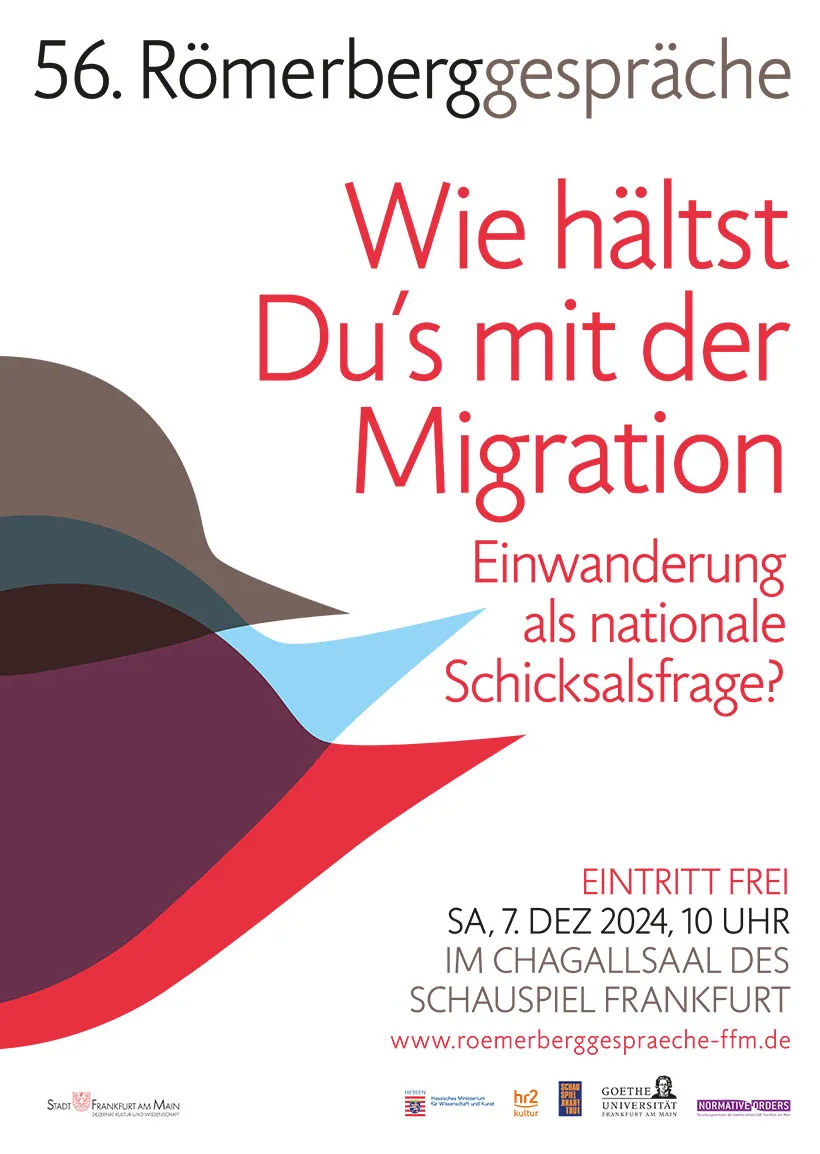
Ein neuer Politikstil macht international Karriere. Er ist gekennzeichnet von Vulgarität, Verrohung und erklärter Rechtsfeindschaft. Machtinteressen werden nicht mehr juristisch bemäntelt. Stattdessen wird das angebliche Recht des Stärkeren zur Staatsdoktrin gemacht – innenpolitisch wie außenpolitisch. Treibende Kraft hinter dieser Verrohung der politischen Sitten ist ein US-Präsident, der nicht nur die amerikanische Gesellschaft und Kultur, sondern auch die globale Ordnung nach seinen Vorstellungen und Interessen umgestaltet. Die Römerberggespräche wollen diesen Politikstil verstehen.

more information ›
Event
29.04.2026 | Frankfurt am Main

Kulturindustrie heute?

Panel Discussion

Das Gespräch „Kulturindustrie heute?“ widmet sich der Aktualität und Tragfähigkeit eines zentralen Begriffs der Kritischen Theorie. Die Filmwissenschaftlerin Gertrud Koch diskutiert im Rahmen der Gesprächsreihe "Frankfurter Schule" mit dem Filmkritiker Bert Rebhandl die gegenwärtigen Formen kultureller Produktion und Verbreitung vor dem Hintergrund von Digitalisierung, Plattformen und globalen Medienmärkten.

more information ›
Event
20.03.2026 | Frankfurt am Main

40 Jahre Schengen-Raum

Colloquium

Der 1984 geschlossene Schengen-Vertrag schuf einen heute 29 Staaten umfassenden Raum ohne Binnengrenzen, doch Migration über die Außengrenzen führte zuletzt zur Wiedereinführung von Kontrollen, auch durch die Bundesregierung ab 8. Mai 2025. Das Walter Hallstein-Kolloquium diskutiert die rechtliche Zulässigkeit, wirtschaftliche Folgen insbesondere für Arbeitsmigration und Arbeitsmarkt sowie die Zukunft des Schengen-Raums.

more information ›
News
12.02.2026

Satanist politics and the decline of reason in liberal democracies

For the last time in the winter semester 2025/26, the Research Center hosted the lecture series "Am Scheidepunkt. On the crisis of democracy". At the end, philosopher Michael Rosen from Harvard University presented his concept of "satanic politics" as a variant of the political interpretation of the world.

more information ›
News
09.02.2026

On the topicality of the concept of violence based on Camus and Derrida

Prof. Dr. Christine Abbt from the University of St. Gallen gave a lecture on democracies and the concept of violence as part of the lecture series "At the crossroads? On the crisis of democracy", she gave a lecture on democracies and the concept of violence. Under the title "Defending democracies. On the topicality of the concept of violence in Camus and Derrida", the philosopher discussed forms of violence and revolt and categorized them with regard to a democratic setting.

more information ›
Publication
04.02.2026 | Journal article

New Perspectives on Trust in International Conflicts

Wille, Tobias; Simon, Hendrik; Daase, Christopher; Deitelhoff, Nicole; Wheeler, Nicholas J.; Holmes, Marcus; Rathbun, Brian C.; Acharya, Amitav; Mitzen, Jennifer (2026): „New Perspectives on Trust in International Conflicts“. In: International Studies Review 28 (1), viaf027.

more information ›
News
02.02.2026

States competing for people - David Owen on civil geopolitics

As part of the lecture series "At the Crossroads - The Future of Democracy", David Owen from the University of Southampton presented his concept of civil geopolitics.

more information ›
News
20.01.2026

Christine Hentschel on reorientation in catastrophic times

As part of the lecture series "At the crossroads? On the crisis of democracy", the sociologist spoke about living in and dealing with catastrophic times. Against the backdrop of the destruction of living conditions, wars, permanent crises and threats to democracy, Hentschel addressed the infiltration of the catastrophic into everyday social life and a changing activist and literary approach to the future.

more information ›
Publication
08.01.2026 | Journal article

Gender Differences in Financial Advice

Bucher-Koenen, Tabea; Hackethal, Andreas; Koenen, Johannes; Laudenbach, Christine (2025): „Gender Differences in Financial Advice“. In: American Economic Review, 115 (12), pp. 4218–4252.

more information ›