
11.07.2024
Monograph

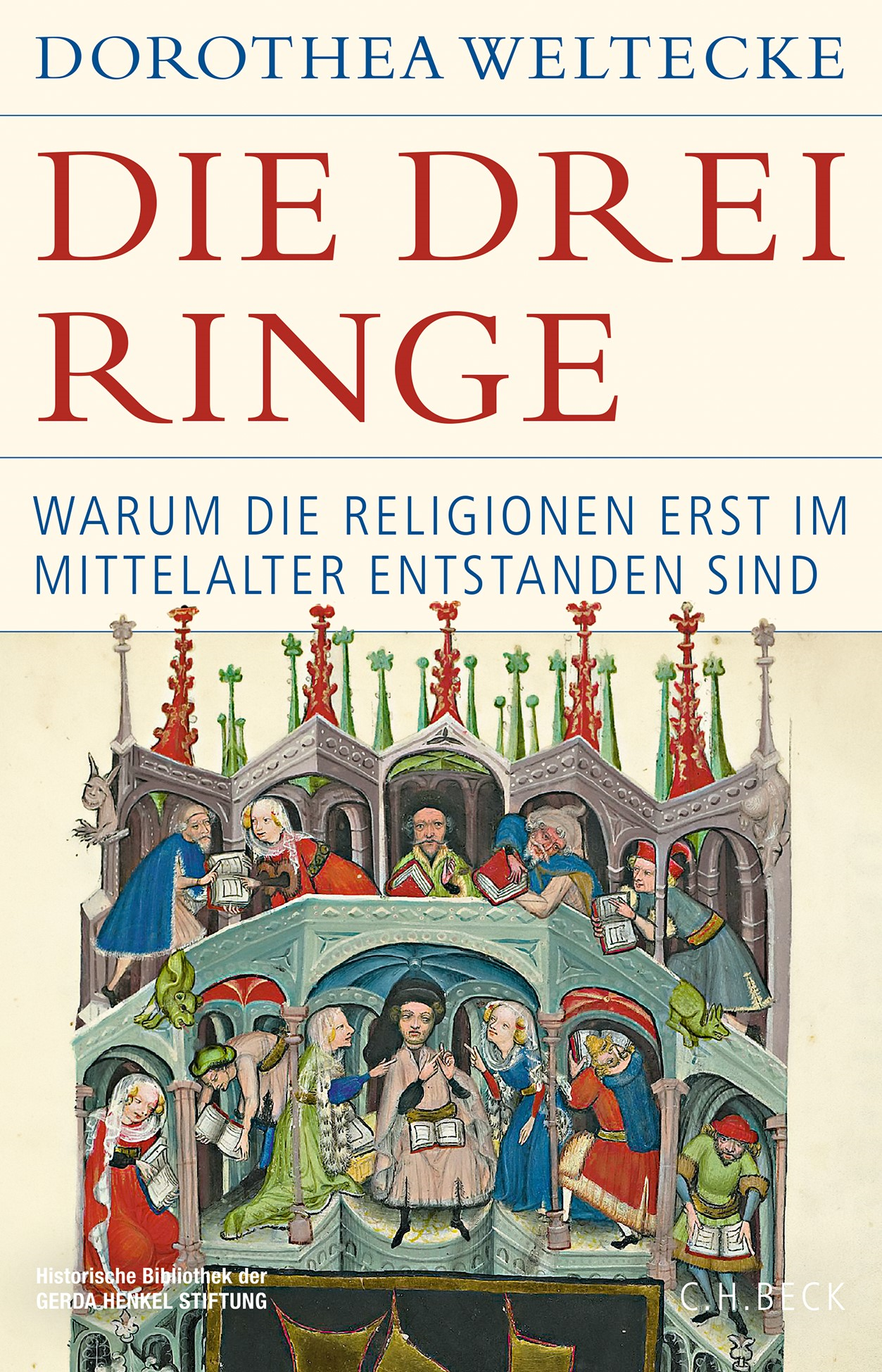
The three rings: Why religions only emerged in the Middle Ages

Summary:

In the parable of the three rings, the brothers argue about the inheritance they received from their father. In the Middle Ages, Jews, Christians and Muslims were very aware that their traditions were related. Historian Dorothea Weltecke shows that their conflict-ridden yet shared history in the vast area between the Atlantic, the Nile and the Indus gave rise to the exclusive “religions” in the first place.
The tomb of the prophet Ezekiel near Baghdad was a destination for Jewish, Muslim and Christian pilgrims in the Middle Ages. Dorothea Weltecke uses this and many other examples to illustrate how intensively the religious communities exchanged ideas. Together they built a new cultural landscape. Jews, Christians and Muslims knew in the Middle Ages that their traditions were related. In the parable of the three rings, however, the brothers argue about the inheritance they received from their common father. It was not their claims to truth that became problematic for the relationship between the religious communities in the Middle Ages, but new legal distinctions between believers, the merely tolerated and the non-tolerated. The theories and the violence with which this inequality was continuously justified and maintained militarized the boundaries between the faith traditions. The book thus impressively exposes a layer of religious history that was buried by the lava flow of polemics.
News from the research center

Event
23./24.06.2026 | Frankfurt am Main

The Legacy of Kant’s Political Philosophy

Workshop

A two-day workshop on Howard Williams‘ new book about Immanuel Kant‘s political philosophy.

more information ›
Event
01./03.07.2026 | Frankfurt am Main

Sexual Agency

Conference

A three-day conference about sexual agency, covering questions of autonomy, responsibility, power, consent, desire and embodiement. Organized by Manon Garcia and Milena Bartholain.

more information ›
News
19.06.2026

Internationales Symposium würdigt Lebenswerk von Jürgen Habermas

Am Freitag, den 19. Juni 2026, würdigte das Forschungszentrum Normative Orders gemeinsam mit dem Suhrkamp-Verlag den verstorbenen Jürgen Habermas mit einem internationalen Symposium an der Goethe-Universität Frankfurt.

more information ›
News
18.05.2026

Videopodcast-Reihe „Our Planet, Our Health“ gestartet

Mit „Our Planet, Our Health“ startet eine neue Videopodcast-Reihe zu Fragen globaler Gesundheitsgerechtigkeit. Die Reihe, gehostet von Dr. Romina Rekers, ist eine Initiative des Global Health Justice Postdoctoral Programme (GHJ), gefördert von der Höppschen Stiftung.

more information ›
Publication
12.05.2026 | Online article

Disinhibited Informalization: Talk Radio, Bro Podcasts and the Aesthetics of Populism

Völz, Johannes (2026): "Disinhibited Informalization: Talk Radio, Bro Podcasts and the Aesthetics of Populism". In: b2o - boundary 2 online.

more information ›
Event
25./26.06.2026 | Frankfurt

DGTF Conference 2026: Shifting Regimes, Changing Orders

Conference

Conference as part of WDC 2026 in collaboration with Deutsche Gesellschaft für Designtheorie und -forschung (DGTF), Kunstgewerbemuseum/Design Campus SKD and Design and Democracy

more information ›
Publication
22.04.2026 | Chapter

Körpergeschlecht und Selbstbestimmung

Britz, Gabriele (2026): "Körpergeschlecht und Selbstbestimmung". In. Mangold, Anna Katharina; Völzmann, Berit (Hrsg.): Gerechtigkeit als Thema der Rechtswissenschaft, Nomos, S. 41-48.

more information ›
Publication
22.04.2026 | Chapter

Festrede zu Ehren von Prof. Dr. Dr. h.c. Ute Sacksofsky, M.P.A. (Harvard), 4. April 2025

Schmidt, Rebecca Caroline; Forst, Rainer; Günther, Klaus (2026): "Festrede zu Ehren von Prof. Dr. Dr. h.c. Ute Sacksofsky, M.P.A. (Harvard), 4. April 2025". In: Mangold, Anna Katharina; Völzmann, Berit (Hrsg.): Gerechtigkeit als Thema der Rechtswissenschaft, Nomos, S. 13-18.

more information ›