

30.06.2023
Chapter

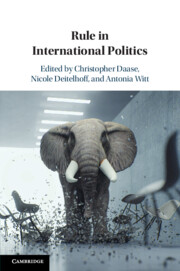
The Elephant in the Room of International Relations: Rule in the Study of International Politics

International Relations scholars are increasingly studying different forms of sub- and superordination in the international system through analytical lenses such as hierarchy, hegemony, or authority. Drawing on these debates, this introduction sets out to establish the concept of rule as the defining feature of order in the international realm. More specifically, we argue that the manifold conceptual approaches to sub- and superordination in the international should be understood as rich conceptualizations of one concept: rule. We define rule broadly as constellations of formally or informally institutionalized sub- and superordination with the aim of affecting the distribution of basic goods and influence and of stabilizing expectations, regardless of whether these constellations are primarily of sociocultural, economic, or military nature. With this, we aim at advancing a research agenda that defines rule as a systematic approach to studying international politics. By promoting the concept of rule, we aim to show that rule can serve both as an integrating and a diagnostic tool for the study of the international “beyond anarchy.”
News from the research center

News
19.06.2026

International symposium honours the lifework of Jürgen Habermas

On Friday 19 June 2026, the Research Centre Normative Orders, in collaboration with Suhrkamp Verlag, paid tribute to the late Jürgen Habermas with an international symposium at Goethe University Frankfurt.

more information ›
News
18.05.2026

Videopodcast-Reihe „Our Planet, Our Health“ gestartet

Mit „Our Planet, Our Health“ startet eine neue Videopodcast-Reihe zu Fragen globaler Gesundheitsgerechtigkeit. Die Reihe, gehostet von Dr. Romina Rekers, ist eine Initiative des Global Health Justice Postdoctoral Programme (GHJ), gefördert von der Höppschen Stiftung.

more information ›
Publication
12.05.2026 | Online article

Disinhibited Informalization: Talk Radio, Bro Podcasts and the Aesthetics of Populism

Völz, Johannes (2026): "Disinhibited Informalization: Talk Radio, Bro Podcasts and the Aesthetics of Populism". In: b2o - boundary 2 online.

more information ›
Publication
22.04.2026 | Chapter

Körpergeschlecht und Selbstbestimmung

Britz, Gabriele (2026): "Körpergeschlecht und Selbstbestimmung". In. Mangold, Anna Katharina; Völzmann, Berit (Hrsg.): Gerechtigkeit als Thema der Rechtswissenschaft, Nomos, S. 41-48.

more information ›
Publication
22.04.2026 | Chapter

Festrede zu Ehren von Prof. Dr. Dr. h.c. Ute Sacksofsky, M.P.A. (Harvard), 4. April 2025

Schmidt, Rebecca Caroline; Forst, Rainer; Günther, Klaus (2026): "Festrede zu Ehren von Prof. Dr. Dr. h.c. Ute Sacksofsky, M.P.A. (Harvard), 4. April 2025". In: Mangold, Anna Katharina; Völzmann, Berit (Hrsg.): Gerechtigkeit als Thema der Rechtswissenschaft, Nomos, S. 13-18.

more information ›
Publication
22.04.2026 | Anthology

Gerechtigkeit als Thema der Rechtswissenschaft: Kontinuität und Wandel in intergenerationeller Betrachtung

Mangold, Anna Katharina; Völzmann, Berit (Hrsg.) (2026): "Gerechtigkeit als Thema der Rechtswissenschaft: Kontinuität und Wandel in intergenerationeller Betrachtung". Nomos.

more information ›
Event
14.07.2026 | Frankfurt am Main

Democracy Over Time and the Climate Crisis

Lecture Series

Vortrag von Anja Karnein (Binghamton). Die Vortragsreihe untersucht Fragen der Klimakrise als Herausforderungen für demokratische Gesellschaften und konzentriert sich auf Themen wie politische Legitimität, Widerstand gegen fossile Brennstoffe und die Interessen künftiger Generationen. Sie wird organisiert von Prof. Dr. Darrel Moellendorf und Dr. Lukas Sparenborg.

more information ›
Publication
11.03.2026 | Chapter

Von Poujade über Berlusconi zu Trump. Eine Genealogie des libertären Patrimonialismus

Biebricher, Thomas (2026): „Von Poujade über Berlusconi zu Trump. Eine Genealogie des libertären Patrimonialismus“. In: Geiselberger, Heinrich (Hrsg.): Oben rechts. Rechtspopulismus als Klassenprojekt, Suhrkamp, S. 103-144.

more information ›