

24.08.2023
Monograph

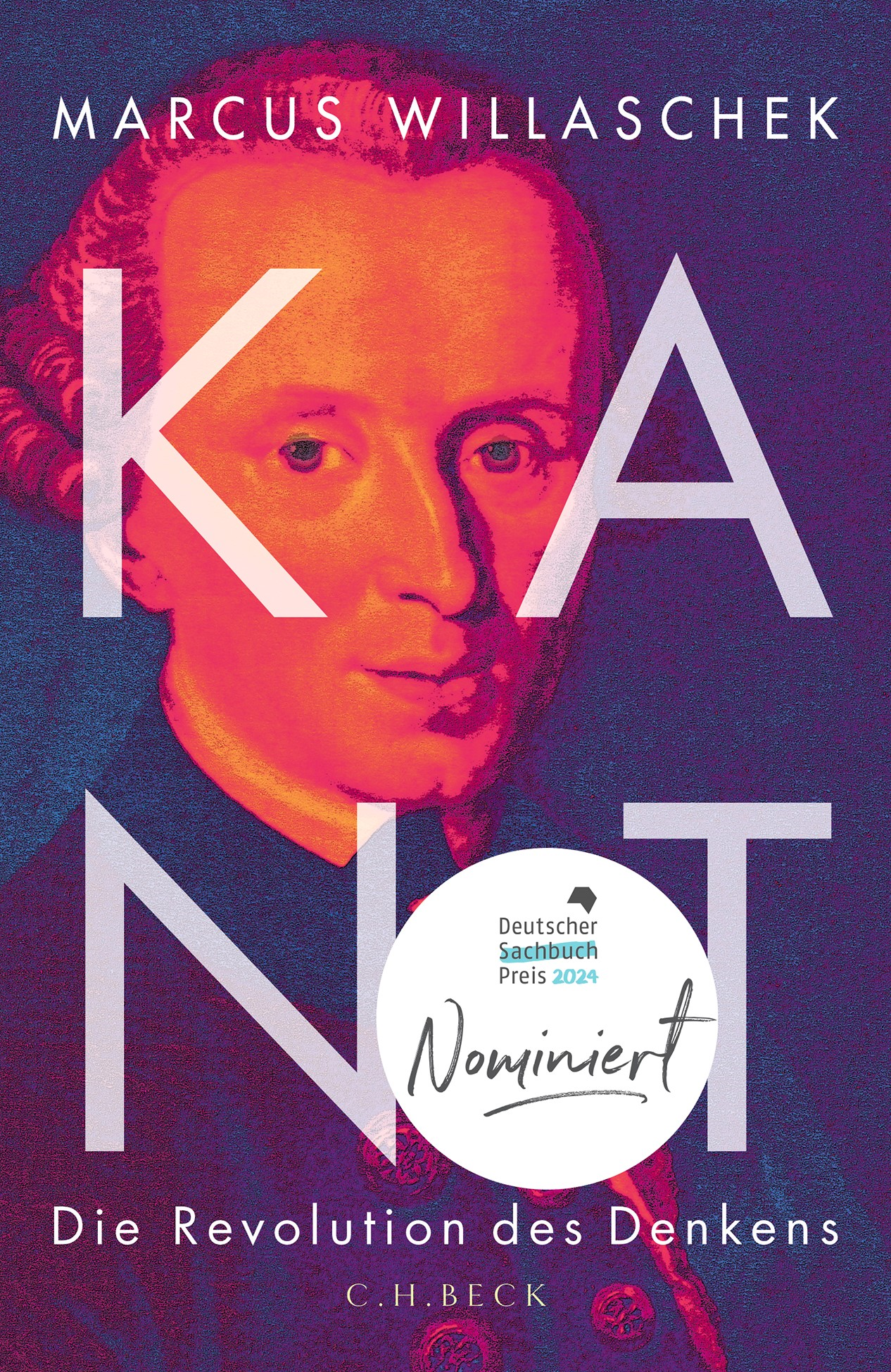
Kant: The revolution of thought

About the book:

Immanuel Kant, the most important philosopher of modern times, was born 300 years ago. But his revolutionary thinking is still relevant today. Kant explains the origin of our planetary system, establishes a new form of metaphysics and formulates the categorical imperative. Kant paved the way for cosmopolitanism and the idea of human dignity. His thinking not only shaped philosophy and science, but also the German constitution and the United Nations. In his book, Marcus Willaschek describes the many facets of Kant’s revolution of thought, which places the active human being at the center of the world, in an understandable and vivid way.

Willaschek’s book traces Kant’s revolution of thought through his entire oeuvre. It thus provides a comprehensive insight into his philosophy. In thirty short chapters, each readable in its own right, Willaschek presents the various themes and aspects of Kant’s thought clearly, succinctly and comprehensibly. His descriptions are interwoven with biographical and historical miniatures, so that a picture of Immanuel Kant as a person and philosopher in his time also emerges. At the same time, the current relevance – and occasionally also the problematic nature – of his revolutionary thought becomes clear.
News from the research center

Event
09./10.07.2026 | Frankfurt am Main

Democracy: Principles and Practice, Resilience and Innovation

Conference

Annual Conference of the Research Program "Zeitenwenden. Normative Ordnungen im Umbruch?" with Arthur Ripstein, Astrid Séville, John McCormick, Nadia Urbinati, Claudia Landwehr, Hubertus Buchstein and Peter Niesen.

more information ›
News
19.06.2026

International symposium honours the lifework of Jürgen Habermas

On Friday 19 June 2026, the Research Centre Normative Orders, in collaboration with Suhrkamp Verlag, paid tribute to the late Jürgen Habermas with an international symposium at Goethe University Frankfurt.

more information ›
News
18.05.2026

Videopodcast-Reihe „Our Planet, Our Health“ gestartet

Mit „Our Planet, Our Health“ startet eine neue Videopodcast-Reihe zu Fragen globaler Gesundheitsgerechtigkeit. Die Reihe, gehostet von Dr. Romina Rekers, ist eine Initiative des Global Health Justice Postdoctoral Programme (GHJ), gefördert von der Höppschen Stiftung.

more information ›
Publication
12.05.2026 | Online article

Disinhibited Informalization: Talk Radio, Bro Podcasts and the Aesthetics of Populism

Völz, Johannes (2026): "Disinhibited Informalization: Talk Radio, Bro Podcasts and the Aesthetics of Populism". In: b2o - boundary 2 online.

more information ›
Publication
22.04.2026 | Chapter

Körpergeschlecht und Selbstbestimmung

Britz, Gabriele (2026): "Körpergeschlecht und Selbstbestimmung". In. Mangold, Anna Katharina; Völzmann, Berit (Hrsg.): Gerechtigkeit als Thema der Rechtswissenschaft, Nomos, S. 41-48.

more information ›
Publication
22.04.2026 | Chapter

Festrede zu Ehren von Prof. Dr. Dr. h.c. Ute Sacksofsky, M.P.A. (Harvard), 4. April 2025

Schmidt, Rebecca Caroline; Forst, Rainer; Günther, Klaus (2026): "Festrede zu Ehren von Prof. Dr. Dr. h.c. Ute Sacksofsky, M.P.A. (Harvard), 4. April 2025". In: Mangold, Anna Katharina; Völzmann, Berit (Hrsg.): Gerechtigkeit als Thema der Rechtswissenschaft, Nomos, S. 13-18.

more information ›
Publication
22.04.2026 | Anthology

Gerechtigkeit als Thema der Rechtswissenschaft: Kontinuität und Wandel in intergenerationeller Betrachtung

Mangold, Anna Katharina; Völzmann, Berit (Hrsg.) (2026): "Gerechtigkeit als Thema der Rechtswissenschaft: Kontinuität und Wandel in intergenerationeller Betrachtung". Nomos.

more information ›
Event
14.07.2026 | Frankfurt am Main

Democracy Over Time and the Climate Crisis

Lecture Series

Vortrag von Anja Karnein (Binghamton). Die Vortragsreihe untersucht Fragen der Klimakrise als Herausforderungen für demokratische Gesellschaften und konzentriert sich auf Themen wie politische Legitimität, Widerstand gegen fossile Brennstoffe und die Interessen künftiger Generationen. Sie wird organisiert von Prof. Dr. Darrel Moellendorf und Dr. Lukas Sparenborg.

more information ›