

15.09.2025
Working Paper

Der Globale Pandemievertrag

Abstract
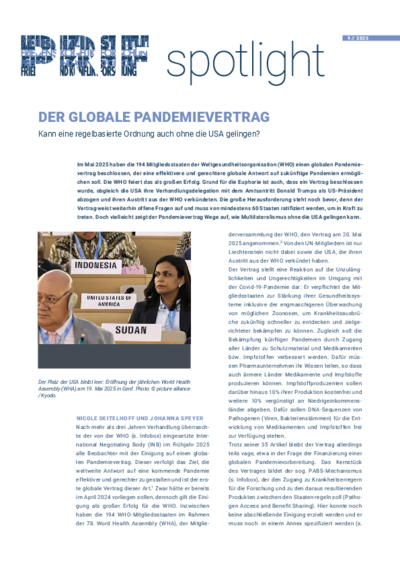
Im Mai 2025 haben die 194 Mitgliedsstaaten der Weltgesundheitsorganisation (WHO) einen globalen Pandemievertrag beschlossen, der eine effektivere und gerechtere globale Antwort auf zukünftige Pandemien ermöglichen soll. Die WHO feiert das als großen Erfolg. Grund für die Euphorie ist auch, dass ein Vertrag beschlossen wurde, obgleich die USA ihre Verhandlungsdelegation mit dem Amtsantritt Donald Trumps als US-Präsident abzogen und ihren Austritt aus der WHO verkündeten. Die große Herausforderung steht noch bevor, denn der Vertrag weist weiterhin offene Fragen auf und muss von mindestens 60 Staaten ratifiziert werden, um in Kraft zu treten. Doch vielleicht zeigt der Pandemievertrag Wege auf, wie Multilateralismus ohne die USA gelingen kann.
News from the research center

Publication
08.01.2026 | Journal article

The rural-urban divide in Europe

Riera, Pedro; Roßteutscher, Sigrid (Hrsg.) (2025): „The rural-urban divide in Europe: Assessing its impact on political attitudes and voting behavior“. In: Electoral Studies, Special Issue.

more information ›
Publication
08.01.2026 | Journal article

Gender Differences in Financial Advice

Bucher-Koenen, Tabea; Hackethal, Andreas; Koenen, Johannes; Laudenbach, Christine (2025): „Gender Differences in Financial Advice“. In: American Economic Review, 115 (12), pp. 4218–4252.

more information ›
News
11.12.2025

Jonathan White on future thinking in democracies

On the second date of the lecture series "At the crossroads? On the crisis of democracy". Political scientist White discusses views on the future of democracies. A follow-up report

more information ›
News
04.12.2025

The crisis of democratic theory from a sociological perspective

Sociologist Jenny Brichzin's lecture "Crisis of Democratic Theory? A sociological intervention" opened our lecture series "At the crossroads? On the future of democratic theory". The sociologist criticized the fact that social coexistence has so far been insufficiently addressed in democratic theory. A follow-up report

more information ›
Publication
03.12.2025 | Journal article

The Archipelago Capitalism of Citizenship-By-Investment

Džankić, Jelena; Seyfettinoglu, Mira; Shachar, Ayelet; Vink, Maarten; Baaren, Luuk van der (2025): „The Archipelago Capitalism of Citizenship-By-Investment“. In: Comparative Political Studies, OnlineFirst.

more information ›
Publication
01.12.2025

Non-Fiction Cinema in Postwar Europe

Hediger, Vinzenz (2025): „Preface: (Re)Building Europe through Cinema (Studies)”. In: Cesalkova, Lucia, et al. (eds.): Non-Fiction Cinema in Postwar Europe. Visual Culture and the Reconstruction of Public Space. Amsterdam University Press.

more information ›
Publication
21.11.2025 | Chapter

Die Möglichkeiten des Einsatzes von Multi-Party-Computation beim Datenaustausch zwischen Sicherheitsbehörden als Grundlage der Qualitätssicherung von KI-Anwendungen

Müllmann, Dirk; Spiecker gen. Döhmann, Indra (2025): „Die Möglichkeiten des Einsatzes von Multi-Party-Computation beim Datenaustausch zwischen Sicherheitsbehörden als Grundlage der Qualitätssicherung von KI-Anwendungen“. In: Honekamp, Wilfried; Kemme, Stefanie; Struck, Jens: Auswirkungen von Künstlicher Intelligenz auf die zukünftige Polizeiarbeit. Springer.

more information ›
Publication
21.11.2025 | Chapter

Die Sicherheit der Zukunft – Künstliche Intelligenz und soziale Kontrolle: Vom Predictive Policing zum Social Scoring

Singelnstein, Tobias (2025): „Die Sicherheit der Zukunft – Künstliche Intelligenz und soziale Kontrolle: Vom Predictive Policing zum Social Scoring“. In: Honekamp, Wilfried; Kemme, Stefanie; Struck, Jens: Auswirkungen von Künstlicher Intelligenz auf die zukünftige Polizeiarbeit. Springer.

more information ›
Publication
21.11.2025 | Anthology

Handbook of Leadership. Applied Business Psychology for Managers

Felfe, Jörg; Dick, Rolf van (eds.) (2025): Handbook of Leadership. Applied Business Psychology for Managers. Springer.

more information ›