

A radical approach to popular sovereignty
An obituary for Prof. Dr. Ingeborg Maus (1937-2024)
With the death of Ingeborg Maus, who passed away on December 14 at the age of 87, Goethe University and the community of researchers have lost one of the most important political theorists of our time. Her thinking left a lasting mark on Frankfurt and national political science and jurisprudence in a special way – through the most radical interpretation of the principle of popular sovereignty that is compatible with the structures of the modern state.
Ingeborg Maus, born in Wiesbaden in 1937, studied political science, German and philosophy in Frankfurt and Berlin. Her doctorate in Frankfurt in 1971, supervised by Carlo Schmid and Christian Graf von Krockow, already dealt with her life’s theme: the constitutional power of all citizens and how it could be translated into positive, democratic law – in contrast to theories of law and the state that ranged from Carl Schmitt to contemporary legal thinking. For Maus, the general form of law was to be strictly preserved in order to enable the freedom and equality of all and to defend it against the self-authorization of executives and the legal overarching of popular sovereignty. Her book Bürgerliche Rechtstheorie und Faschismus (Civil Legal Theory and Fascism) from 1976 set this out, as did her later book on legal theory and political theory in late capitalism (1986).
After working as a research assistant and completing her habilitation in Frankfurt in 1980, she taught at Goethe University and at various universities in Germany and Japan before becoming a member of the working group on legal theory founded by Jürgen Habermas with funding from the Leibniz Prize. There, the author of these lines was able to experience the commitment with which Ingeborg Maus adhered to the basic principles of the modern democratic constitutional state. Rousseau and Kant in particular provided the philosophical foundations for her thinking, which was able to move elegantly between the history of ideas, philosophy and current democratic and legal theory. All of this flowed into her main work, Zur Aufklärung der Demokratietheorie, which appeared in 1992 and may be considered unrivalled in the consistency with which she interprets Kant’s political philosophy in a radically democratic way and pursues the captivating idea that the democratic self-legislation of the people follows the same structural logic of strict universalization as the categorical imperative in Kant’s moral philosophy. In this way, practical reason becomes a political-legal, institutional reality.
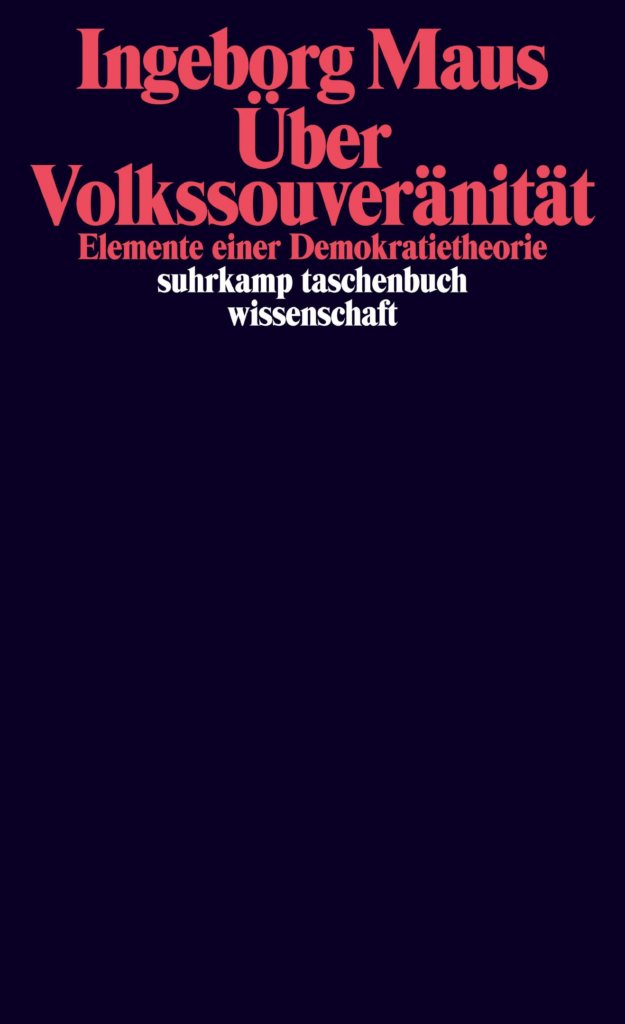
In 1992, Ingeborg Maus was appointed Professor of Political Theory and History of Ideas, succeeding Iring Fetscher, and developed an extensive teaching career that was driven by a positive enthusiasm for the principles of democracy understood in the right way as well as by criticism of the “refeudalization” of law and politics in de-formalized and legally over-regulated systems of rule.
After her retirement in 2003, she published a series of important works in which she elaborated on her concept of popular sovereignty, human rights and peace policy as well as her criticism of the judiciary as a “social superego”. These positions round off the picture of a comprehensive, stringently developed political theory based on clear basic ideas, which can be regarded as the purest form of the modern concept of democratic citizenship.
Ingeborg Maus will be remembered as both a great theorist and the wonderful person she was.