02.02.2026

States competing for people – David Owen on civil geopolitics

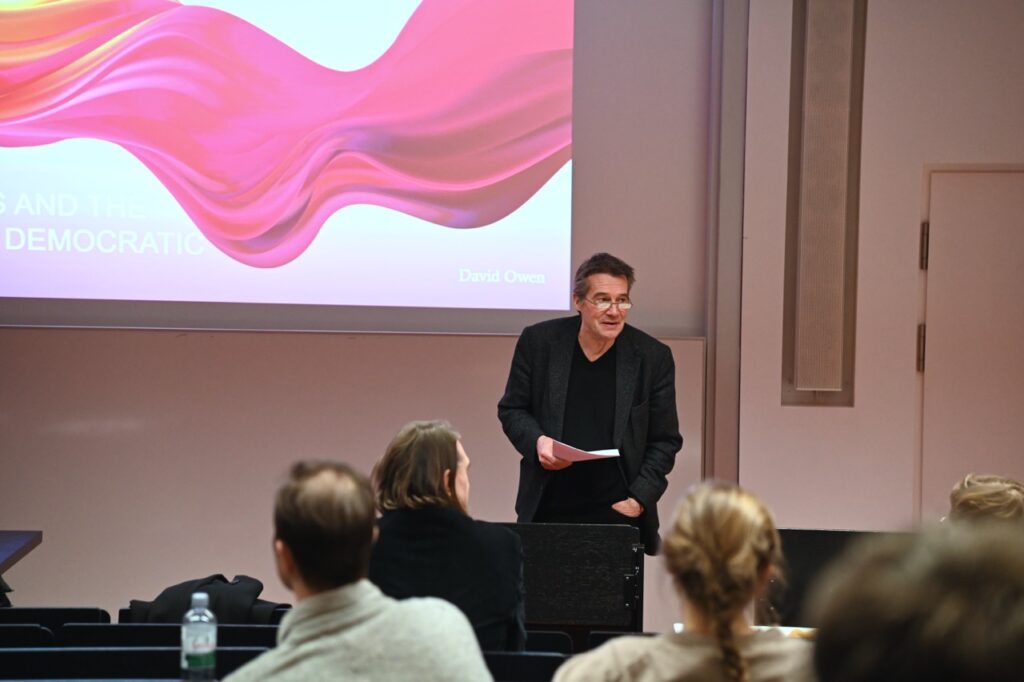
On the fourth date of the lecture series “At the Crossroads – The Crisis of Democracy”, David Owen from the University of Southampton presented and explained his concept of civil geopolitics. According to him, “civil geopolitics” is the competition between states for people, which works by creating, advertising and promoting connections within the citizenry as well as rejecting and refusing other connections.
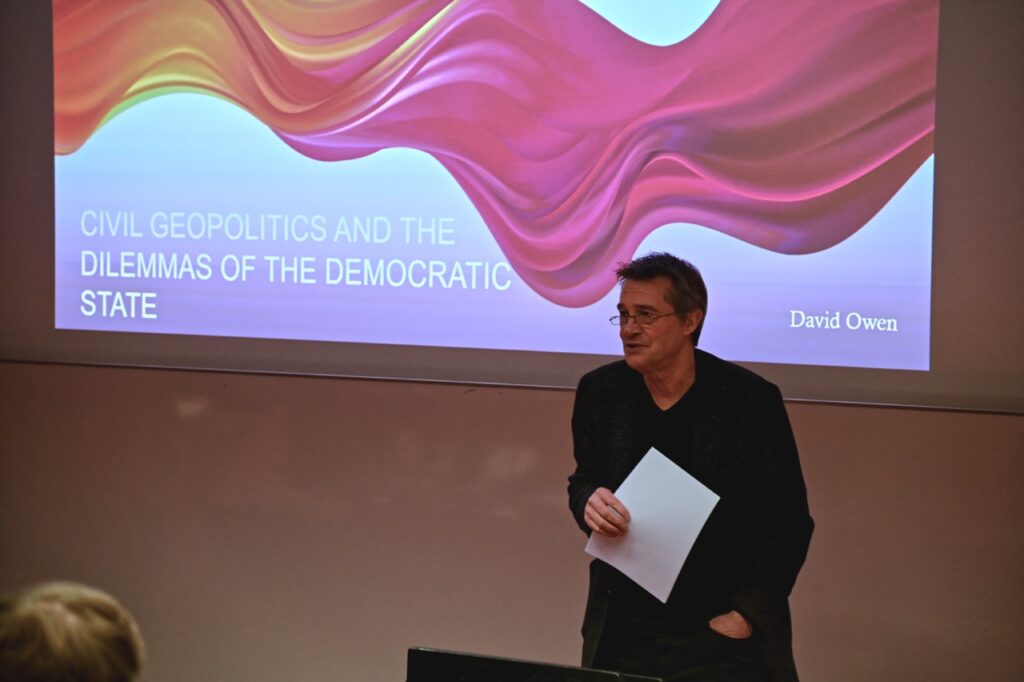
Civil geopolitics is the conceptualization of a well-known phenomenon of global geopolitics. This was evident in the 17th and 18th centuries, when the immigration of workers was promoted or restricted by states. However, it was not until the second half of the 20th century that this type of policy became an important branch of state geopolitics, whereas previously the competition for territory had played a more dominant role. Meanwhile, the governance of citizenship and civic belonging has become an integral part of state policy. Individuals and groups have thus become a geopolitical project, according to Owen.

He explained various transformations that have made these developments possible: the rise of state institutions in contact with diaspora communities, the increasing tolerance of dual citizenship and the expansion of extraterritorial voting rights. Added to this are new communication technologies and travel opportunities, which give states new possibilities in their relations with those who leave their territory.

These transformations result in new state geopolitical strategies. For example, denationalization, i.e. the withdrawal of citizenship, is increasingly being discussed, even though this is rarely applied in reality. Increased opportunities to acquire citizenship with so-called “golden passports”, the politically influenced granting of citizenship and extraterritorial voting rights as well as the granting of citizenship as reparation to compensate for historical injustices can also be observed.

At the end of the lecture, the politics professor presented four ideal types of citizenship that arise from the previous considerations: classical citizenship based on national affiliation, affiliation on a territorial basis (for example in New Zealand), as well as cosmopolitan forms of transactional and transnational citizenship. Today, there is a mixture of several of these ideal types. According to Owen, the question of what citizenship means today can no longer be answered unambiguously.

News from the research center

News
02.02.2026

States competing for people - David Owen on civil geopolitics

As part of the lecture series "At the Crossroads - The Future of Democracy", David Owen from the University of Southampton presented his concept of civil geopolitics.

more information ›
News
20.01.2026

Christine Hentschel on reorientation in catastrophic times

As part of the lecture series "At the crossroads? On the crisis of democracy", the sociologist spoke about living in and dealing with catastrophic times. Against the backdrop of the destruction of living conditions, wars, permanent crises and threats to democracy, Hentschel addressed the infiltration of the catastrophic into everyday social life and a changing activist and literary approach to the future.

more information ›
Publication
08.01.2026 | Journal article

Gender Differences in Financial Advice

Bucher-Koenen, Tabea; Hackethal, Andreas; Koenen, Johannes; Laudenbach, Christine (2025): „Gender Differences in Financial Advice“. In: American Economic Review, 115 (12), pp. 4218–4252.

more information ›
Publication
19.12.2025 | Anthology

Faszination und Freiheit 

Günther, Klaus; Zabel, Benno (Hrsg.) (2025): Faszination und Freiheit - Gegenwartsdiagnosen im Anschluss an Christoph Menkes Theorie der Befreiung, Weilerswist (Velbrück Wissenschaft).

more information ›
Publication
12.12.2025 | Anthology

Zwischen Transformation und Abolitionismus. Das Strafrecht und die Vielfalt der Alternativen

Tobias Singelnstein, Christoph Burchard (2025)

more information ›
Publication
12.12.2025 | Chapter

Was bleibt von der Verantwortung jenseits der Strafe übrig?

Günther, Klaus (2025): „Was bleibt von der Verantwortung jenseits der Strafe übrig?“. In: Zabel Benno; Singelnstein; Tobias und Burchard, Christoph (Hrsg.): Zwischen Transformation und Abolitionismus. Das Strafrecht und die Vielfalt der Alternativen. Velbrück Wissenschaft, S. 207-241.

more information ›
News
11.12.2025

Jonathan White on future thinking in democracies

On the second date of the lecture series "At the crossroads? On the crisis of democracy". Political scientist White discusses views on the future of democracies. A follow-up report

more information ›
News
04.12.2025

The crisis of democratic theory from a sociological perspective

Sociologist Jenny Brichzin's lecture "Crisis of Democratic Theory? A sociological intervention" opened our lecture series "At the crossroads? On the future of democratic theory". The sociologist criticized the fact that social coexistence has so far been insufficiently addressed in democratic theory. A follow-up report

more information ›
Publication
03.12.2025 | Journal article

The Archipelago Capitalism of Citizenship-By-Investment

Džankić, Jelena; Seyfettinoglu, Mira; Shachar, Ayelet; Vink, Maarten; Baaren, Luuk van der (2025): „The Archipelago Capitalism of Citizenship-By-Investment“. In: Comparative Political Studies, OnlineFirst.

more information ›