

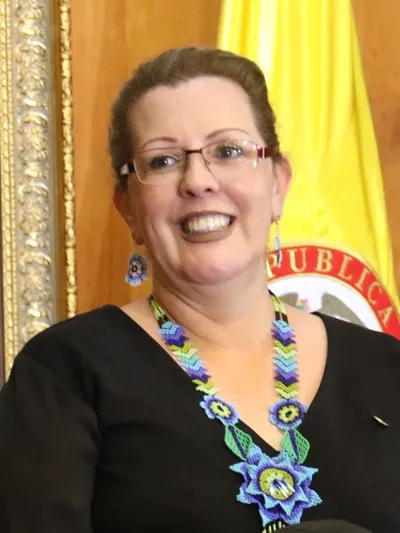
Magistrada / Federal Judge at the Colombian Federal Administrative Court (Consejo de Estado, Colombia)
Research project:
The peace process and the democratic system in Colombia: The role of electoral justice in the post-conflict period
Abstract
The signing of the final agreement to end the conflict and build a stable and lasting peace between the Colombian government and the FARC guerrillas led to a change in the framework in which social conflicts develop in the country.
Democracy replaces the battlefields where armed violence prevailed in the past, re-establishing institutional channels to channel protests and social demands as a sine qua non for maintaining peaceful coexistence within any society.
This is no small achievement, as it puts an end to an armed conflict that not only lasted more than half a century, but also claimed more than 8,376,843 victims, all of whom are now demanding truth, justice, reparation and non-repetition. Thus, one of the cruelest phases of Colombian violence, that characteristic feature of republican history, but which has its origins in the arrival of the Spanish “conquistadors” in the territory in 1499, comes to an end.
The construction and consolidation of peace in Colombia is thus achieved by strengthening the democratic system as a substitute sphere for the violent conflict; the goal of “democratic opening to build peace” (as the second aspect of the Havana Agreement) promotes not only the quantitative expansion, but the fundamental qualification (deepening) of this democratic opening beyond elections, recognizing the quality of those who were outside the civil society sphere in the past as political subjects.
These two approaches – expansion and qualification – of the democratic principle are realized with the signing of the Peace Pact, on the one hand, by strengthening affirmative measures with a gender focus that lead to a certain political equality of the sexes and, on the other hand, by creating a normative framework that changes the status quo of the electoral regime by, among other things, reducing the costs of establishing political parties and movements, promoting the emergence of new electoral authorities and regulating the exercise of political opposition.
These changes to the Colombian electoral regime pose new challenges for the electoral jurisdiction, whose task in this new scenario will be to protect the “bulwark” of the agreement – namely the democratic principle. On the one hand, it must guarantee compliance with the commitments to a gender-equal democracy, and on the other, it must adapt to the new legal framework.
Democracy becomes the epicenter for the construction of a stable and lasting peace, and the role of the electoral judge must be precisely to maintain the minimum conditions for its implementation, so that in this peaceful context social demands can develop that have used war as a means of protest in the past. The function of the electoral jurisdiction is thus primarily to maintain the conditions for the exercise of democracy, as a basis for the development of a culture of political debate, as is characteristic of the transitional regime that established the signing of the agreement.
The electoral judge is the guarantor of the demands arising from the signing of the Havana Agreement and affecting the country’s democratic system, so that his jurisdiction will undoubtedly go beyond the judicial sphere and influence the political dynamic – its exercise and consolidation.
However, the preservation of democracy is not an exclusive task of this specialized jurisdiction, but rather extends to various judicial bodies in Colombia, in particular the Special Jurisdiction for Peace, which was created by the Havana Pact. Its task is to investigate and try crimes committed during the armed civil war, whereby a conviction does not exclude or restrict the political participation of those convicted.
The construction of the agreement is thus understood as the key to democracy – as a basic value framework to be upheld by the electoral judges, but equally by the emerging jurisdiction responsible for the transitional instruments.
Events:
Thursday, November 8, 2018, 6 p.m.
Public lecture: Dhe peace process and the democratic system in Colombia: The role of electoral justice in the post-conflict period
Friday, November 9, 2018, 1:45 p.m.
Lecture in the seminar “Contemporary Political Thought” at the American University of Paris
The Peace Process and Democratic System in Colombia: The Role of Electoral Jurisdiction in Post-Conflict Situations
Wednesday, November 14, 2018, 2 p.m.
Lecture at the Ibero-American Colloquium at the Max Planck Institute for Comparative Public Law and International Law
The peace process in Colombia. Progress and challenges from the perspective of the Council of State
-
Biografische Angaben
Lucy Jeannette Bermúdez Bermúdez studied law at the Universidad La Gran Colombia (Bogotá) and specialized in criminal law and criminology at the Universidad Santo Tomás (Bogotá). Since 2013, she has been a federal judge in Colombia (Consejo de Estado), where she has presided over important trials such as the nullity action against the results of the referendum for peace in Colombia and currently the nullity action against the 2018-2022 elections to the Senate of the Republic. Before becoming a federal judge, she held various positions as a public prosecutor. She was also Vice President of the National Commission for Control and Electoral Matters of the Attorney General's Office and a judge at the National Electoral Council and the Council of State. She has taught at various universities such as the Universidad Libre de Colombia, the Colegio Mayor de Nuestra Señora del Rosario and the Universidad Sergio Arboleda. She has also acted as a consultant on issues of electoral law, contractual and non-contractual liability of the state, disciplinary law and property liability of public officials. Lucy Jeannette Bermúdez Bermúdez is the author of numerous articles and research papers on various topics, including public defense, arbitration, electoral crimes, the electoral process and electoral control. -
Publikationen
/